
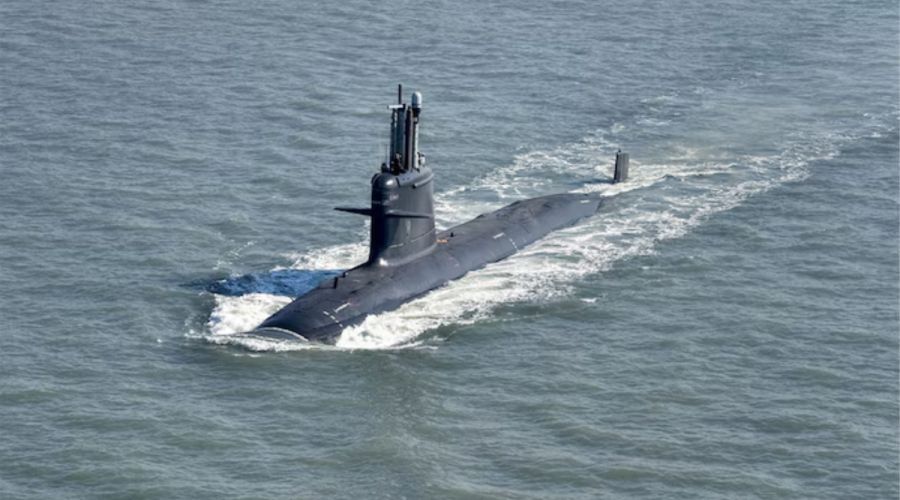
History
Project 75(I), also written P-75(I), is an Indian program to acquire and build six conventionally powered attack submarines for the Indian Navy. The current proposal pairs Mazagon Dock Shipbuilders Limited (MDL) in Mumbai with Germany's ThyssenKrupp Marine Systems (TKMS) and is centered on an enlarged, customized submarine derived from the Type 214 design.
The planned submarines are intended to combine diesel-electric propulsion with a sea-proven fuel-cell air-independent propulsion system. The design is expected to displace about 3,000 tonnes and to carry a substantially larger weapons load than India's preceding Kalvari-class submarines.
As of August 2026, the acquisition had not yet received its final Cabinet Committee on Security authorization. The Finance Ministry cleared the acquisition on May 28, 2026, while contract conclusion was being targeted for 2026 and the first submarine was required within seven years of contract signing. Operational induction has been projected for 2034–2035.
Origins and early approvals
Project 75(I) developed from India's 30-year submarine construction plan approved on July 12, 1999. That plan envisaged 24 conventional submarines. Two initial foreign-assisted production lines were to build six submarines each, followed by 12 submarines incorporating greater indigenous design and construction experience.
The first line became Project 75 and produced the six Kalvari-class submarines. The Project 75(I) line was repeatedly delayed. The acquisition received approvals in 2010 and 2014, followed by another Acceptance of Necessity in January 2019 under India's Strategic Partnership procurement model. A detailed secondary chronology of the procurement is available in the Project 75(I) program overview.
Competition
During different stages of the competition, candidate designs included German Type 214 concepts, French Scorpène and diesel-electric Barracuda-derived proposals, Russia's Amur-1650, Sweden's A26, Japan's Sōryū class, Spain's S-80 Plus and a South Korean KSS-III derivative. In January 2020, India shortlisted five foreign suppliers: TKMS, Naval Group, Navantia, Daewoo Shipbuilding and Marine Engineering, and Rubin Design Bureau. MDL and Larsen & Toubro were selected as the Indian shipyards.
The July 2021 request for proposals required an operational, sea-proven air-independent propulsion system. Saab had already withdrawn. Russia later withdrew because it could not satisfy the requirements, while Naval Group withdrew in April 2022 because its proposed submarine could not provide the required fuel-cell AIP installation. The South Korean contender also ceased participating.
TKMS returned to the competition and signed a memorandum of understanding with MDL in June 2023. The competing Indian-Spanish team consisted of Larsen & Toubro and Navantia, which proposed the S-80 Plus. Both remaining proposals passed an initial Indian Navy technical evaluation in February 2024. Indian personnel evaluated the German solution at Kiel in March 2024 and the Spanish solution at Cartagena in June 2024.
The requirement for an AIP installation already demonstrated aboard an operational submarine became decisive. L&T and Navantia were eliminated in January 2025, leaving MDL and TKMS as the only compliant team. MDL's commercial proposal then advanced to negotiations.
Negotiations and approval process
Indian procurement agencies began negotiations with MDL on September 10, 2025. The Cost Negotiation Committee completed its process by January 16, 2026. The Finance Ministry cleared the acquisition on May 28, 2026, leaving Cabinet Committee on Security approval among the remaining major steps before contract signature.
Reports during 2026 placed the program value at different levels, including approximately ₹70,000 crore and higher estimates approaching ₹99,000 crore. These figures are not directly interchangeable because reports differed in timing and in the scope attributed to technology transfer, localization and associated program costs. A July 2026 report described the planned India-Germany arrangement and local construction in Maritime Gateway, while an August 2026 account described the pending government approval process in TenderNews.
The first submarine is contractually required within seven years after signing. If the contract is concluded in 2026, this requirement places the first delivery in the early 2030s. Operational induction has separately been projected for 2034–2035, so the program remains a planned acquisition rather than an operational submarine class.
Design
The Project 75(I) submarine is planned as a customized German-derived design rather than an unchanged production Type 214. The proposed Indian configuration is expected to have a displacement close to 3,000 tonnes and a longer hull adapted to Indian endurance, weapons, sensor and acoustic-signature requirements. Dimensions and performance figures from existing Greek, Portuguese, South Korean or Turkish Type 214 derivatives therefore cannot be applied directly to the Indian design.
Propulsion and endurance
The planned propulsion architecture combines diesel-electric machinery, batteries and a single shaft with German polymer-electrolyte-membrane hydrogen fuel cells for air-independent propulsion. The AIP system is intended to allow the submarine to remain fully submerged for substantially longer periods without operating diesel generators through a snorkel.
Program reporting describes up to 21 consecutive days of submerged endurance using the fuel-cell AIP system under low-speed conditions. Fuel cells provide electrical power efficiently and quietly but are not intended to supply the high power required for sustained high-speed movement. Batteries therefore remain necessary for higher-power submerged manoeuvres.
The AIP requirement was one of the defining characteristics of the procurement. India required a system already demonstrated at sea on an operational submarine rather than an AIP installation that had only been tested ashore or remained under development.
Weapons
The Indian configuration is expected to use 533 mm torpedo tubes. The stated weapons requirement includes 18 heavyweight torpedoes and at least 12 cruise missiles intended for anti-ship and land-attack missions. The final publicly disclosed arrangement of tubes, storage and combat-system integration has not been established in the available material.
Indian configuration
The proposed approximately 3,000-tonne submarine is considerably larger than India's Kalvari-class submarine, which has a reported submerged displacement of 1,775 tonnes. Project 75(I) is therefore intended to provide greater capacity for endurance, weapons and systems than the preceding Project 75 design.
TKMS is responsible for design and engineering within the proposed industrial arrangement, while MDL is assigned construction, integration, testing and delivery responsibilities in India. The localization requirement is reported to begin at 45% indigenous content on the lead submarine and increase progressively toward 60% by the final vessel.
Procurement and industrial plan
The initial acquisition covers six submarines. The first vessel is required within seven years of contract signature, followed by subsequent deliveries at approximately one-year intervals if the contractual schedule is achieved.
The Indian Navy has also considered an option for three additional Project 75(I) submarines. Such a follow-on order would increase the potential fleet to nine boats, but the additional submarines remain an option rather than a confirmed part of the initial six-submarine acquisition.
Technology transfer is a major component of the program. The proposed arrangement is intended to give Indian industry experience with fuel-cell AIP integration, construction of a larger conventional submarine and associated engineering and production processes. This experience is also expected to contribute to India's future indigenous Project 76 conventional submarine effort.
Program status
As of August 2026, MDL and TKMS were the remaining team for Project 75(I), cost negotiations had been completed and the Finance Ministry had cleared the acquisition. Final Cabinet Committee on Security authorization remained pending before contract conclusion.
The program is intended to renew an Indian conventional submarine force that still includes older Sindhughosh-class and Shishumar-class boats alongside the six newer Kalvari-class submarines. Because the first Project 75(I) submarine is not expected to enter service until the mid-2030s, the program does not provide an immediate replacement for the oldest boats.
The projected 2034–2035 operational induction is a planned milestone and has not yet occurred. No completed Project 75(I) submarine is identified in the available material.
Specifications (proposed Project 75(I) Indian configuration)
General characteristics
- Type: Conventionally powered attack submarine
- Planned displacement: approximately 3,000 tonnes
- Propulsion: diesel-electric propulsion with batteries and polymer-electrolyte-membrane hydrogen fuel-cell air-independent propulsion
- Drive: single shaft
- Planned AIP submerged endurance: up to 21 consecutive days under low-speed conditions
Armament
- Torpedo tubes: 533 mm
- Heavyweight torpedoes: requirement for 18
- Cruise missiles: at least 12 for anti-ship and land-attack missions
Related equipment
- Project 75 / Kalvari class: The preceding Indian program that produced six Scorpène-derived conventional attack submarines.
- Type 214: The German submarine family from which the proposed enlarged Project 75(I) configuration is derived. Existing Type 214 dimensions and specifications should not be treated as Project 75(I) specifications.
- Project 76: A planned indigenous Indian conventional attack submarine program expected to incorporate experience from Project 75 and Project 75(I).
 Argentina
 Armenia
 Australia
 Austria
 Austria-Hungary
 Belgium
 Brazil
 United Kingdom
 United States
 Brunei
 Bulgaria
 Canada
 Chile
Chile China
China Colonial America
 Colombia
 Confederate States
 Croatia
 Czech
Czech Denmark
 Egypt
Egypt Finland
 France
 Georgia
 Germany
 German Imperial
 Greece
 Holland
 Hungary
 Indonesia
 Iran
Iran Iraq
Iraq Ireland
 Israel
 Italy
Italy Japan
Japan Japan (1940)
 Jordan
 Kingdom of Italy
 Malaysia
 Mexico
 Myanmar
 Nazi Germany
 Netherlands
 New Zealand
 North Korea
 Norway
 Pakistan
 Peru
Peru Philippines
 Poland
 Portugal
 Prussia
 Romania
 Russia
 Saudi Arabia
 Serbia
 Singapore
 Slovakia
 Slovenia
 South Africa
 South Korea
 Soviet Union
 Spain
Spain Sweden
 Switzerland
 Syria
Syria Taiwan
 Thailand
 Turkey
 UAE
UAE Ukraine
 Vietnam
 Yugoslavia