
History
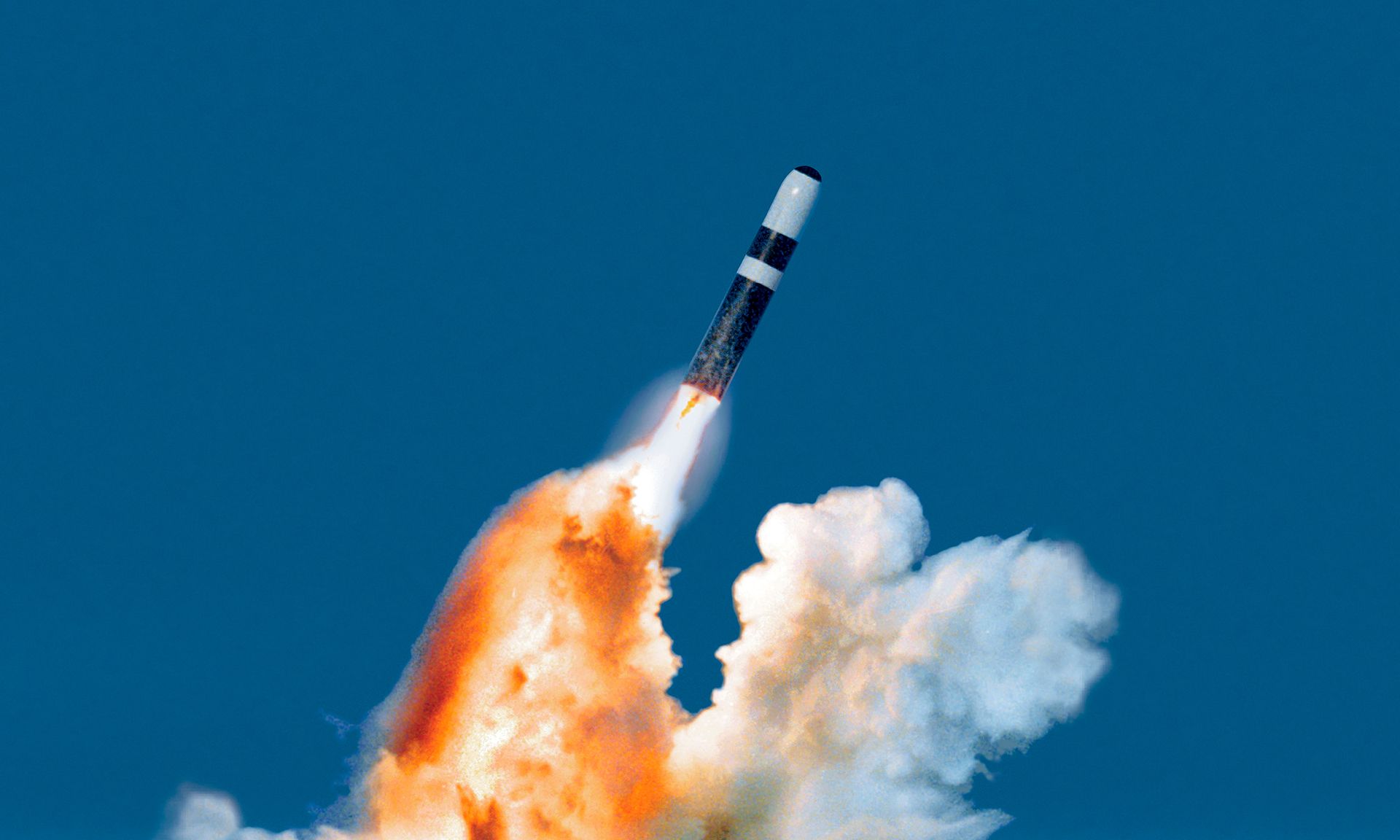
The Lockheed Martin UGM-133A Trident II, commonly known as Trident II D5, is a submarine-launched ballistic missile developed for the United States Navy. It succeeded the earlier Trident I C4 and became a central element of the sea-based strategic nuclear forces of both the United States and the United Kingdom.
The D5 was designed to provide greater range, payload capability, and accuracy than the earlier C4. Its deployment on ballistic-missile submarines allows the missile force to remain mobile at sea and forms the sea-based leg of the United States nuclear triad.
The missile entered operational service in 1990 and has subsequently been supported by continuing life-extension work intended to maintain the system for decades beyond its original service period.
Development
The origins of the Trident program can be traced to studies of future submarine-launched strategic missiles during the 1960s and 1970s. During the 1970s, the United States Navy examined requirements for improved missile accuracy and for a larger successor to Trident I. In 1981, the United States Department of Defense directed the Navy to fund development of the advanced Trident II D5 system. A full-scale development contract followed in 1983.
An initial series of 19 land-based development launches was conducted from Cape Canaveral between January 1987 and January 1989. The first of these launches on 15 January 1987 provides an early confirmed physical test milestone for the D5 program. A detailed chronology is also presented by the Trident II reference overview.
The first submarine launch was attempted from USS Tennessee on 21 March 1989. That flight failed shortly after launch after water entered the missile nozzle before motor ignition. Corrective changes were made, and the missile reached initial operational capability in March 1990.
The United Kingdom selected the D5 under arrangements derived from the Polaris Sales Agreement. British Vanguard-class ballistic-missile submarines subsequently became equipped with Trident II missiles drawn from a shared missile pool with the United States.
Life extension
Trident II has undergone continuing life-extension and modernization work rather than being replaced by an entirely new missile generation. The D5 Life Extension program has included updates to guidance, electronics, support systems, and other components intended to sustain the missile into the 2040s.
In September 2026, the United States Navy awarded Lockheed Martin Space an additional $90.2 million for design and development work associated with a second life extension of the Trident II D5. The award shows that further modernization remains active as the missile is prepared to support future United States strategic submarine operations.
Design
The UGM-133A is a three-stage solid-propellant submarine-launched ballistic missile. It is launched from a submerged submarine by gas pressure, with the first-stage rocket motor igniting after the missile leaves the water.
Airframe and propulsion
The missile is approximately 13.42 m long and 2.11 m in diameter. One technical reference gives a launch weight of about 59,090 kg. The three propulsion stages use solid propellant, and lightweight composite motor cases contribute to the missile's structural efficiency.
The first and second stages use filament-wound composite structures, while the third stage and associated structure also employ lightweight reinforced materials. An extendable aerospike is fitted in the nose area to reduce aerodynamic drag after launch. A detailed technical description and historical specifications are available from Nuclear Companion.
Guidance
The D5 uses inertial guidance supplemented by stellar-reference updates. The Mk 6 guidance system was developed to provide substantially greater accuracy than the guidance system of Trident I C4. Public sources commonly describe the missile as having accuracy measured in roughly tens to about one hundred metres of circular error probable, although exact operational performance is not publicly confirmed.
Payload
Trident II can carry multiple independently targetable reentry vehicles. Public descriptions associate the missile with Mk 4 reentry vehicles carrying W76-series warheads and Mk 5 reentry vehicles carrying W88 warheads. The number of reentry vehicles and achievable range depend on missile loading, treaty restrictions, and operational configuration.
Open sources differ on historical maximum payload configurations. One source describes configurations of up to eight warheads, while another reports that the missile was technically associated with larger Mk 4 payload arrangements before treaty restrictions limited deployed configurations. These figures should therefore be treated as configuration-dependent rather than as a single fixed load.
Operational history
The Trident II D5 entered United States Navy service in March 1990 aboard Ohio-class ballistic-missile submarines. It later became the missile used by the Royal Navy's Vanguard-class ballistic-missile submarines.
The missile gives ballistic-missile submarines a long-range strategic strike capability while allowing them to patrol across large ocean areas. This mobility is central to the survivability of the sea-based nuclear deterrent. A 2026 overview of the system and its continuing strategic role is available from The Defense Post.
United States Ohio-class submarines originally carried up to 24 D5 missiles, although the number of operational launch tubes was later reduced to 20 under arms-control arrangements. British Vanguard-class submarines have 16 missile tubes. British missiles are drawn from a common pool maintained with the United States at Kings Bay, Georgia.
Program status
The Trident II remains in service with the United States Navy and Royal Navy. The D5 Life Extension version is intended to sustain the weapon through approximately 2042, while additional modernization work is being pursued through the second life-extension effort.
The missile is also associated with the transition from the Ohio class to the future Columbia-class ballistic-missile submarines. Continuing life-extension work is therefore intended to bridge the strategic missile system across submarine generations rather than requiring an immediate replacement missile.
Variants
- UGM-133A Trident II D5: Original operational Trident II configuration introduced into United States Navy service in 1990.
- Trident II D5 Life Extension: Modernized configuration incorporating updated components and support systems to extend operational service into the 2040s.
- Second life extension: Further modernization effort under development, including design and development work funded by the United States Navy in 2026.
Operators
- United States: Operated by the United States Navy from Ohio-class ballistic-missile submarines and planned for continued use as the service transitions to the Columbia class.
- United Kingdom: Operated by the Royal Navy from Vanguard-class ballistic-missile submarines using missiles drawn from a shared United States-United Kingdom pool.
Specifications (UGM-133A Trident II D5)
General characteristics
- Type: Submarine-launched ballistic missile.
- Length: Approximately 13.42 m (44 ft 6.6 in).
- Diameter: Approximately 2.11 m (6 ft 11 in).
- Launch weight: Approximately 59,090 kg (130,000 lb).
- Stages: Three.
- Propulsion: Solid-propellant rocket motors.
- Launch method: Submerged gas-ejection launch followed by rocket-motor ignition after the missile clears the water.
- Guidance: Inertial guidance with stellar-reference update.
Performance
- Range: Configuration-dependent; open-source figures range from approximately 7,600 km (4,100 nmi) with heavier payloads to about 11,500 km (6,200 nmi) with reduced payload configurations.
Payload
- Reentry system: Multiple independently targetable reentry vehicles.
- Associated reentry vehicles: Mk 4 with W76-series warheads and Mk 5 with W88 warheads.
Related equipment
- UGM-96A Trident I C4: Earlier Trident submarine-launched ballistic missile and direct predecessor of the D5.
- Ohio-class ballistic-missile submarine: Principal United States launch platform for the operational D5 force.
- Vanguard-class ballistic-missile submarine: Royal Navy launch platform for the Trident II D5.
- Columbia-class ballistic-missile submarine: Future United States strategic submarine class planned to continue use of the D5 missile family.
 Argentina
 Armenia
 Australia
 Austria
 Austria-Hungary
 Belgium
 Brazil
 United Kingdom
 Brunei
 Bulgaria
 Canada
 Chile
Chile China
China Colonial America
 Colombia
 Confederate States
 Croatia
 Czech
Czech Denmark
 Egypt
Egypt Finland
 France
 Georgia
 Germany
 German Imperial
 Greece
 Holland
 Hungary
 India
India Indonesia
 Iran
Iran Iraq
Iraq Ireland
 Israel
 Italy
Italy Japan
Japan Japan (1940)
 Jordan
 Kingdom of Italy
 Malaysia
 Mexico
 Myanmar
 Nazi Germany
 Netherlands
 New Zealand
 North Korea
 Norway
 Pakistan
 Peru
Peru Philippines
 Poland
 Portugal
 Prussia
 Romania
 Russia
 Saudi Arabia
 Serbia
 Singapore
 Slovakia
 Slovenia
 South Africa
 South Korea
 Soviet Union
 Spain
Spain Sweden
 Switzerland
 Syria
Syria Taiwan
 Thailand
 Turkey
 UAE
UAE Ukraine
 Vietnam
 Yugoslavia