
History
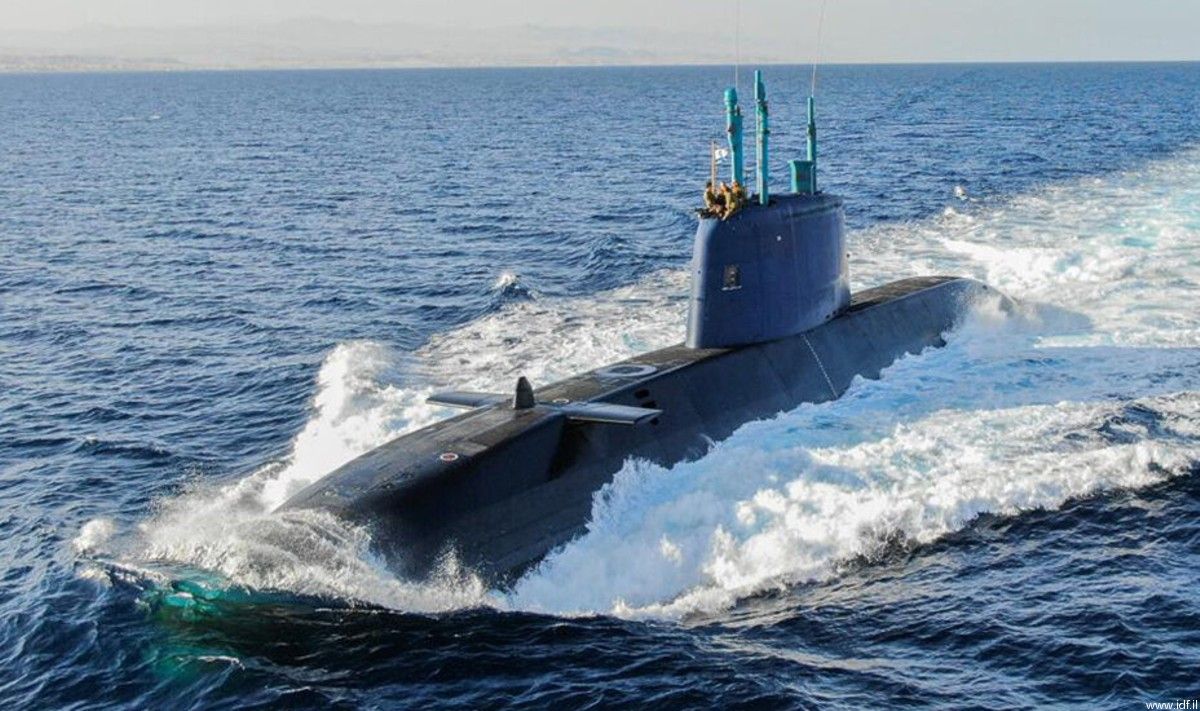
The Dolphin II class is a group of German-built diesel-electric attack submarines developed for the Israeli Navy as an enlarged successor to the first three Dolphin-class boats. The design incorporates fuel-cell air-independent propulsion, allowing prolonged submerged operation without relying as frequently on atmospheric oxygen.
The first two Dolphin II submarines, INS Tanin and INS Rahav, were ordered in 2006. According to the U.S. Naval Institute, the boats use a lengthened design with an approximately 11.3 m propulsion-system hull section and are larger than the original Dolphin class.
The third boat, INS Drakon, is larger than Tanin and Rahav and incorporates substantial design changes. TKMS delivered the submarine in September 2026, completing construction of the Dolphin II class while work was already underway on the successor Dakar class.
Development and construction
Discussions about acquiring a more capable successor to the original Dolphin-class submarines began soon after the third original boat entered Israeli service. Israel ordered Tanin and Rahav in 2006. Germany financed one-third of their cost, while Israel funded the remaining two-thirds.
Tanin was launched in 2012 and entered Israeli Navy service in 2014. Rahav was launched in 2013 and entered service in 2016. Both submarines were built at the HDW shipyard in Kiel, Germany.
Israel ordered a sixth submarine, which became INS Drakon, in 2011. Drakon was launched at Kiel in 2023. Unlike the earlier Dolphin II boats, it has an enlarged and lengthened sail. Open-source analysts have suggested that the sail could contain a vertical launch system, but this configuration has not been officially confirmed.
Production of the successor Dakar-class submarines began in November 2024. On 1 September 2026, TKMS and the Israeli Navy held a ceremony in Kiel marking the delivery and departure of INS Drakon for Israel. The event completed construction of the three-submarine Dolphin II class. The first Dakar-class delivery is expected in the early 2030s.
Design
The Dolphin II design is derived from the earlier Dolphin class but has a longer hull and greater submerged displacement. Tanin and Rahav displace about 2,400 tonnes submerged and measure approximately 68.6 m in length. Their crew is reported as 35.
Propulsion
The submarines combine conventional diesel-electric propulsion and batteries with a fuel-cell air-independent propulsion system. The AIP installation allows electrical power to be generated while submerged without operating diesel engines that require atmospheric oxygen. Published estimates of submerged endurance differ. TKMS has stated that the boats can remain submerged for several weeks, while the Nuclear Threat Initiative cites an endurance of up to about one week for the AIP-equipped boats.
Sensors and weapons
Dolphin and Dolphin II submarines are reported to use hull-mounted and flank-array sonar systems. The bow contains ten torpedo tubes. Six have a diameter of 533 mm and four are enlarged 650 mm tubes.
The tubes can employ German DM2A4 wire-guided torpedoes, mines, and U.S. Harpoon anti-ship missiles. The 650 mm tubes have also been reported as suitable for swimmer delivery vehicles or for weapons carried through liners. Numerous publications have claimed that Israeli Dolphin submarines may carry nuclear-armed cruise missiles. These claims remain unconfirmed, and Israeli authorities have denied reported submarine-launched missile tests associated with such assertions.
INS Drakon changes
INS Drakon is larger than the preceding Dolphin II boats and has a distinctive elongated sail. Analysts have speculated that this structure could contain vertical missile launch cells. Available public sources do not confirm the number, arrangement, or weapons associated with any such system, so the claimed vertical launch capability should be regarded as unverified.
Operational history
INS Tanin joined the Israeli fleet in 2014 and INS Rahav followed in 2016. They became the Israeli Navy's first Dolphin submarines equipped with air-independent propulsion. The submarines operate as part of Shayetet 7, the Israeli Navy submarine unit based at Haifa.
INS Drakon was delivered by TKMS in September 2026 and departed Kiel for Israel. Its delivery completed the Dolphin II construction program. Public information available in the supplied sources does not establish a confirmed operational commissioning date for Drakon.
Variants
- INS Tanin — First Dolphin II-class submarine. Ordered in 2006, launched in 2012, and entered Israeli Navy service in 2014.
- INS Rahav — Second Dolphin II-class submarine. Ordered with Tanin in 2006, launched in 2013, and entered service in 2016.
- INS Drakon — Third and final Dolphin II-class submarine. Ordered in 2011, launched in 2023, and delivered in September 2026. It is larger than the earlier boats and has a lengthened sail associated with an unconfirmed possible vertical launch system.
Operators
- Israel — The Israeli Navy operates the Dolphin II class through Shayetet 7. Tanin and Rahav entered service in 2014 and 2016 respectively, while Drakon was delivered in September 2026.
Specifications (Dolphin II class: Tanin and Rahav)
General characteristics
- Type: Diesel-electric attack submarine with fuel-cell air-independent propulsion
- Length: Approximately 68.6 m
- Submerged displacement: Approximately 2,400 tonnes
- Crew: 35
Performance
- Maximum submerged speed: Approximately 25 knots
- Reported range: Approximately 4,500 km
Armament
- Torpedo tubes: Six 533 mm tubes and four 650 mm tubes
- Reported weapons: DM2A4 wire-guided torpedoes, mines, and U.S. Harpoon anti-ship missiles
Related equipment
- Dolphin class — Earlier Israeli submarine design from which the enlarged Dolphin II class was developed.
- Dakar class — Next-generation three-submarine class intended to succeed the oldest Israeli Dolphin boats. Production began in November 2024, with first delivery expected in the early 2030s.
 Argentina
 Armenia
 Australia
 Austria
 Austria-Hungary
 Belgium
 Brazil
 United Kingdom
 United States
 Brunei
 Bulgaria
 Canada
 Chile
Chile China
China Colonial America
 Colombia
 Confederate States
 Croatia
 Czech
Czech Denmark
 Egypt
Egypt Finland
 France
 Georgia
 German Imperial
 Greece
 Holland
 Hungary
 India
India Indonesia
 Iran
Iran Iraq
Iraq Ireland
 Israel
 Italy
Italy Japan
Japan Japan (1940)
 Jordan
 Kingdom of Italy
 Malaysia
 Mexico
 Myanmar
 Nazi Germany
 Netherlands
 New Zealand
 North Korea
 Norway
 Pakistan
 Peru
Peru Philippines
 Poland
 Portugal
 Prussia
 Romania
 Russia
 Saudi Arabia
 Serbia
 Singapore
 Slovakia
 Slovenia
 South Africa
 South Korea
 Soviet Union
 Spain
Spain Sweden
 Switzerland
 Syria
Syria Taiwan
 Thailand
 Turkey
 UAE
UAE Ukraine
 Vietnam
 Yugoslavia