

History
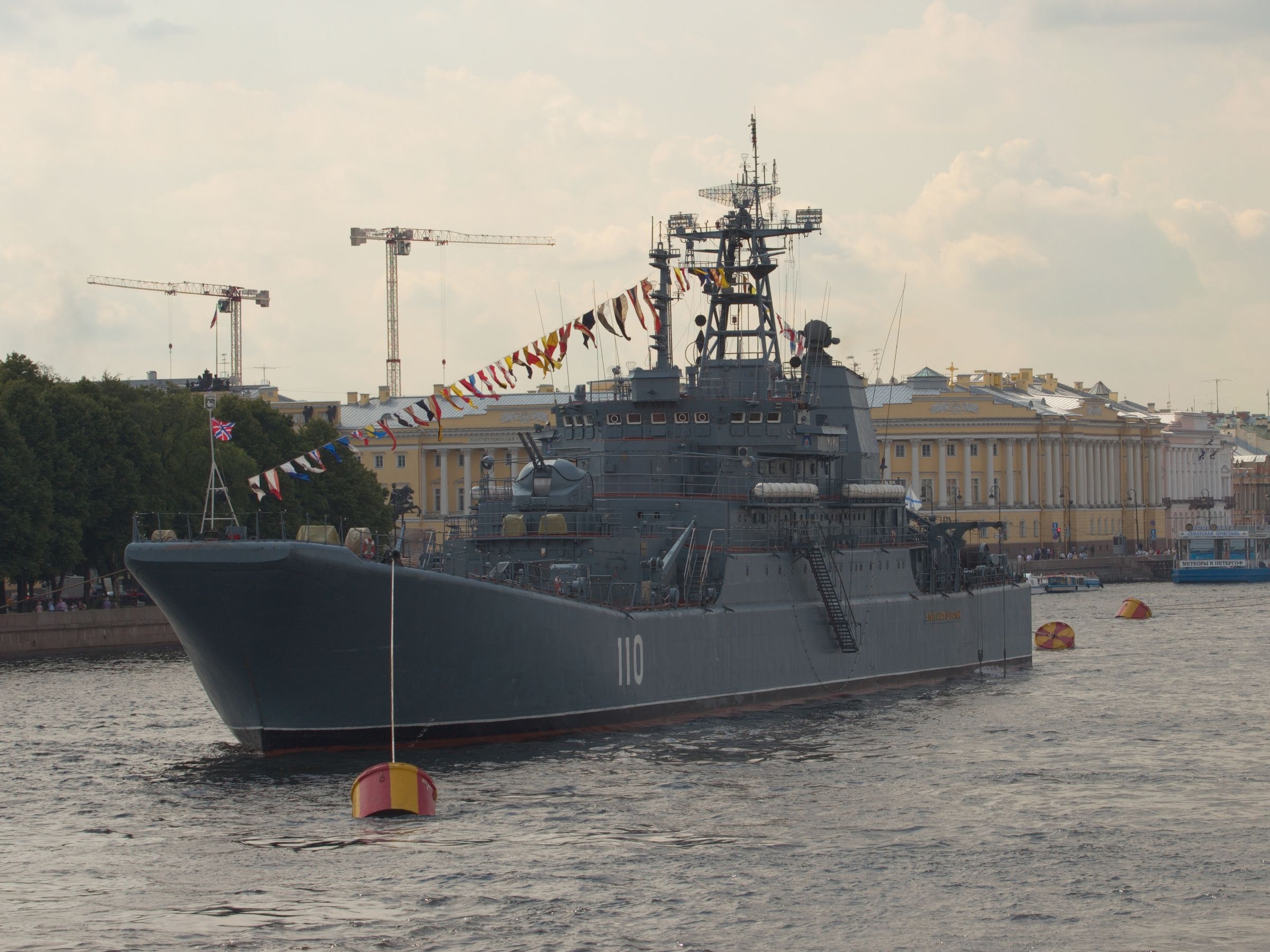
Aleksandr Shabalin is a Project 775/II Ropucha-class large landing ship serving with the Russian Navy's Baltic Fleet. Built in Poland for the Soviet Navy, the ship was launched in 1985 as BDK-60 and received the name Aleksandr Shabalin in 1986.
The ship was designed to transport troops, armored vehicles and other military cargo and to unload them through bow and stern ramps. Its documented service has included Baltic Fleet exercises, Mediterranean deployments, transport missions connected with Syria and Libya, and major repair periods.
Aleksandr Shabalin remained active into 2026. In September 2026, reporting based on satellite and ground imagery described the ship escorting the Russian-linked vessels Anastasiia and Yuriy Arshenevskiy to Tobruk, Libya, where military equipment was reported being unloaded.
Construction and commissioning
The ship was built as BDK-60 by Stocznia Północna in Gdańsk, in the Polish People's Republic. It was laid down in 1985, launched on 11 June 1985 and commissioned into the Soviet Navy on 31 December 1985. It joined the Baltic Fleet and was based at Baltiysk.
BDK-60 was renamed Aleksandr Shabalin on 12 November 1986. Following the dissolution of the Soviet Union in 1991, the vessel continued its career in the Russian Navy. It is identified as a Project 775/II subtype of the Ropucha class. A detailed career summary is available from the Aleksandr Shabalin reference article.
Repairs and return to service
During a refit at the Yantar Shipyard in Kaliningrad, a fire broke out in the engine room on 10 April 2009 and spread to the refrigeration compartment. The fire was extinguished after damaging an area reported as 5 square meters.
The ship entered Yantar Shipyard again on 16 April 2012 for repairs. By early July it had returned to sea for a two-week voyage that included a visit to Zeebrugge for Belgian Navy Day.
After further assessments, Aleksandr Shabalin began another major refit at the Kronstadt Marine Plant in October 2020. Work continued into 2023. Sea trials, initially expected in 2023, were delayed until February 2024. The ship returned to service in the summer of 2024.
Design
Aleksandr Shabalin is a conventional large landing ship with vehicle access ramps at the bow and stern. This arrangement allows vehicles and cargo to be driven through the ship during loading and unloading where suitable facilities or landing conditions are available.
The vessel is powered by two Zgoda-Sulzer 16ZVB40/48 diesel engines, each rated at 9,600 hp. Electrical power is supplied by three 750 kW diesel generators. The documented maximum speed is 18 knots.
The ship can carry several different combinations of armored vehicles and troops. Reported configurations include 10 main battle tanks and 340 troops, or 12 BTR armored personnel carriers and 340 troops. Another documented load combines three main battle tanks, three 2S9 Nona-S self-propelled guns, five MT-LB armored vehicles, four trucks and 313 troops. It can alternatively carry approximately 500 tonnes of cargo.
Its armament includes two twin AK-725 57 mm dual-purpose gun mountings, Strela-2 surface-to-air missile launchers and two A-215 Grad-M rocket launchers.
Operational history
In 2013 Aleksandr Shabalin was deployed to the Mediterranean as part of the transport activity commonly known as the Syrian Express, moving personnel and equipment between Black Sea ports and the Russian naval facility at Tartus. The ship entered Novorossiysk on 21 January and again on 27 March 2013, and it made further Mediterranean deployments in 2014 and 2015.
On 18 May 2015, Aleksandr Shabalin participated in the Maritime Interaction 2015 exercise with Russian and Chinese naval forces. Later that year it appeared at the Baltic Fleet Navy Day parade in Baltiysk. The ship conducted naval gunnery exercises in July 2016 and participated in the Navy Day parade at Kronstadt in July 2017.
After returning from its 2020-2024 refit, Aleksandr Shabalin conducted loading and unloading training on 8 August 2024 and artillery firing in the Baltic Sea on 13 August. In September 2024 it deployed with the Baltic Fleet corvettes Boikiy and Soobrazitelny to Northern Fleet training areas for the Okean 2024 exercise.
In December 2024, Aleksandr Shabalin, the Ropucha-class ship Aleksandr Otrakovsky and the Ivan Gren-class landing ship Ivan Gren were dispatched toward the Russian naval installation at Tartus. Reporting described the ships as being involved in removing equipment after the fall of the Assad government and transporting equipment toward Libya.
Aleksandr Shabalin was back in the Baltic by March 2025 and conducted further artillery firing on 29 March. In late September 2025 it was reported near Danish waters in the southwestern Baltic. On 24 October 2025, reporting placed the ship near the entrance to Lübeck Bay after anchoring close to a commercial shipping route. German police stated that the vessel remained outside German territorial waters and did not violate national law or international navigation rules. Contemporary reporting is summarized by Militarnyi.
In September 2026, the ship was reported escorting Anastasiia and Yuriy Arshenevskiy to the Libyan port of Tobruk. Satellite and ground imagery associated with the report appeared to show armored personnel carriers, logistics vehicles and other military equipment being unloaded after the vessels arrived.
Operators
- Soviet Navy: Commissioned into the Baltic Fleet on 31 December 1985 as BDK-60 and served until the dissolution of the Soviet Union.
- Russian Navy: Continued in Baltic Fleet service after 1991 and remained active through 2026.
Specifications (Project 775/II Aleksandr Shabalin)
General characteristics
- Type: Ropucha-class large landing ship, Project 775/II
- Standard displacement: 3,450 tonnes
- Full-load displacement: 4,080 tonnes
- Length: 112.5 m (369 ft 1 in)
- Beam: 15.01 m (49 ft 3 in)
- Draught: 4.26 m (14 ft)
- Complement: 98
- Vehicle access: Bow and stern ramps
- Cargo capacity: Up to approximately 500 tonnes, or specified combinations of armored vehicles and troops
Powerplant and performance
- Propulsion: 2 × Zgoda-Sulzer 16ZVB40/48 diesel engines, 9,600 hp each
- Electrical generation: 3 × 750 kW diesel generators
- Maximum speed: 18 knots (33 km/h)
- Range: 11,000 km (6,000 nmi) at 12 knots
- Range at higher cruising speed: 6,500 km (3,500 nmi) at 16 knots
- Endurance: 30 days
Armament
- Guns: 2 × AK-725 twin 57 mm dual-purpose gun mountings
- Surface-to-air missiles: 4 × eight-round Strela-2 launcher installations
- Rocket launchers: 2 × 22-round A-215 Grad-M launchers
 Argentina
 Armenia
 Australia
 Austria
 Austria-Hungary
 Belgium
 Brazil
 United Kingdom
 United States
 Brunei
 Bulgaria
 Canada
 Chile
Chile China
China Colonial America
 Colombia
 Confederate States
 Croatia
 Czech
Czech Denmark
 Egypt
Egypt Finland
 France
 Georgia
 Germany
 German Imperial
 Greece
 Holland
 Hungary
 India
India Indonesia
 Iran
Iran Iraq
Iraq Ireland
 Israel
 Italy
Italy Japan
Japan Japan (1940)
 Jordan
 Kingdom of Italy
 Malaysia
 Mexico
 Myanmar
 Nazi Germany
 Netherlands
 New Zealand
 North Korea
 Norway
 Pakistan
 Peru
Peru Philippines
 Poland
 Portugal
 Prussia
 Romania
 Saudi Arabia
 Serbia
 Singapore
 Slovakia
 Slovenia
 South Africa
 South Korea
 Soviet Union
 Spain
Spain Sweden
 Switzerland
 Syria
Syria Taiwan
 Thailand
 Turkey
 UAE
UAE Ukraine
 Vietnam
 Yugoslavia