
History
The Sentinel-class offshore patrol vessel is a class of four purpose-built Singapore Government Vessels developed for the Republic of Singapore Navy's Maritime Security and Response Flotilla. The ships are designed for maritime security operations in and around Singapore's territorial waters and will replace the existing Sentinel-class Maritime Security and Response Vessels converted from former Fearless-class patrol vessels.
German shipbuilder Fassmer is developing the class in cooperation with Singapore's naval and defence-technology organisations. The design combines greater endurance and manoeuvrability with modular mission systems, ballistic protection, a mixed lethal and less-lethal weapons suite, and facilities for launching manned and unmanned craft.
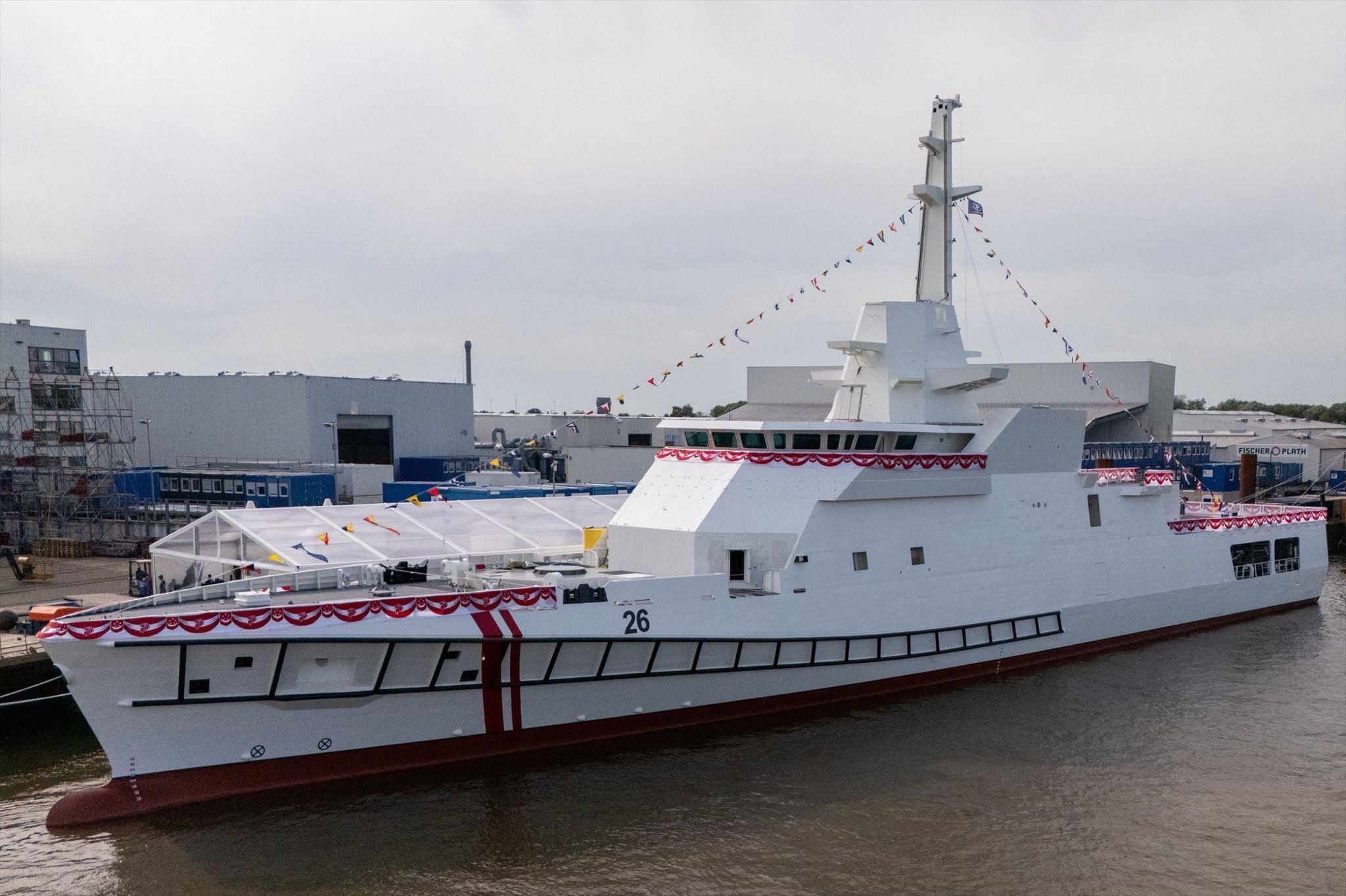
The first ship, Sentinel, was launched at Berne, Germany, on 1 October 2026. It is scheduled to undergo platform acceptance and sea trials before delivery and operationalisation, with progressive delivery of the four-ship class planned from 2028.
Development
Singapore began planning a purpose-built replacement for its maritime-security patrol vessels as the demands and scope of maritime security operations increased. The existing Sentinel-class Maritime Security and Response Vessels are refurbished former Fearless-class patrol vessels. The first two converted ships entered service in 2021, followed by the remaining vessels in 2022, providing an interim capability while a new class was developed.
The replacement offshore patrol vessel programme was in its early design phase by 2021. Singapore's Ministry of Defence selected Fassmer and signed a contract on 20 November 2023 for four new ships. The class is based on Fassmer's offshore patrol vessel design lineage and is associated with the OPV90 Mk II design, a larger development of the company's 86 m offshore patrol vessel family used by Germany's Federal Police.
The Defence Science and Technology Agency, Republic of Singapore Navy and Fassmer worked together to adapt the design to Singapore's operational requirements. Particular emphasis was placed on operation in congested waters, mission flexibility, manpower efficiency and the ability to accept additional capabilities over the ships' service lives.
Construction and launch
Construction is divided between Lithuania and Germany. Steel cutting for all four ships took place at Western Baltic Shipyard in Klaipėda, Lithuania, on 11 October 2024. The keels of the first two ships were laid on 7 April 2025. Fassmer subsequently carries out fitting-out work in Germany.
The lead ship was launched at Fassmer's yard in Berne, Germany, on 1 October 2026 and was christened Sentinel. Its launch established 2026 as the first year in which a completed physical example of the class entered the water. The remaining three vessels, Guardian, Protector and Bastion, remained under construction at the time of the launch.
Following launch, Sentinel is scheduled to complete fitting-out, platform acceptance activities and sea trials to verify its systems and performance before departing for Singapore. Progressive delivery of the class is planned from 2028. The existing Sentinel-class Maritime Security and Response Vessels are intended to remain in operational service until the new offshore patrol vessels are fully operational.
Design
The Sentinel-class is substantially larger than the vessels it will replace. Each ship is 94.85 m long, has a beam of 15.2 m and displaces approximately 2,700 tonnes. Despite the increase in size and capability, the baseline complement is approximately 40 personnel. Automation and integrated platform-management features are intended to reduce routine manual workload and permit remote monitoring and control of ship systems.
The ships have white hulls with red racing stripes to reflect their dedicated maritime-security role. They will fly Singapore's State Marine Ensign, which is used by government-owned or operated vessels engaged in government non-commercial service.
Propulsion and manoeuvrability
Propulsion uses a combined diesel-electric or diesel arrangement. Diesel-electric operation is intended for efficient lower-speed patrols, while diesel propulsion provides the higher-speed capability required for rapid response. This arrangement allows the crew to balance fuel consumption, endurance and speed according to the mission.
The ships are designed for high manoeuvrability in Singapore's congested maritime environment. Robust fendering around the bow allows rapid close-approach and alongside operations with vessels of interest while reducing the risk of damage during contact and manoeuvring.
Mission systems and protection
Mission modularity is a central feature of the class. Containerised systems can be embarked to configure a ship for different maritime-security tasks and to introduce new capabilities as operational requirements change. The design also provides additional infrastructure for future equipment, including allowances for power, cooling and network connections, reducing the need for major structural changes when new systems are introduced.
A stern launch and recovery system supports the deployment and recovery of both manned and unmanned craft. The system is intended to reduce handling time and crew exposure while allowing controlled launch and recovery in challenging sea conditions.
Key operational spaces have ballistic protection to improve crew protection during security operations. The combination of modular equipment, protected operating spaces and specialised boat-handling systems reflects the class's focus on sustained maritime-security missions rather than conventional fleet combat alone.
Weapons and sensors
The Sentinel-class combines conventional weapons with less-lethal systems so that crews can select a response appropriate to different maritime incidents. The principal gun is a 76 mm STRALES guided gun. A RAFAEL 30 mm remotely-controlled weapon system provides an additional armed response capability. The STRALES system also contributes to defence against unmanned threats.
Less-lethal and non-kinetic capabilities include a Sitep Italia laser dazzler and acoustic hailing device, a less-lethal grenade launcher and a water cannon system. These systems provide options for warning, deterrence and graduated intervention before greater force is required.
The sensor suite includes a Terma navigation radar, a Saab radar system, a Thales fire-control radar, a Safran electro-optical system and Seadronix 360-degree navigation cameras. Together with the weapons and non-kinetic systems, these sensors support surveillance, navigation, target assessment and calibrated maritime-security responses.
Program status
As of October 2026, Sentinel had been launched and was entering the fitting-out and trials phase. Guardian, Protector and Bastion remained under construction. Deliveries are scheduled to begin progressively from 2028, with Sentinel planned for delivery and operationalisation during that year.
The vessels will operate under the Republic of Singapore Navy's Maritime Security and Response Flotilla. Their primary tasks are maritime security operations and protection of Singapore's territorial waters. They are also intended to work with other Singapore government maritime organisations, including the Police Coast Guard and the Maritime and Port Authority of Singapore.
Ships in class
- Sentinel, pennant 26: Lead ship, launched on 1 October 2026 and scheduled for fitting-out, acceptance trials and sea trials before planned operationalisation in 2028.
- Guardian, pennant 27: Under construction as of October 2026.
- Protector, pennant 28: Under construction as of October 2026.
- Bastion, pennant 29: Under construction as of October 2026.
Operators
- Singapore: Four ships ordered for operation by the Republic of Singapore Navy's Maritime Security and Response Flotilla as Singapore Government Vessels. Progressive delivery is planned from 2028.
Specifications (Sentinel-class offshore patrol vessel)
General characteristics
- Type: Offshore patrol vessel and maritime-security vessel
- Displacement: Approximately 2,700 tonnes
- Length: 94.85 m
- Beam: 15.2 m
- Baseline complement: Approximately 40 personnel
- Propulsion: Combined diesel-electric or diesel propulsion
Performance
- Maximum speed: In excess of 43 km/h (23 knots)
- Endurance: More than 7,400 km (4,000 nautical miles)
Armament and non-kinetic systems
- Main gun: STRALES 76 mm guided gun
- Secondary weapon: RAFAEL 30 mm remotely-controlled weapon system
- Non-kinetic systems: Sitep Italia laser dazzler and acoustic hailing device
- Less-lethal systems: Less-lethal grenade launcher and water cannon system
Sensors
- Navigation radar: Terma navigation radar
- Radar: Saab radar system
- Fire control: Thales fire-control radar
- Electro-optical system: Safran electro-optical system
- Navigation cameras: Seadronix 360-degree navigation cameras
Mission equipment
- Modular payloads: Containerised mission systems
- Boat and unmanned craft handling: Stern launch and recovery system for manned and unmanned craft
- Protection: Ballistic protection for key operational spaces
- Close-approach equipment: Robust bow fendering for alongside operations
Related equipment
- Sentinel-class Maritime Security and Response Vessel: Refurbished former Fearless-class patrol vessels currently performing the maritime-security missions that the new offshore patrol vessels are intended to inherit.
- Fassmer OPV90 Mk II: Offshore patrol vessel design associated with the Singapore programme and derived from Fassmer's established patrol-vessel design lineage.
 Argentina
 Armenia
 Australia
 Austria
 Austria-Hungary
 Belgium
 Brazil
 United Kingdom
 United States
 Brunei
 Bulgaria
 Canada
 Chile
Chile China
China Colonial America
 Colombia
 Confederate States
 Croatia
 Czech
Czech Denmark
 Egypt
Egypt Finland
 France
 Georgia
 German Imperial
 Greece
 Holland
 Hungary
 India
India Indonesia
 Iran
Iran Iraq
Iraq Ireland
 Israel
 Italy
Italy Japan
Japan Japan (1940)
 Jordan
 Kingdom of Italy
 Malaysia
 Mexico
 Myanmar
 Nazi Germany
 Netherlands
 New Zealand
 North Korea
 Norway
 Pakistan
 Peru
Peru Philippines
 Poland
 Portugal
 Prussia
 Romania
 Russia
 Saudi Arabia
 Serbia
 Singapore
 Slovakia
 Slovenia
 South Africa
 South Korea
 Soviet Union
 Spain
Spain Sweden
 Switzerland
 Syria
Syria Taiwan
 Thailand
 Turkey
 UAE
UAE Ukraine
 Vietnam
 Yugoslavia