History
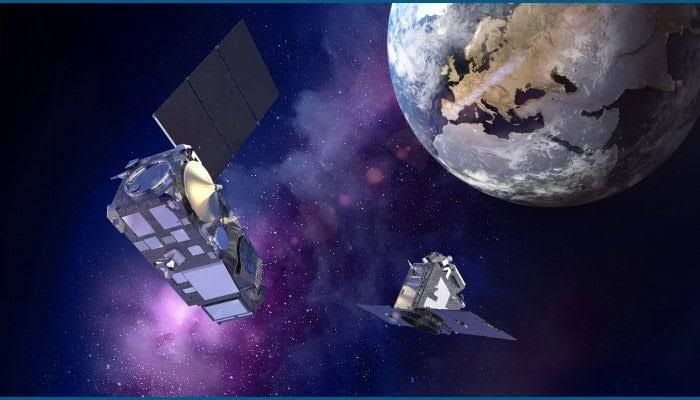
Copernicus Sentinel-3C is a European Earth-observation satellite developed for the European Union's Copernicus programme. It continues the Sentinel-3 mission, which systematically observes Earth's oceans, land, ice and atmosphere.
The spacecraft was designed and developed by the European Space Agency on behalf of the European Commission, with Thales Alenia Space serving as prime contractor. The European Commission owns and manages the Copernicus programme, while EUMETSAT is scheduled to operate Sentinel-3C after completion of in-orbit testing.
Sentinel-3C was launched on 15 September 2026 at 03:21 CET from Europe's Spaceport in Kourou, French Guiana, aboard an Avio-operated Vega C rocket. It was launched together with ESA's FLEX Earth-observation satellite and entered orbit successfully.
Development and launch
Sentinel-3C was developed to maintain continuity of the Sentinel-3 observation programme alongside Sentinel-3A and Sentinel-3B. The mission supports long-term monitoring of environmental conditions and provides data for climate monitoring, environmental management, weather forecasting, agriculture, water management and marine applications.
Before launch, the European Commission stated that mission VV30 would place Sentinel-3C into a Sun-synchronous orbit at approximately 820 km altitude. The satellite had a mass of approximately 1,143 kg. The planned mission and development partnership were described by the European Commission.
The Vega C lifted off from Kourou at 01:21 UTC on 15 September 2026. Sentinel-3C and FLEX were released at an altitude of about 820 km, and both spacecraft were flying freely by 116 minutes after launch. Sentinel-3C established its first contact with Earth at 04:33 CET, confirming that the spacecraft was in good health. The successful launch was subsequently confirmed by the European Commission.
Design
Sentinel-3C carries an Earth-observation instrument suite intended to measure conditions across the oceans, land, ice and atmosphere. The mission provides systematic observations of sea surface temperature, ocean colour, sea level, land cover and other environmental indicators.
Its measurements can be used to track coastal water quality and harmful algal blooms, wildfires, droughts, vegetation health, land surface temperature, heatwaves and changes in polar ice. Sentinel-3 observations also contribute near-real-time information used for ocean and weather forecasting.
Sentinel-3C complements ESA's FLEX mission. Sentinel-3 provides broad observations of ocean, land and ecosystem conditions, while FLEX measures vegetation fluorescence. The two satellites were launched together but perform separate Earth-observation missions.
Program status
After its successful September 2026 launch and initial contact, Sentinel-3C entered a commissioning and calibration phase. Its instruments and spacecraft systems are to undergo several months of testing before the satellite becomes fully operational.
Once commissioning is complete, Sentinel-3C is intended to work alongside the other Sentinel-3 spacecraft and maintain the long-term availability of Copernicus Earth-observation data.
Operators
- European Commission: Owns and manages Sentinel-3C as part of the European Union's Copernicus Earth-observation programme.
- EUMETSAT: Scheduled to operate Sentinel-3C and deliver its data and services after completion of in-orbit testing.
Specifications (Copernicus Sentinel-3C)
General characteristics
- Type: Earth-observation satellite
- Mass: Approximately 1,143 kg
- Developer: European Space Agency, on behalf of the European Commission
- Prime contractor: Thales Alenia Space
- Programme: European Union Copernicus Earth-observation programme
Orbit and mission
- Orbit: Sun-synchronous orbit
- Orbital altitude: Approximately 820 km
- Observation areas: Oceans, land, ice and atmosphere
- Measurements: Sea surface temperature, ocean colour, sea level, land cover and other environmental indicators
Launch
- Launch date: 15 September 2026
- Launch vehicle: Vega C
- Mission: VV30
- Launch site: Europe's Spaceport, Kourou, French Guiana
- Co-passenger: FLEX Earth-observation satellite
 Argentina
 Armenia
 Australia
 Austria
 Austria-Hungary
 Belgium
 Brazil
 United Kingdom
 United States
 Brunei
 Bulgaria
 Canada
 Chile
Chile China
China Colonial America
 Colombia
 Confederate States
 Croatia
 Czech
Czech Denmark
 Egypt
Egypt Finland
 France
 Georgia
 Germany
 German Imperial
 Greece
 Holland
 Hungary
 India
India Indonesia
 Iran
Iran Iraq
Iraq Ireland
 Israel
 Italy
Italy Japan
Japan Japan (1940)
 Jordan
 Kingdom of Italy
 Malaysia
 Mexico
 Myanmar
 Nazi Germany
 Netherlands
 New Zealand
 North Korea
 Norway
 Pakistan
 Peru
Peru Philippines
 Poland
 Portugal
 Prussia
 Romania
 Russia
 Saudi Arabia
 Serbia
 Singapore
 Slovakia
 Slovenia
 South Africa
 South Korea
 Soviet Union
 Spain
Spain Sweden
 Switzerland
 Syria
Syria Taiwan
 Thailand
 Turkey
 UAE
UAE Ukraine
 Vietnam
 Yugoslavia