History
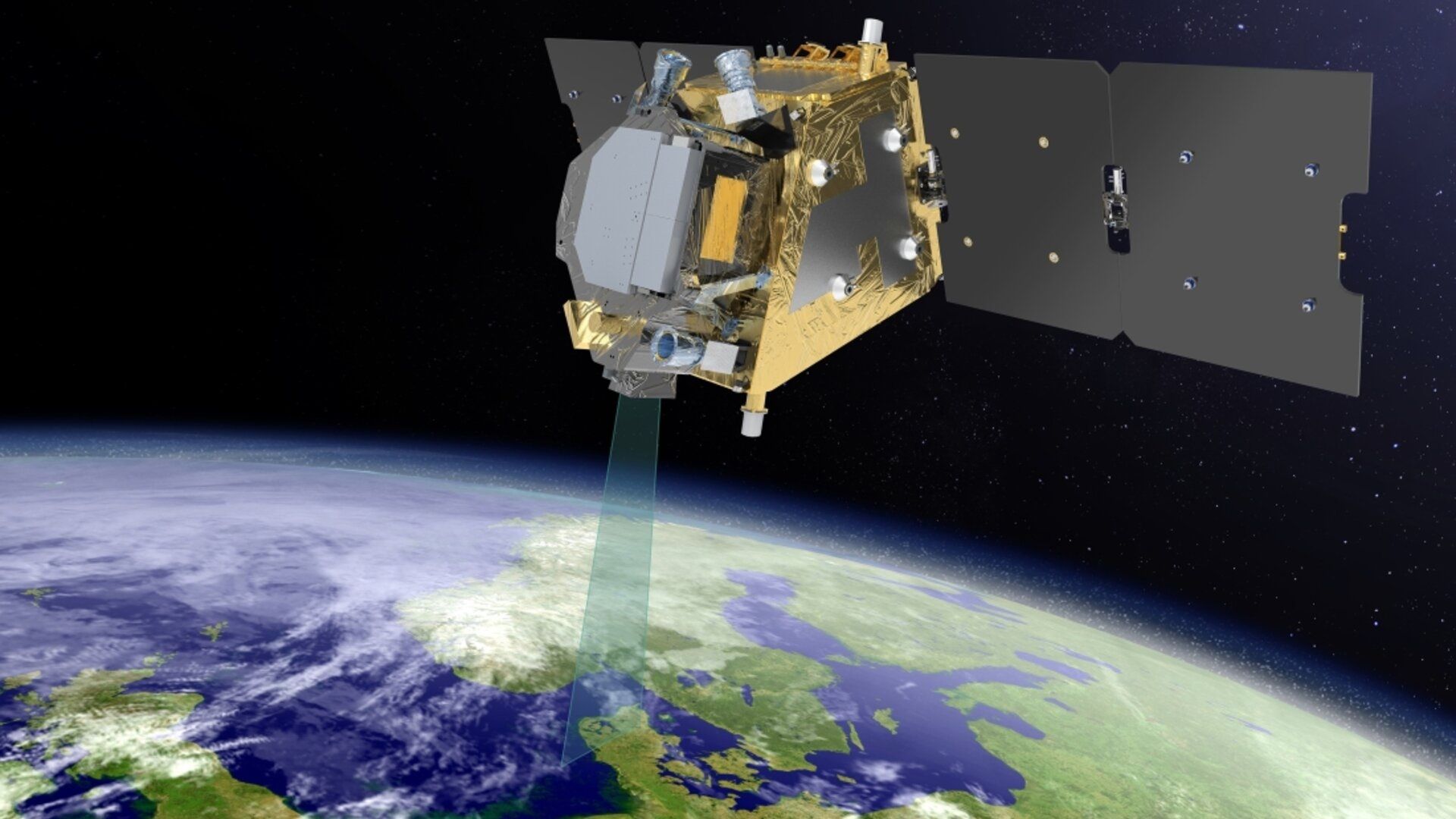
FLEX, the Fluorescence Explorer, is a European Space Agency Earth-observation satellite developed to map chlorophyll fluorescence from terrestrial vegetation. It is the eighth mission in ESA's Earth Explorer series and is intended to provide global information about photosynthetic activity and plant health.
The spacecraft carries the FLORIS fluorescence imaging spectrometer and is designed to operate in tandem with a Copernicus Sentinel-3 satellite. The close formation allows FLEX observations to be combined with complementary optical and thermal measurements from Sentinel-3.
FLEX was launched with Sentinel-3C aboard a Vega-C rocket from the Guiana Space Centre in French Guiana on 15 September 2026. The spacecraft was successfully deployed at an altitude of about 820 km and was flying freely after launch.
Development
ESA selected FLEX in November 2015 as the eighth Earth Explorer mission. Its scientific objective is to measure the faint fluorescence emitted by vegetation during photosynthesis and convert those observations into information about photosynthetic activity, plant condition and the exchange of carbon between vegetation and the atmosphere.
In early 2019, ESA contracted Thales Alenia Space as prime contractor for construction of the satellite. Leonardo Space was responsible for the main payload. The spacecraft configuration was developed around the requirements of the FLORIS instrument, including an unobstructed Earth view, precise pointing, line-of-sight stability and compatibility with the Vega launcher fairing.
Launch
A Vega-C rocket carrying FLEX and Sentinel-3C lifted off from the Guiana Space Centre at 01:21 UTC on 15 September 2026. Sentinel-3C was deployed first. FLEX was released approximately 56 minutes later, after additional burns of the AVUM+ upper stage. Both spacecraft were deployed as planned, with FLEX free-flying by about 116 minutes after liftoff.
Design
FLEX is a single three-axis-stabilised spacecraft approximately 1.5 m by 1.2 m by 1.2 m in its launch configuration. Two solar-array panels deploy in orbit, increasing the overall width to about 5.2 m. ESA describes the spacecraft mass as approximately 400 kg, while the launch report gave a mass of about 397 kg.
FLORIS instrument
The principal payload is FLORIS, a fluorescence imaging spectrometer designed to detect the weak optical signal produced by vegetation during photosynthesis. Plant fluorescence occurs in the approximate wavelength region from 640 to 800 nm. These measurements can be used as an indicator of photosynthetic performance and can provide information about plant health and stress.
The mission is intended to improve understanding of the global carbon and water cycles. Its observations can also support research related to agriculture and food security by providing large-scale information about vegetation activity.
Tandem observations
FLEX is designed to fly in formation with a Copernicus Sentinel-3 satellite. ESA expects FLEX to orbit about 100 km ahead of Sentinel-3, allowing complementary measurements to be acquired within approximately 6 to 15 seconds of each other. This short interval helps reduce differences caused by moving clouds and other rapidly changing conditions.
Mission operations
FLEX operates in a Sun-synchronous orbit with a nominal altitude of 814 km, an inclination of 98.64 degrees and a 27-day repeat cycle. The launch deployment altitude was reported as approximately 820 km.
Mission control is provided by ESA's European Space Operations Centre in Darmstadt, Germany. Tandem operations with Sentinel-3 are coordinated with EUMETSAT. Science data are transmitted through X-band links using ground facilities in Svalbard and Norway, while S-band telemetry uses Kiruna in Sweden. ESA's Centre for Earth Observation in Frascati, Italy, supports mission data activities.
Operational history
FLEX reached Earth orbit on 15 September 2026 following its Vega-C launch with Sentinel-3C. The available launch reports confirm successful spacecraft separation and free flight. They do not establish completion of subsequent in-orbit commissioning.
Operators
- European Space Agency: operator of FLEX as the eighth Earth Explorer mission.
Specifications (FLEX)
General characteristics
- Type: Earth-observation satellite
- Mission: Earth Explorer 8
- Mass: approximately 400 kg; about 397 kg reported for launch
- Dimensions: approximately 1.5 m x 1.2 m x 1.2 m
- Deployed width: approximately 5.2 m
- Stabilisation: three-axis stabilised
- Power: two deployable solar-array panels and batteries
- Main instrument: FLORIS fluorescence imaging spectrometer
Orbit
- Orbit type: Sun-synchronous orbit
- Nominal altitude: 814 km
- Inclination: 98.64 degrees
- Repeat cycle: 27 days
- Formation: designed to fly about 100 km ahead of a Copernicus Sentinel-3 satellite
- Observation separation: approximately 6-15 seconds relative to Sentinel-3 measurements
Launch
- Launch date: 15 September 2026
- Launch vehicle: Vega-C
- Launch site: Guiana Space Centre, Kourou, French Guiana
- Co-passenger: Sentinel-3C
Related equipment
- Copernicus Sentinel-3: Earth-observation satellite series used to provide complementary measurements for the FLEX tandem mission.
- Vega-C: European launch vehicle used to place FLEX and Sentinel-3C into orbit in September 2026.
 Argentina
 Armenia
 Australia
 Austria
 Austria-Hungary
 Belgium
 Brazil
 United Kingdom
 United States
 Brunei
 Bulgaria
 Canada
 Chile
Chile China
China Colonial America
 Colombia
 Confederate States
 Croatia
 Czech
Czech Denmark
 Egypt
Egypt Finland
 France
 Georgia
 Germany
 German Imperial
 Greece
 Holland
 Hungary
 India
India Indonesia
 Iran
Iran Iraq
Iraq Ireland
 Israel
 Italy
Italy Japan
Japan Japan (1940)
 Jordan
 Kingdom of Italy
 Malaysia
 Mexico
 Myanmar
 Nazi Germany
 Netherlands
 New Zealand
 North Korea
 Norway
 Pakistan
 Peru
Peru Philippines
 Poland
 Portugal
 Prussia
 Romania
 Russia
 Saudi Arabia
 Serbia
 Singapore
 Slovakia
 Slovenia
 South Africa
 South Korea
 Soviet Union
 Spain
Spain Sweden
 Switzerland
 Syria
Syria Taiwan
 Thailand
 Turkey
 UAE
UAE Ukraine
 Vietnam
 Yugoslavia