
History
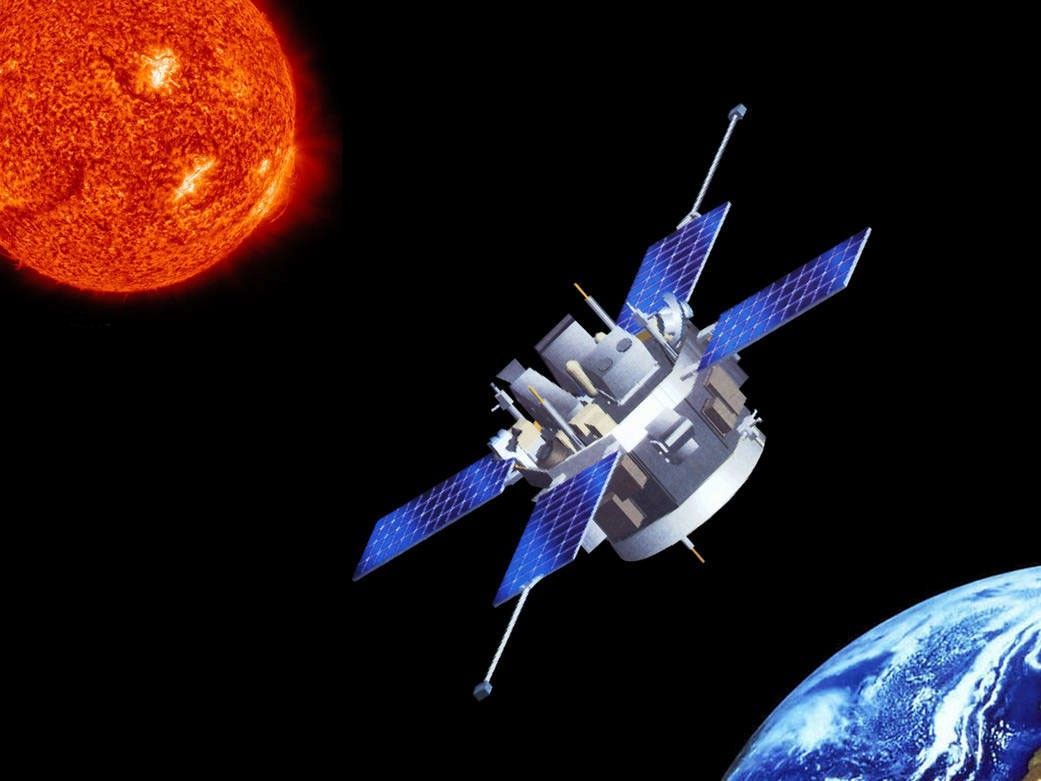
The Advanced Composition Explorer, or ACE, is a NASA spacecraft designed to study energetic particles traveling through space. Its observations include the solar wind, galactic cosmic rays, and interplanetary and interstellar particles.
NASA launched ACE on August 25, 1997, aboard a Delta II rocket from Launch Complex 17A at Cape Canaveral Air Force Station in Florida. The spacecraft then spent about three and a half months traveling to its observing position near the Sun-Earth L1 Lagrangian point.
ACE was originally expected to operate for up to five years. By August 2026, however, the spacecraft had remained active for 29 years and continued to support both scientific research and space-weather monitoring.
Launch and deployment
ACE was launched to observe accelerated particles in space and to provide sustained measurements of conditions in the solar wind. Its destination near L1 placed it at a gravitational equilibrium region between Earth and the Sun, allowing continuous monitoring of solar-wind conditions before they reach Earth.
Long-duration mission
The spacecraft significantly exceeded its original planned mission duration. ACE continued operating for decades after launch and became one of NASA's oldest active spacecraft dedicated to monitoring the Sun and the space environment.
In 2005, the Solar Energetic Particle Ionic Charge Analyzer stopped returning data. According to the supplied source, this was the only one of ACE's nine primary instruments lost during the mission by August 2026.
Design
ACE carries nine primary scientific instruments intended to measure energetic particles and conditions in the space environment. At the time of launch, NASA described these instruments as substantially more capable than earlier space-based sensors, with improvements ranging from 10 to 10,000 times depending on the measurement.
The spacecraft observes the solar wind as well as other populations of charged particles, including galactic cosmic rays and particles originating in interplanetary and interstellar space. These measurements support studies of particle composition, acceleration, and transport through space.
Operational history
From its position near the Sun-Earth L1 point, ACE provides continuous monitoring of the solar wind. This information contributes to early warning of geomagnetic storms that can affect communication satellites and electrical power grids on Earth.
ACE became a core element of NASA's space-weather monitoring capability. By August 25, 2026, the spacecraft had operated for 29 years and was still returning observations despite having been designed around a mission expected to last up to five years.
Specifications (Advanced Composition Explorer)
Mission characteristics
- Operator: NASA
- Launch date: August 25, 1997
- Launch vehicle: Delta II
- Launch site: Launch Complex 17A, Cape Canaveral Air Force Station, Florida
- Observing region: Near the Sun-Earth L1 Lagrangian point
- Transit to observing position: About three and a half months
- Original planned mission duration: Up to five years
- Primary scientific instruments: Nine
Scientific role
- Primary observations: Solar wind and energetic particles traveling through space
- Additional particle populations: Galactic cosmic rays and interplanetary and interstellar particles
- Space-weather function: Continuous solar-wind monitoring used to help provide warning of geomagnetic storms
 Argentina
 Armenia
 Australia
 Austria
 Austria-Hungary
 Belgium
 Brazil
 United Kingdom
 Brunei
 Bulgaria
 Canada
 Chile
Chile China
China Colonial America
 Colombia
 Confederate States
 Croatia
 Czech
Czech Denmark
 Egypt
Egypt Finland
 France
 Georgia
 Germany
 German Imperial
 Greece
 Holland
 Hungary
 India
India Indonesia
 Iran
Iran Iraq
Iraq Ireland
 Israel
 Italy
Italy Japan
Japan Japan (1940)
 Jordan
 Kingdom of Italy
 Malaysia
 Mexico
 Myanmar
 Nazi Germany
 Netherlands
 New Zealand
 North Korea
 Norway
 Pakistan
 Peru
Peru Philippines
 Poland
 Portugal
 Prussia
 Romania
 Russia
 Saudi Arabia
 Serbia
 Singapore
 Slovakia
 Slovenia
 South Africa
 South Korea
 Soviet Union
 Spain
Spain Sweden
 Switzerland
 Syria
Syria Taiwan
 Thailand
 Turkey
 UAE
UAE Ukraine
 Vietnam
 Yugoslavia