
History
Ranger 1 was an uncrewed spacecraft developed by the Jet Propulsion Laboratory for NASA as the first flight of the Ranger program. Launched on August 23, 1961, it was primarily an engineering spacecraft intended to test systems and techniques needed for later lunar and planetary missions.
The spacecraft was designed to enter a highly elliptical Earth orbit reaching about 1.1 million km from Earth. A failure of the Agena B upper stage to perform the required restart left Ranger 1 in low Earth orbit instead. The spacecraft nevertheless operated for several days and provided useful engineering experience before re-entering Earth's atmosphere on August 30, 1961.
Ranger 1 also carried scientific instruments for measurements of particles, radiation, magnetic and electric fields, cosmic dust, and solar X-rays. Its unexpectedly low orbit limited the scientific program, while the engineering mission demonstrated parts of the three-axis stabilization concept used in later spacecraft.
Development
NASA directed the Jet Propulsion Laboratory to prepare a series of lunar missions during the early development of the United States lunar exploration program. By early 1960, the Ranger project had taken shape. The first two spacecraft used the Ranger Block I configuration and were intended as engineering test flights rather than lunar impact missions. A detailed history of the program is provided by The Space Review.
The Block I flights were intended to verify the spacecraft-launch vehicle interface and demonstrate control of a three-axis-stabilized spacecraft. They also provided engineering experience applicable to later Ranger probes and other JPL planetary spacecraft.
Launch and mission
Ranger 1, also identified as P-32, was launched from Launch Complex 12 at Cape Canaveral aboard an Atlas-LV3 Agena-B launch vehicle on August 23, 1961. Launch data compiled by Weebau gives the launch time as 10:04 UT. Most supplied mission references give August 23 as the launch date, although one secondary historical account gives August 26; the August 23 date is also used by the supplied NASA-related source material and independent spacecraft references.
The launch vehicle successfully placed the spacecraft and Agena stage into an initial parking orbit. The Agena B was then supposed to restart and send Ranger 1 into an elongated orbit of approximately 60,000 by 1,100,000 km. The restart failed, leaving the spacecraft in low Earth orbit. Gunter's Space Page lists the resulting orbit as approximately 179 by 446 km with an inclination of 32.9 degrees.
After separation, Ranger 1 deployed its solar panels and attempted to maintain its intended attitude. The Block I spacecraft had not been designed for the rapid day-night cycle of low Earth orbit. Repeated passages into Earth's shadow disrupted Sun acquisition and caused increased use of the nitrogen attitude-control jets. The attitude-control gas was eventually depleted, after which the spacecraft tumbled.
Ranger 1 completed only part of its intended engineering and scientific program. Some radiation and cosmic-ray measurements were obtained, but the spacecraft remained too close to Earth for the planned deep-space environment measurements. After about seven days in orbit and 111 revolutions of Earth, atmospheric drag caused re-entry on August 30, 1961.
The mission did not achieve its planned high orbit, but the spacecraft demonstrated important elements of the Ranger hardware and three-axis control approach. The later Ranger program eventually produced successful lunar imaging missions. The National Air and Space Museum notes that Rangers 7, 8, and 9 later returned close-up television images of the lunar surface.
Design
Structure
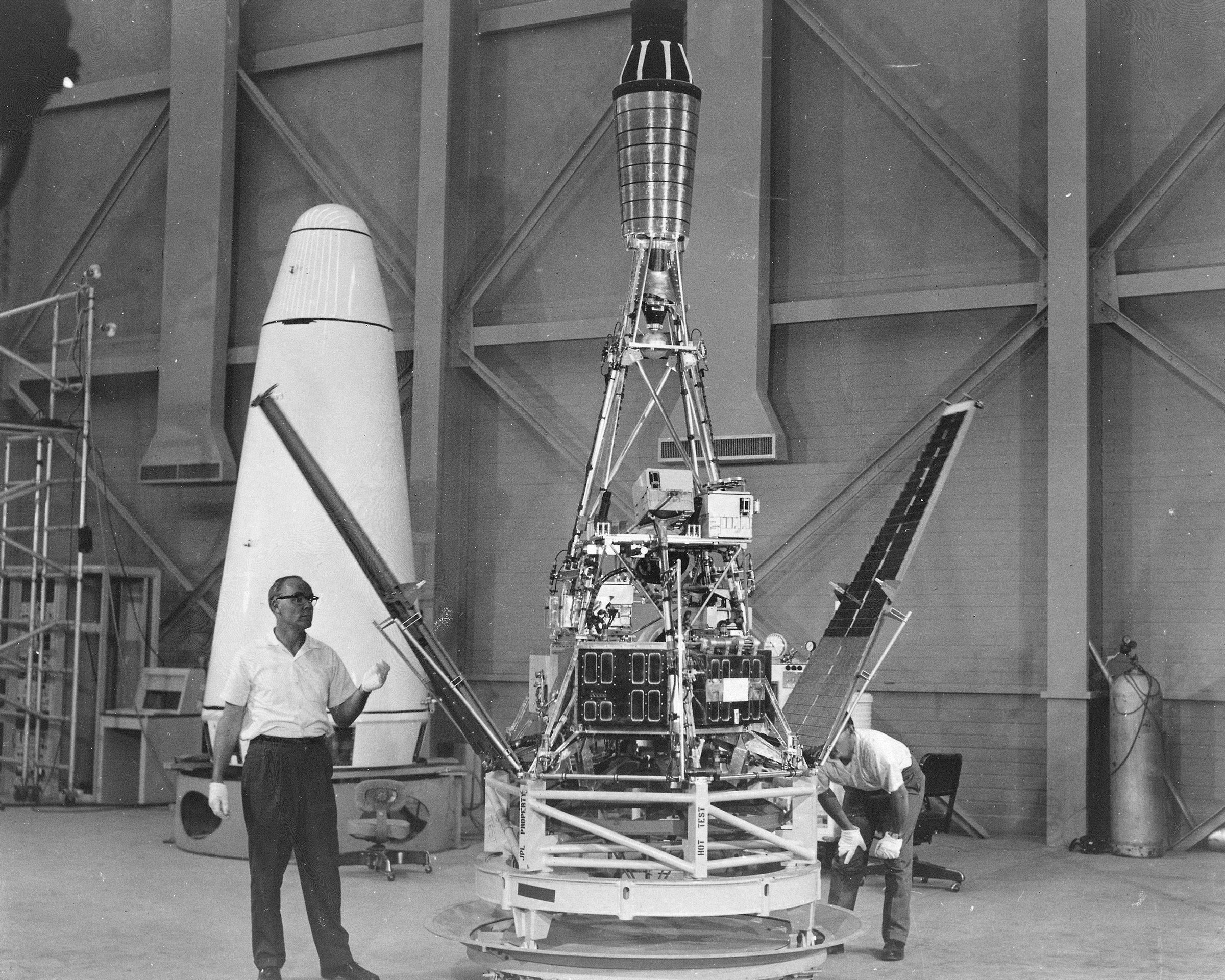
Ranger 1 used the Ranger Block I spacecraft design. It had a hexagonal base approximately 1.5 m across with a cone-shaped open tower of aluminum struts and braces extending about 4 m above the base. Two solar-panel wings extended from opposite sides, producing a deployed span of approximately 5.2 m.
A directional high-gain dish antenna was mounted beneath the base. Scientific instruments and spacecraft equipment were distributed around the base and tower. The general Block I configuration and equipment are described by Ranger 1 reference material and the independent spacecraft record from Gunter's Space Page.
Power and communications
Electrical power was supplied by two solar arrays containing a total of 8,680 solar cells. A 57 kg silver-zinc battery provided stored electrical energy, while some scientific experiments carried additional smaller batteries.
The communications system included a high-gain directional antenna and an omnidirectional medium-gain antenna. Ranger 1 carried two radio transmitters. One operated at 960.1 MHz with an output of 0.25 W, while the second operated at 960.05 MHz with an output of 3 W.
Attitude control and thermal control
Ranger 1 was designed for three-axis stabilization. Its attitude-control system used a solid-state timing controller, Sun and Earth sensors, and gas jets for pitch and roll control. The Block I design did not carry the midcourse correction engine used by later spacecraft.
Thermal control was primarily passive. Gold-plated surfaces, white paint, and polished aluminum were used to control heating and radiation from the spacecraft structure.
Scientific equipment
The scientific payload was intended to investigate the space environment while also supporting engineering evaluation of the spacecraft. Instruments included a Lyman-alpha telescope, a rubidium-vapor magnetometer, electrostatic analyzers, medium-energy particle detectors, triple-coincidence telescopes, a cosmic-ray integrating ionization chamber, cosmic-dust detectors, and solar X-ray scintillation counters.
Unlike later lunar-imaging Ranger spacecraft, Ranger 1 did not carry television cameras. Its role was technology development and environmental measurement rather than photographing the Moon.
Program status
Ranger 1 was destroyed during atmospheric re-entry on August 30, 1961. Its planned high Earth orbit was not achieved because of the launch vehicle malfunction. The flight was therefore unsuccessful in reaching its intended trajectory, although part of the spacecraft engineering test program was completed.
Ranger 1 and Ranger 2 formed the Block I phase of the Ranger program. Both failed to leave low Earth orbit, but the flights contributed engineering information used during continued development of Ranger and later JPL spacecraft.
Specifications (Ranger 1)
General characteristics
- Configuration: Ranger Block I uncrewed engineering spacecraft
- Operator: NASA
- Developer and contractor: Jet Propulsion Laboratory
- Base width: approximately 1.5 m
- Spacecraft height: approximately 4 m
- Solar-panel span: approximately 5.2 m
- Power source: two solar arrays with 8,680 solar cells and a silver-zinc battery
- Main battery mass: 57 kg
Communications
- Transmitter 1: 960.1 MHz, 0.25 W
- Transmitter 2: 960.05 MHz, 3 W
- Antennas: high-gain directional dish and omnidirectional medium-gain antenna
Mission and orbit
- Launch date: August 23, 1961
- Launch vehicle: Atlas-LV3 Agena-B
- Launch site: Launch Complex 12, Cape Canaveral
- Planned orbit: approximately 60,000 by 1,100,000 km
- Achieved orbit: approximately 179 by 446 km
- Orbital inclination: 32.9 degrees
- Re-entry: August 30, 1961
 Argentina
 Armenia
 Australia
 Austria
 Austria-Hungary
 Belgium
 Brazil
 United Kingdom
 Brunei
 Bulgaria
 Canada
 Chile
Chile China
China Colonial America
 Colombia
 Confederate States
 Croatia
 Czech
Czech Denmark
 Egypt
Egypt Finland
 France
 Georgia
 Germany
 German Imperial
 Greece
 Holland
 Hungary
 India
India Indonesia
 Iran
Iran Iraq
Iraq Ireland
 Israel
 Italy
Italy Japan
Japan Japan (1940)
 Jordan
 Kingdom of Italy
 Malaysia
 Mexico
 Myanmar
 Nazi Germany
 Netherlands
 New Zealand
 North Korea
 Norway
 Pakistan
 Peru
Peru Philippines
 Poland
 Portugal
 Prussia
 Romania
 Russia
 Saudi Arabia
 Serbia
 Singapore
 Slovakia
 Slovenia
 South Africa
 South Korea
 Soviet Union
 Spain
Spain Sweden
 Switzerland
 Syria
Syria Taiwan
 Thailand
 Turkey
 UAE
UAE Ukraine
 Vietnam
 Yugoslavia