
History
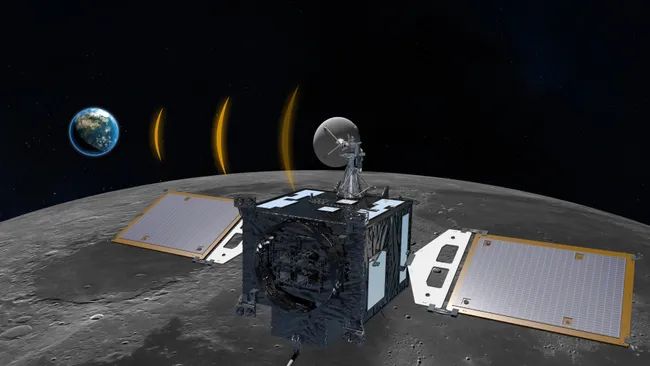
KARI Danuri, formally the Korea Pathfinder Lunar Orbiter (KPLO), is South Korea's first lunar spacecraft and its first exploratory mission beyond Earth orbit. The Korea Aerospace Research Institute developed, manufactured, and operates the orbiter.
Danuri studies the lunar surface, maps possible resources and future landing areas, and demonstrates technologies for later deep-space missions. Its payload combines South Korean instruments with NASA's ShadowCam camera for observing permanently shadowed terrain near the lunar poles.
The spacecraft was launched by a SpaceX Falcon 9 Block 5 on 4 August 2022 UTC. It followed an energy-efficient ballistic lunar transfer, entered lunar orbit in December 2022, and began scientific observations in January 2023.
Development
KARI and NASA completed a lunar-orbiter feasibility study in July 2014. The agencies signed an implementation agreement in December 2016 covering cooperation on a scientific instrument, mission design, navigation, and deep-space communications. Danuri became the first phase of the Korean Lunar Exploration Program and was intended to develop national lunar-exploration capabilities before later lander and rover missions.
The mission was originally associated with earlier launch schedules, but development and spacecraft-mass changes delayed the flight until 2022. South Korea's Ministry of Science and ICT officially assigned the name Danuri in May 2022. The name combines Korean words associated with the Moon and enjoyment.
A Falcon 9 launched Danuri from Space Launch Complex 40 at Cape Canaveral Space Force Station. The ballistic transfer took approximately 135 days and reduced the propulsion needed to reach the Moon. Danuri entered lunar orbit in mid-December and subsequently established its low polar mission orbit. An overview of the mission and its scientific objectives is available from The Planetary Society.
Design
Danuri is an uncrewed lunar orbiter with a launch mass of 678 kg. Its payload has a mass of approximately 40 kg. Two deployable solar arrays provide electrical power, while batteries support spacecraft operation when sunlight is unavailable.
The propulsion system uses four 30 N monopropellant thrusters for major trajectory and orbital maneuvers. Four smaller 5 N thrusters provide attitude-control capability. The spacecraft communicates through S-band and X-band links.
Scientific and technology payloads
- Lunar Terrain Imager (LUTI): A high-resolution camera for imaging candidate landing areas and selected lunar-surface targets. It can obtain imagery at a resolution better than 5 m and has produced images at approximately 2.5 m per pixel under suitable conditions.
- Wide-Angle Polarimetric Camera (PolCam): Observes reflected and scattered light to investigate the properties, composition, and distribution of lunar surface materials outside the polar regions.
- KPLO Magnetometer (KMAG): Measures weak magnetic fields around the Moon and supports research into localized magnetic features and the history of the lunar magnetic environment.
- KPLO Gamma Ray Spectrometer (KGRS): Detects gamma rays associated with elements in the lunar surface and maps their spatial distribution.
- Delay-Tolerant Networking experiment (DTNPL): Tests communication methods designed to operate despite the long delays and intermittent links encountered in deep space.
- ShadowCam: A NASA-provided optical camera for imaging permanently shadowed regions near the lunar poles. It uses faint light scattered from surrounding terrain to map areas that receive no direct sunlight and to support investigations of possible water-ice deposits.
ShadowCam was derived from the Lunar Reconnaissance Orbiter Narrow Angle Camera but is substantially more sensitive to very low light. It can map shadowed terrain at resolutions reaching approximately 1.7 m per pixel. NASA also contributed scientific personnel and technical support for navigation, communications, and mission design.
Operational history
Danuri started its main lunar observations in January 2023 from a roughly 100 km polar orbit. The mission has collected terrain, polarimetric, magnetic, gamma-ray, and shadow-region data. It has also tested delay-tolerant communications for future links between Earth, orbiting spacecraft, and landed systems.
On 5 August 2026, the upper stage of a Falcon 9 struck the Moon near Einstein crater. Danuri obtained LUTI observations shortly before the predicted impact and conducted seven additional imaging sessions afterward. The spacecraft was approximately 340–350 km from the site during the observations.
Comparison images revealed a newly formed impact trace, changes in the surrounding terrain, and ejecta dispersed from the site. PolCam also observed the region so researchers could examine changes in the reflection and polarization of light. Ground-based telescopes had not clearly identified the crater, making Danuri's orbital imagery important direct evidence of the event. Details of the observation were published by DongA Science.
Operator
- South Korea: The Korea Aerospace Research Institute developed and manufactured Danuri and operates the spacecraft as part of the Korean Lunar Exploration Program.
Specifications (Danuri/KPLO)
General characteristics
- Type: Uncrewed lunar orbiter
- Manufacturer: Korea Aerospace Research Institute
- Operator: Korea Aerospace Research Institute
- Launch mass: 678 kg (1,495 lb)
- Approximate dry mass: 550 kg (1,210 lb)
- Payload mass: Approximately 40 kg (88 lb)
- Electrical power: 760 W
- Power source: Two deployable solar arrays and batteries
- Communications: S-band and X-band
- COSPAR identification: 2022-094A
Propulsion
- Main maneuvering thrusters: Four 30 N monopropellant thrusters
- Attitude-control thrusters: Four 5 N monopropellant thrusters
Mission profile
- Launch date: 4 August 2022 UTC
- Launch vehicle: SpaceX Falcon 9 Block 5
- Launch site: Cape Canaveral Space Force Station, Space Launch Complex 40
- Transfer: Ballistic lunar transfer
- Mission orbit: Approximately 100 km circular polar lunar orbit
- Payloads: LUTI, PolCam, KMAG, KGRS, DTNPL, and ShadowCam
Additional spacecraft data and payload descriptions are available from Gunter's Space Page and the Space.com mission profile.
 Argentina
 Armenia
 Australia
 Austria
 Austria-Hungary
 Belgium
 Brazil
 United Kingdom
 United States
 Brunei
 Bulgaria
 Canada
 Chile
Chile China
China Colonial America
 Colombia
 Confederate States
 Croatia
 Czech
Czech Denmark
 Egypt
Egypt Finland
 France
 Georgia
 Germany
 German Imperial
 Greece
 Holland
 Hungary
 India
India Indonesia
 Iran
Iran Iraq
Iraq Ireland
 Israel
 Italy
Italy Japan
Japan Japan (1940)
 Jordan
 Kingdom of Italy
 Malaysia
 Mexico
 Myanmar
 Nazi Germany
 Netherlands
 New Zealand
 North Korea
 Norway
 Pakistan
 Peru
Peru Philippines
 Poland
 Portugal
 Prussia
 Romania
 Russia
 Saudi Arabia
 Serbia
 Singapore
 Slovakia
 Slovenia
 South Africa
 Soviet Union
 Spain
Spain Sweden
 Switzerland
 Syria
Syria Taiwan
 Thailand
 Turkey
 UAE
UAE Ukraine
 Vietnam
 Yugoslavia