
History
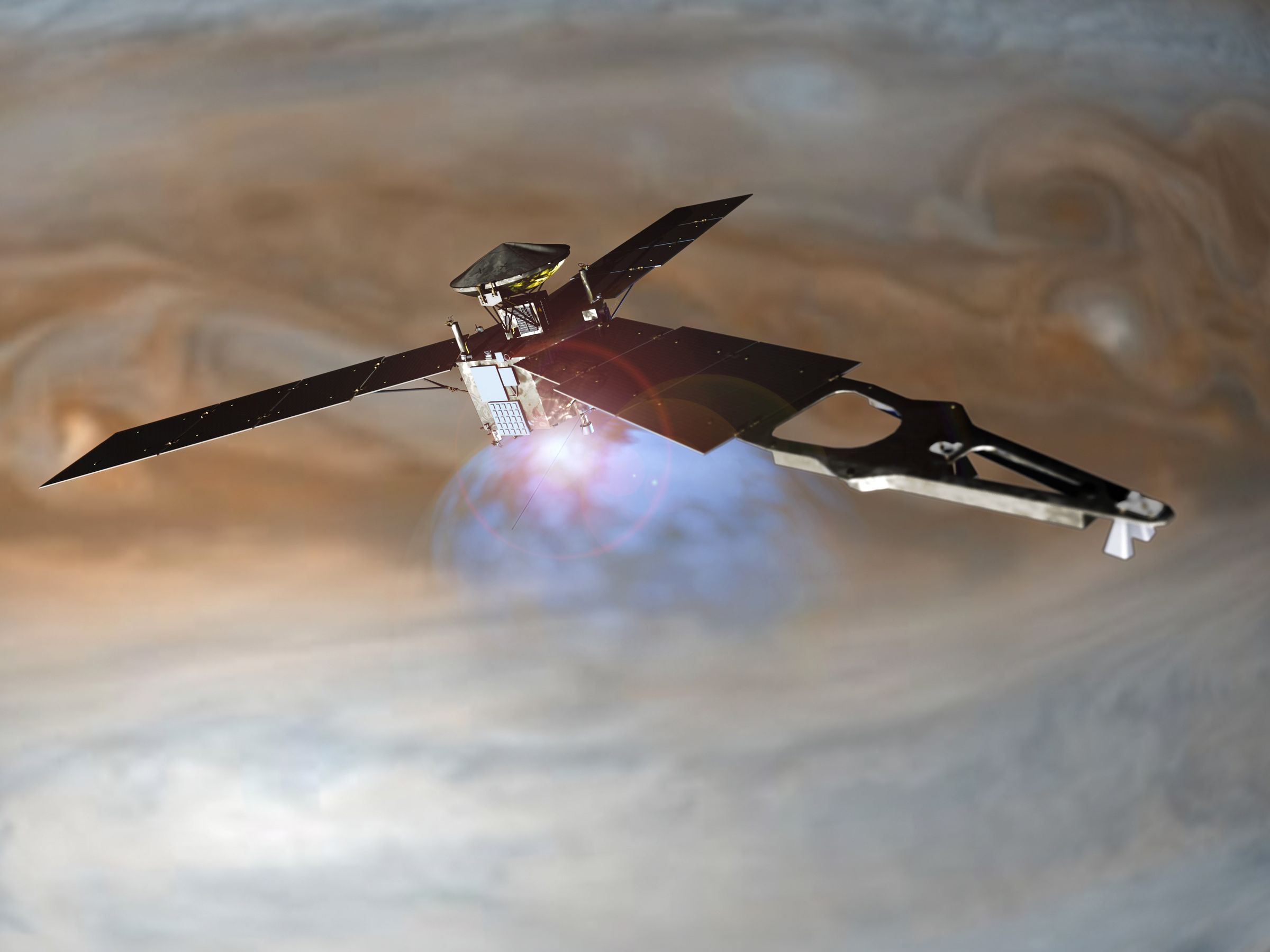
Juno is a solar-powered NASA spacecraft built by Lockheed Martin Space to investigate Jupiter. NASA's Jet Propulsion Laboratory manages the mission, while the Southwest Research Institute leads its scientific investigation.
The orbiter examines Jupiter's origin and internal structure by measuring its atmosphere, gravity, magnetic field and polar magnetosphere. Its polar trajectory also provides close views of the planet's cloud systems, auroras, rings and selected moons.
Juno became the first solar-powered spacecraft to operate at Jupiter and the second spacecraft to orbit the planet after Galileo. The NASA mission overview describes Juno as an active Jupiter orbiter.
Development and launch
NASA selected Juno in June 2005 as the second mission in the New Frontiers program. The spacecraft was designed and constructed by Lockheed Martin Space. Scott Bolton of the Southwest Research Institute became the principal investigator, and several United States and international institutions supplied instruments or mission support.
Juno launched from Space Launch Complex 41 at Cape Canaveral Air Force Station on 5 August 2011 at 16:25 UTC. A United Launch Alliance Atlas V 551 rocket placed the spacecraft on an Earth-escape trajectory. The Centaur upper stage spun Juno before separation, after which the spacecraft deployed its three solar-array wings.
Cruise and Jupiter arrival
Juno performed two deep-space maneuvers in August and September 2012. It returned to Earth for a gravity-assist flyby on 9 October 2013, passing approximately 559 km (347 mi) above the planet. This maneuver supplied the energy required to continue toward Jupiter.
After travelling approximately 2.8 billion km (1.7 billion mi), Juno reached Jupiter in July 2016. A main-engine burn lasting about 35 minutes slowed the spacecraft sufficiently for capture into a highly elliptical polar orbit on 5 July UTC, corresponding to 4 July in the United States.
The original plan called for Juno to enter a shorter 14-day science orbit. Concerns about valves in the main-engine pressurization system led the mission team to retain the longer orbit rather than risk another major engine firing.
Design
Structure and radiation protection
Juno has a six-sided central body surrounded by three solar-array wings spaced at intervals of 120 degrees. The main body is approximately 3.5 m (11.5 ft) high and 3.5 m wide. With its arrays deployed, the spacecraft spans more than 20 m (66 ft).
Jupiter's magnetosphere exposes spacecraft to intense charged-particle radiation. Juno therefore approaches over the poles and passes between the planet and the strongest parts of its radiation belts. Sensitive avionics are housed inside a titanium-walled radiation vault weighing approximately 180 kg (400 lb). Thermal control combines insulation, louvers, electrical heaters and passive cold-biased design.
Power and attitude control
Three rigid, deployable solar-array wings provide electrical power. Each array measures approximately 9 m by 2.65 m (29.5 ft by 8.7 ft). The arrays produced about 14 kW near Earth and approximately 435 to 486 W at Jupiter, where sunlight is only about four percent as intense as at Earth.
Two radiation-tolerant 55 Ah lithium-ion batteries support the spacecraft when solar power is temporarily unavailable. A power distribution and drive unit manages the electrical bus, spacecraft loads and battery charge.
Juno is spin-stabilized. It normally rotated at about one revolution per minute during cruise, two revolutions per minute during science operations and five revolutions per minute for major engine burns. Inertial measurement units, stellar reference units and Sun sensors provide attitude information. Thrusters change the orientation of the spin axis, control rotation and perform trajectory corrections.
Propulsion
The dual-mode propulsion system combines a fixed LEROS 1b bipropellant main engine with 12 reaction-control thrusters mounted on four engine modules. The main engine burns hydrazine fuel with nitrogen tetroxide oxidizer and produces approximately 645 N of thrust. The smaller thrusters use hydrazine for attitude control, spin changes and most minor course corrections.
Six spherical tanks carry fuel and oxidizer. A deployable micrometeoroid shield protected the main-engine nozzle during the interplanetary flight.
Communications and computing
Juno communicates through NASA's Deep Space Network. Its telecommunications system supports X-band command, telemetry and science-data links, together with X-band and Ka-band Doppler tracking for the gravity investigation. The principal antenna is a 2.5 m (8.2 ft) dual-reflector high-gain antenna. Medium-gain, low-gain and toroidal antennas provide coverage in other spacecraft attitudes and during critical maneuvers.
The command and data-handling system uses redundant RAD750 flight processors. The original spacecraft description specifies 256 MB of non-volatile flash memory, 128 MB of128 MB of local dynamic memory and 32 Gbit of science-data storage. A detailed subsystem account is available in the Juno spacecraft description.
Scientific instruments
- Microwave Radiometer: Measures water, ammonia and temperature in the deep atmosphere across six microwave wavelengths.
- Jovian Infrared Auroral Mapper: Maps infrared emissions, atmospheric composition and temperature, and observes the surfaces of Jupiter's moons.
- Magnetometer: Maps Jupiter's magnetic field and supports investigation of the planet's internal dynamo and polar magnetosphere.
- Gravity Science: Uses changes in radio signals between Juno and Earth to map the distribution of mass inside Jupiter.
- Jovian Auroral Distributions Experiment: Measures lower-energy ions and electrons associated with Jupiter's auroras and magnetosphere.
- Jupiter Energetic Particle Detector Instrument: Measures higher-energy ions and electrons in the polar magnetosphere.
- Waves: Detects radio and plasma waves associated with auroral currents and particle acceleration.
- Ultraviolet Spectrograph: produces spectral images of ultraviolet auroral emissions.
- JunoCam: A visible-light color camera originally included for education and public outreach. Its observations have also supported studies of cloud dynamics and Jupiter's moons.
The spacecraft also carries a Stellar Reference Unit that was designed for navigation but has contributed low-light scientific observations. The Italian Space Agency provided JIRAM and components of the Ka-band radio system.
Operational history
Prime mission
Juno made its first close science pass over Jupiter on 27 August 2016 and returned the first close views of the planet's north pole. Retaining the approximately 53-day orbit reduced the frequency of close passes but preserved the science opportunity at each perijove and allowed observations of more distant parts of Jupiter's magnetosphere.
During its prime mission, Juno mapped Jupiter's gravity and magnetic fields, measured the deep atmosphere and examined the polar regions. The spacecraft showed that the visible belts and zones extend thousands of kilometres below the cloud tops. Its data also indicated that Jupiter has a large, diffuse heavy-element core rather than a sharply separated compact core. JunoCam revealed persistent groups of large cyclones around both poles.
The Jet Propulsion Laboratory mission record reports that Juno completed 35 prime-mission orbits and returned more than three terabits of scientific data.
Extended missions
NASA extended Juno's operations in 2021. The expanded investigation covers Jupiter's rings and major moons as well as continued studies of the planet. Juno passed within approximately 1,038 km (645 mi) of Ganymede in June 2021 and within 352 km (219 mi) of Europa in September 2022. It made close flybys of volcanic Io in December 2023 and February 2024.
The moon encounters changed Juno's trajectory and progressively reduced its orbital period from about 53 days to approximately 33 days. The mission has used its instruments to study Ganymede, Europa and Io, including Europa's ice shell and Io's volcanic activity. NASA's astrobiology mission page explains the importance of these observations for understanding the Jovian system and the potential habitability of Europa.
A second extended mission began in October 2025 with a planned duration of three years. It added investigations of Jupiter's inner radiation belts, rings and small inner moons. Juno remained operational and in communication with Earth in August 2026.
Scientific results
Juno measured Jupiter's atmospheric water abundance, mapped variations in the planet's gravity and magnetic fields, and demonstrated that its weather layer reaches far beneath the visible clouds. Gravity measurements indicated that the east-west jet streams extend approximately 3,000 km (1,900 mi) below the cloud tops.
The spacecraft found that Jupiter's magnetic field is irregular and stronger in some regions than pre-mission models predicted. It documented large, organized polar cyclones and showed that Jovian lightning differs in distribution and behavior from lightning on Earth. Measurements of the Great Red Spot indicated that the storm extends hundreds of kilometres below the visible cloud layer.
Operators
- United States: NASA owns the spacecraft. The Jet Propulsion Laboratory manages the mission, and the Southwest Research Institute leads the scientific investigation.
Specifications (Juno)
General characteristics
- Type: Uncrewed Jupiter orbiter
- Manufacturer: Lockheed Martin Space
- Launch mass: 3,625 kg (7,992 lb)
- Dry mass: 1,593 kg (3,512 lb)
- Main-body dimensions: Approximately 3.5 m high by 3.5 m wide (11.5 ft by 11.5 ft)
- Overall deployed span: More than 20 m (66 ft)
- Solar-array dimensions: Three arrays, each approximately 9 m by 2.65 m (29.5 ft by 8.7 ft)
- Electrical storage: Two 55 Ah lithium-ion batteries
- Main engine: One LEROS 1b bipropellant engine
- Main-engine thrust: Approximately 645 N
- Attitude-control system: Twelve hydrazine thrusters on four engine modules
- Stabilization: Spin-stabilized
Mission and orbit
- Launch date: 5 August 2011
- Launch vehicle: Atlas V 551
- Launch site: Cape Canaveral, Space Launch Complex 41
- Jupiter orbit insertion: 5 July 2016 UTC
- Orbit type: Highly elliptical polar orbit
- Initial orbital inclination: Approximately 90 degrees
- Initial science-orbit period: Approximately 53 days
- Initial close-approach altitude: Approximately 4,200 km (2,600 mi) above Jupiter
Communications and payload
- Primary communications: X-band through NASA's Deep Space Network
- Radio-science link: X-band and Ka-band Doppler tracking
- High-gain antenna diameter: 2.5 m (8.2 ft)
- Flight processor: RAD750
- Science instruments: MWR, JIRAM, MAG, Gravity Science, JADE, JEDI, Waves and UVS
- Imaging systems: JunoCam and Stellar Reference Unit
Related equipment
- Galileo: The first spacecraft to orbit Jupiter and Juno's predecessor in long-term orbital investigation of the planet.
- New Horizons: The first mission in NASA's New Frontiers program, followed by Juno as New Frontiers 2.
 Argentina
 Armenia
 Australia
 Austria
 Austria-Hungary
 Belgium
 Brazil
 United Kingdom
 Brunei
 Bulgaria
 Canada
 Chile
Chile China
China Colonial America
 Colombia
 Confederate States
 Croatia
 Czech
Czech Denmark
 Egypt
Egypt Finland
 France
 Georgia
 Germany
 German Imperial
 Greece
 Holland
 Hungary
 India
India Indonesia
 Iran
Iran Iraq
Iraq Ireland
 Israel
 Italy
Italy Japan
Japan Japan (1940)
 Jordan
 Kingdom of Italy
 Malaysia
 Mexico
 Myanmar
 Nazi Germany
 Netherlands
 New Zealand
 North Korea
 Norway
 Pakistan
 Peru
Peru Philippines
 Poland
 Portugal
 Prussia
 Romania
 Russia
 Saudi Arabia
 Serbia
 Singapore
 Slovakia
 Slovenia
 South Africa
 South Korea
 Soviet Union
 Spain
Spain Sweden
 Switzerland
 Syria
Syria Taiwan
 Thailand
 Turkey
 UAE
UAE Ukraine
 Vietnam
 Yugoslavia