
History
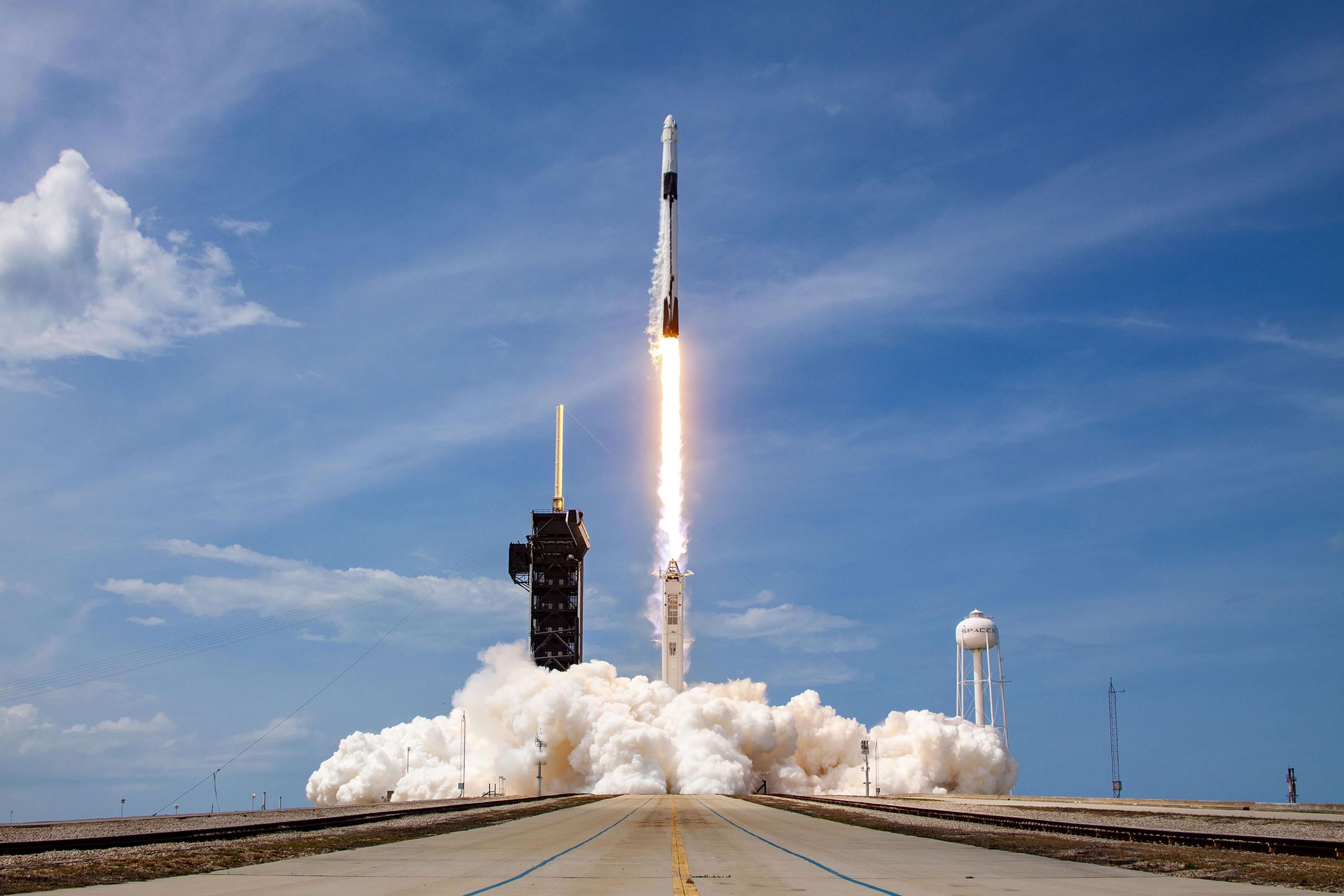
SpaceX Falcon 9 is a two-stage orbital launch vehicle developed in the United States. It transports crewed spacecraft, cargo, satellites and other payloads into Earth orbit and beyond.
The vehicle combines a reusable first stage with an expendable second stage. Its ability to recover and refly boosters has reduced the amount of new hardware required for a high launch cadence.
Falcon 9 also supports United States national-security missions. In 2026, SpaceX received launch orders valued at $1.6 billion for military satellite networks supporting missile tracking, targeting and communications.
Development
SpaceX announced Falcon 9 in 2005 as a larger successor to Falcon 1. The company developed the launch vehicle with private funding and support from NASA's Commercial Orbital Transportation Services program. The program included demonstrations of the Falcon 9 and Dragon cargo spacecraft.
Ground testing progressed through multi-engine firings in 2008 and tests of flight-ready stages in 2009 and 2010. The first Falcon 9 launched from Space Launch Complex 40 at Cape Canaveral on 4 June 2010.
Falcon 9 carried its first operational International Space Station cargo mission in 2012. The enlarged v1.1 version entered service in 2013. Falcon 9 Full Thrust followed in 2015 and introduced further improvements in propulsion and performance.
Recovery and reuse
Early recovery experiments used controlled atmospheric entries and attempted landings at sea. In December 2015, a Falcon 9 first stage made the first successful vertical landing of an orbital-class booster after completing its launch role. A booster first landed successfully on an autonomous drone ship in April 2016.
SpaceX reflown a recovered orbital-class booster for the first time in March 2017. The Block 5 configuration entered service in May 2018 and became the principal operational version. Falcon 9 launched astronauts into orbit for the first time in May 2020.
The current vehicle and its principal characteristics are described by the SpaceX Falcon 9 overview. Mission integration and payload provisions are detailed in the Falcon Payload User's Guide.
Design
Vehicle structure
Falcon 9 has two stages arranged in tandem. Both stages use liquid oxygen and rocket-grade kerosene, known as RP-1. Aluminum-lithium alloy tanks form the main propellant structures.
A composite interstage connects the stages. Pneumatic pushers separate them during flight. Four hypersonic grid fins near the interstage control the returning first stage by changing its aerodynamic center of pressure.
The recoverable first stage has four deployable landing legs. After stage separation, selected missions use engine burns to guide the booster toward a ground landing zone or an autonomous drone ship.
Propulsion
The first stage uses nine SpaceX Merlin engines. This arrangement provides more than 7,600 kN of thrust at sea level in the Block 5 configuration. Engine gimballing controls pitch, yaw and roll during powered flight.
The second stage uses one restartable Merlin Vacuum engine. It places the payload into its intended orbit and can conduct multiple burns when required by the mission. This capability allows Falcon 9 to deploy several payloads into different orbits when performance and mission design permit.
Payload systems
Satellites are carried inside a carbon-composite payload fairing. The fairing protects them during atmospheric flight and is jettisoned after the vehicle reaches sufficiently thin air. Its two halves descend under parachutes and can be recovered for reuse.
Falcon 9 supports single spacecraft, multiple-payload dispensers and secondary payload adapters. It can perform missions to low Earth orbit, polar and sun-synchronous orbit, geostationary transfer orbit and Earth-escape trajectories.
Operational history
Falcon 9 operates from Space Launch Complex 40 at Cape Canaveral Space Force Station and Launch Complex 39A at Kennedy Space Center in Florida. It also launches from Space Launch Complex 4 East at Vandenberg Space Force Base in California.
Florida launch sites support low- and medium-inclination missions, geostationary transfer missions and crewed flights. Vandenberg is used primarily for polar and sun-synchronous trajectories.
The launch vehicle has carried commercial satellites, NASA crew and cargo spacecraft, planetary missions, rideshare payloads and United States national-security spacecraft. Its military missions include satellites used for communications, navigation and other defense functions. The 2026 orders extended this role to launches for networks supporting missile tracking, targeting and military communications.
Variants
- Falcon 9 v1.0: Initial configuration used for five launches between 2010 and 2013.
- Falcon 9 v1.1: Enlarged version introduced in 2013 with uprated Merlin 1D engines and a revised first-stage engine arrangement.
- Falcon 9 Full Thrust: Improved configuration first launched in 2015, with increased propellant capacity and engine performance.
- Falcon 9 Block 4: Transitional Full Thrust configuration operated before the introduction of Block 5.
- Falcon 9 Block 5: Current operational configuration, introduced in 2018 and optimized for repeated first-stage reuse.
Specifications (Falcon 9 Block 5)
General characteristics
- Type: Partially reusable, two-stage medium-lift orbital launch vehicle
- Manufacturer: SpaceX
- Height: 70 m (229.6 ft)
- Diameter: 3.7 m (12 ft)
- Launch mass: 549,054 kg (1,207,920 lb)
- Propellants: Liquid oxygen and RP-1 kerosene
Propulsion
- First-stage engines: Nine Merlin engines
- First-stage sea-level thrust: Approximately 7,600 kN (1.7 million lbf)
- Second-stage engine: One Merlin Vacuum engine
- Second-stage vacuum thrust: 981 kN (220,500 lbf)
- Second-stage burn time: 397 seconds
Payload capacity
- Low Earth orbit: Up to 22,800 kg (50,265 lb)
- Geostationary transfer orbit: Up to 8,300 kg (18,300 lb)
- Mars trajectory: Up to 4,020 kg (8,860 lb)
 Argentina
 Armenia
 Australia
 Austria
 Austria-Hungary
 Belgium
 Brazil
 United Kingdom
 Brunei
 Bulgaria
 Canada
 Chile
Chile China
China Colonial America
 Colombia
 Confederate States
 Croatia
 Czech
Czech Denmark
 Egypt
Egypt Finland
 France
 Georgia
 Germany
 German Imperial
 Greece
 Holland
 Hungary
 India
India Indonesia
 Iran
Iran Iraq
Iraq Ireland
 Israel
 Italy
Italy Japan
Japan Japan (1940)
 Jordan
 Kingdom of Italy
 Malaysia
 Mexico
 Myanmar
 Nazi Germany
 Netherlands
 New Zealand
 North Korea
 Norway
 Pakistan
 Peru
Peru Philippines
 Poland
 Portugal
 Prussia
 Romania
 Russia
 Saudi Arabia
 Serbia
 Singapore
 Slovakia
 Slovenia
 South Africa
 South Korea
 Soviet Union
 Spain
Spain Sweden
 Switzerland
 Syria
Syria Taiwan
 Thailand
 Turkey
 UAE
UAE Ukraine
 Vietnam
 Yugoslavia