
History
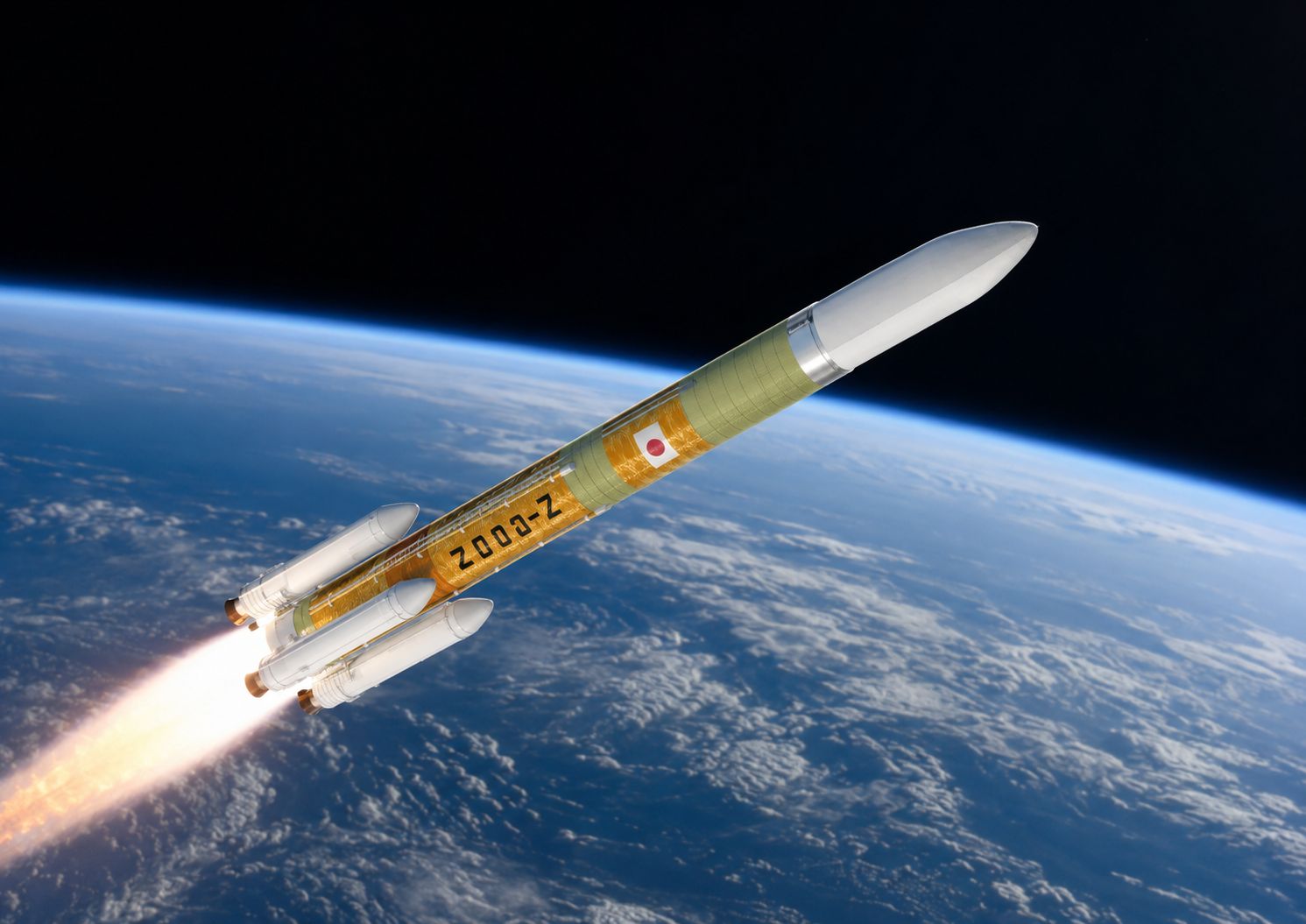
The H3 is a Japanese two-stage medium-lift launch vehicle developed by the Japan Aerospace Exploration Agency and Mitsubishi Heavy Industries. It is Japan's new main launch system and the successor to the H-IIA and H-IIB.
The modular rocket can use two or three liquid-propellant first-stage engines, zero, two, or four solid rocket boosters, and several payload fairings. These configurations support government, commercial, space-station logistics, and deep-space missions.
The first H3 flight took place in March 2023 and failed after the second-stage engine did not ignite. The second test flight succeeded in February 2024, and H3 subsequently entered active service.
Development
The Japanese government approved the H3 program in May 2013. Detailed development began in 2014, with Mitsubishi Heavy Industries serving as prime contractor and cooperating with JAXA on the propulsion system. The program was intended to preserve Japan's independent access to space while reducing launch costs and competing for commercial missions.
Development requirements emphasized competitive performance and price, shorter launch-site operations, schedule flexibility, high reliability, and reduced vibration for payloads. The design retained proven elements from the H-IIA and H-IIB while simplifying structures, manufacturing, inspection, and launch preparation. A detailed account of the early program is available in the MHI development report.
Ground firing of the first LE-9 engineering engine began in April 2017. The initial series included 11 firings with a combined duration of approximately 270 seconds. The first SRB-3 solid-booster firing tests followed in August 2018.
Qualification testing in May 2020 revealed openings in the LE-9 combustion-chamber wall and fatigue cracks in liquid-hydrogen turbopump blades. Engineers revised operating conditions and redesigned turbine blades to prevent damaging resonance. These problems delayed the inaugural flight from its original schedule.
The first complete test vehicle was shipped to Tanegashima in January 2021. A wet dress rehearsal in March 2021 tested propellant loading, vehicle checks, the automatic countdown, and interaction with ground facilities. Structural, electrical, electromagnetic compatibility, attitude-control, and fairing-separation tests were also conducted.
Flight testing and service entry
An attempted launch on 17 February 2023 was aborted before the SRB-3 boosters ignited. On 7 March 2023, Test Flight 1 lifted off with the ALOS-3 Earth-observation satellite. Its second-stage engine failed to ignite, and the vehicle was destroyed by a flight-termination command.
Test Flight 2 launched on 17 February 2024. The second stage reached its intended orbit and deployed the VEP-4 evaluation payload and two rideshare satellites. This mission marked the first successful H3 flight.
Operational missions followed with ALOS-4 in July 2024, the Kirameki-3 defense communications satellite in November 2024, and the QZS-6 navigation satellite in February 2025. The first H3-24W launched the HTV-X1 cargo spacecraft toward the International Space Station on 26 October 2025.
An H3-22S mission failed on 22 December 2025. JAXA suspected that the payload support structure failed shortly after fairing separation and damaged the second-stage liquid-hydrogen tank. The H3 returned to flight on 12 June 2026, when the first H3-30S successfully placed an evaluation payload and several rideshare spacecraft into orbit.
Design
The H3 uses a modular architecture that matches propulsion and fairing arrangements to different payloads. Its designation follows the H3-abc format. The first digit gives the number of LE-9 first-stage engines, the second gives the number of SRB-3 boosters, and the final letter identifies the short, long, or wide payload fairing.
Structure and payload system
The launch vehicle has two liquid-propellant stages. Simplified shapes, fewer specialized materials, automated drilling and riveting, and integrally formed tank domes reduce the number of components and manufacturing operations. Standard payload adapters support clamp-band diameters of 937, 1,194, and 1,666 mm. Specialized adapters can accommodate multiple small satellites.
The short-fairing vehicle is approximately 57 m long. Configurations with long or wide fairings are approximately 63 m long. The wide fairing is about 16.4 m long and 5.4 m in diameter, compared with approximately 5.2 m for the long fairing.
First stage
The first stage uses two or three LE-9 engines burning liquid oxygen and liquid hydrogen. The LE-9 employs an expander-bleed cycle, in which heat absorbed while cooling the engine expands the hydrogen that drives the turbopumps. This arrangement eliminates an auxiliary combustion chamber and reduces engine complexity.
Electrically operated propellant valves replace pneumatic controls. Additive manufacturing is used for complex components such as injectors. Electric engine-steering actuators also replace hydraulic equipment. Each LE-9 produces approximately 1,471 kN of thrust.
Second stage
The second stage has one restartable LE-5B-3 engine using liquid oxygen and liquid hydrogen. It is derived from the LE-5B-2 but incorporates changes to improve performance, extend mission duration, simplify production, and replace components that had become difficult to obtain. The engine produces approximately 137 kN of thrust.
Solid rocket boosters
Booster-equipped versions use two or four SRB-3 solid rocket boosters. Each booster is approximately 15 m long and 2.5 m in diameter, has a gross mass of 76.2 tonnes, and produces approximately 2,300 kN of thrust. The SRB-3 incorporates experience from the H-IIA, H-IIB, and Epsilon programs while using a simplified joint structure and fixed nozzle.
Guidance and operations
The H3 uses an inertial guidance system. Its development included networked avionics, electric steering, and automated manufacturing and inspection. JAXA describes flexibility, reliability, lower cost, and shorter launch preparation as central features of the H3 launch vehicle.
Operational history
H3 launches take place from Launch Area Y2 at the Tanegashima Space Center. Missions through June 2026 included Earth-observation, navigation, defense communications, technology-demonstration, rideshare, and International Space Station cargo payloads.
The H3-24W mission with HTV-X1 demonstrated the wide-fairing and four-booster configuration. The June 2026 H3-30S mission introduced the lightest configuration, using three LE-9 engines and no solid boosters.
Planned missions
The H3 is planned to support additional Japanese government, commercial, lunar, and interplanetary missions. Scheduled payloads include HTV-X cargo spacecraft, the Martian Moons eXploration mission, the Lunar Polar Exploration mission, and commercial communications satellites. Launch dates and configurations remain subject to mission planning and technical readiness.
In July 2026, Japanese lunar-lander company ispace selected H3 for its next lunar mission, planned for 2028. The mission is intended to use an H3-22S to send the ULTRA lander toward the Moon and forms part of a proposed private Japanese lunar transportation service.
Variants
- H3-30S: Three LE-9 engines, no solid boosters, and a short fairing. It is the lightest and lowest-cost configuration.
- H3-22S: Two LE-9 engines, two SRB-3 boosters, and a short fairing.
- H3-22L: Two LE-9 engines, two SRB-3 boosters, and a long fairing.
- H3-24L: Two LE-9 engines, four SRB-3 boosters, and a long fairing.
- H3-24W: Two LE-9 engines, four SRB-3 boosters, and a 5.4 m wide fairing for large payloads.
- H3-32: Proposed configuration with three LE-9 engines and two boosters. It was cancelled after analysis showed that the H3-22 could satisfy the relevant missions at lower cost.
- Heavy-lift concept: A proposed future system using three H3 core stages in parallel. It has not entered operational service.
Specifications (H3-24L)
General characteristics
- Type: Two-stage medium-lift orbital launch vehicle
- Length: 63 m
- Core diameter: 5.27 m
- Total mass: Approximately 574 tonnes without payload
- First-stage engines: Two LE-9 engines
- Second-stage engine: One LE-5B-3 engine
- Solid rocket boosters: Four SRB-3 boosters
- Propellants: Liquid oxygen and liquid hydrogen in both core stages; solid propellant in the boosters
- Guidance: Inertial guidance system
- Launch site: Tanegashima Space Center, Launch Area Y2
Performance
- First-stage thrust: Approximately 2,942 kN from two LE-9 engines
- Booster thrust: Approximately 9,200 kN from four SRB-3 boosters
- Second-stage thrust: Approximately 137 kN
- Payload to geostationary transfer orbit: Approximately 7,900 kg under the stated 1,500 m/s remaining-velocity condition
Configuration and development details are described in the 2025 MHI technical review.
Related equipment
- H-IIA: Japan's preceding main launch vehicle and an important source of operational experience for H3.
- H-IIB: Heavy Japanese launch vehicle previously used for space-station cargo missions and replaced by H3 with HTV-X.
- Epsilon S: Japanese small launch vehicle that uses technology related to the SRB-3 booster.
 Argentina
 Armenia
 Australia
 Austria
 Austria-Hungary
 Belgium
 Brazil
 United Kingdom
 United States
 Brunei
 Bulgaria
 Canada
 Chile
Chile China
China Colonial America
 Colombia
 Confederate States
 Croatia
 Czech
Czech Denmark
 Egypt
Egypt Finland
 France
 Georgia
 Germany
 German Imperial
 Greece
 Holland
 Hungary
 India
India Indonesia
 Iran
Iran Iraq
Iraq Ireland
 Israel
 Italy
Italy Japan (1940)
 Jordan
 Kingdom of Italy
 Malaysia
 Mexico
 Myanmar
 Nazi Germany
 Netherlands
 New Zealand
 North Korea
 Norway
 Pakistan
 Peru
Peru Philippines
 Poland
 Portugal
 Prussia
 Romania
 Russia
 Saudi Arabia
 Serbia
 Singapore
 Slovakia
 Slovenia
 South Africa
 South Korea
 Soviet Union
 Spain
Spain Sweden
 Switzerland
 Syria
Syria Taiwan
 Thailand
 Turkey
 UAE
UAE Ukraine
 Vietnam
 Yugoslavia