
History
The Martin Marietta Viking 1 was an uncrewed NASA lander designed to investigate the surface and atmosphere of Mars. It operated as one element of a spacecraft that also included an orbiter.
Viking 1 landed in Chryse Planitia on 20 July 1976. NASA describes it as the first fully successful Mars landing, although the Soviet Mars 3 spacecraft had survived touchdown briefly in 1971 before communications ended.
The lander returned images, weather observations, and analyses of Martian soil for more than six years. Its long mission established a foundation for later robotic exploration of Mars.
Development
The Viking program began in 1968 and followed the Mariner missions that had surveyed Mars by flyby and from orbit. NASA Langley Research Center managed the mission, the Jet Propulsion Laboratory participated in design and operations, and Martin Marietta manufactured the landers.
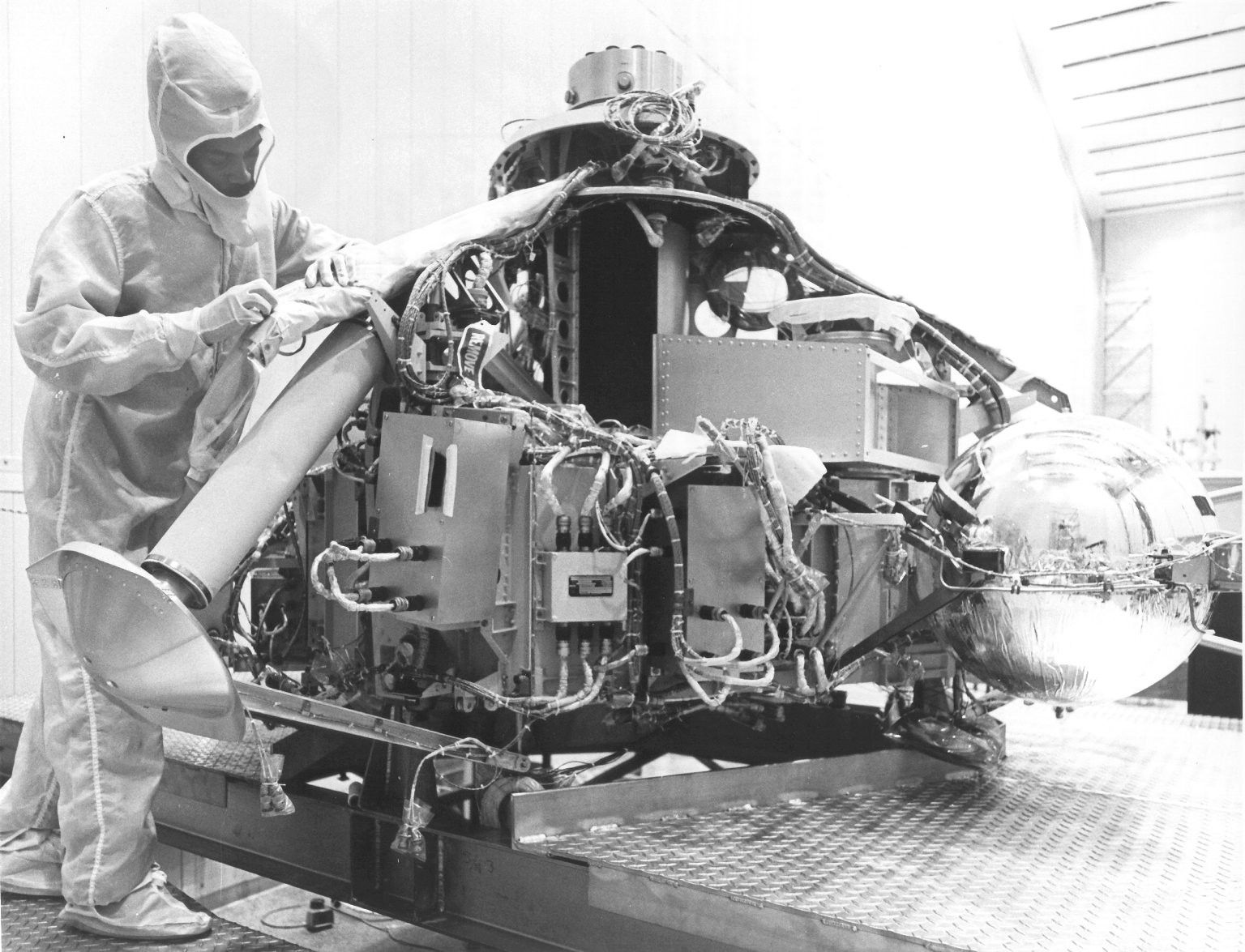
NASA built two flight spacecraft, Viking 1 and Viking 2. Each combined an orbiter with a lander. The orbiter transported the lander to Mars, photographed candidate landing areas, conducted its own scientific observations, and served as a communications relay after touchdown. A separate proof-test lander remained on Earth for structural testing, command verification, and simulation during flight operations. That vehicle is preserved by the National Air and Space Museum.
Launch and arrival
Viking 1, originally identified as Viking B, launched from Cape Canaveral Launch Complex 41 on 20 August 1975 aboard a Titan IIIE-Centaur. It entered orbit around Mars on 19 June 1976 after a 304-day cruise.
The landing was initially planned for 4 July 1976. Orbital photographs showed that the intended area was too rough, so mission controllers delayed the attempt while selecting a safer location in western Chryse Planitia.
The lander separated from the orbiter on 20 July 1976. Its aeroshell and heat shield slowed it during atmospheric entry. A 16 m parachute deployed at an altitude of about 6 km, followed by three throttleable terminal-descent engines. Viking 1 touched down at 11:53:06 UTC, approximately 28 km from its planned target.
Design
Viking 1 used a six-sided aluminum base carried above the surface by three landing legs. The footpads formed an equilateral triangle with sides of 2.21 m. Instruments, communications equipment, cameras, antennas, and a meteorology boom were installed on or above the base.
Entry and landing system
The lander travelled to the surface inside an aeroshell equipped with an ablative heat shield. A hydrazine deorbit system used 12 nozzles arranged in four clusters and provided 32 N of thrust. Guidance equipment included an inertial reference unit, four gyroscopes, a radar altimeter, and terminal-descent radar.
Three hydrazine engines performed the final descent. Their 18-nozzle arrangement dispersed the exhaust to limit disturbance and heating of the surface beneath the spacecraft. The engines were throttleable from 276 to 2,667 N. Touchdown occurred at approximately 2.4 m/s.
Power and communications
Two SNAP-19 radioisotope thermoelectric generators supplied continuous electrical power using heat from plutonium-238. Each unit produced approximately 30 W. Four rechargeable nickel-cadmium batteries supported periods of peak demand.
The communications system included a steerable high-gain S-band antenna and an omnidirectional low-gain antenna for direct contact with Earth. A 381 MHz UHF system transmitted data through the Viking orbiter. The lander also carried a 40 Mbit tape recorder and a computer with a 6,000-word command memory.
Scientific equipment
The scientific payload investigated the appearance, physical properties, chemistry, meteorology, magnetic characteristics, and possible biology of the Martian surface and atmosphere. Two cylindrical scanning cameras could survey the surroundings through 360 degrees. A remote sampler arm collected soil and delivered it to instruments inside the lander.
The payload included a gas chromatograph-mass spectrometer, an X-ray fluorescence spectrometer, three biological experiments, a weather instrument package, a pressure sensor, magnetic targets, and a seismometer. Sensors in the aeroshell measured pressure, temperature, density, atmospheric particles, and atmospheric composition during entry.
Operational history
Viking 1 began transmitting its first surface image 25 seconds after landing. A locking pin initially prevented movement of the sampler arm, but the mechanism was released after five days. The seismometer failed to uncage and could not perform its intended investigation.
On 28 July 1976, the sampler arm delivered the first soil material to the lander's analytical laboratory. The biological experiments produced mixed responses. One test produced a positive reaction, while the gas chromatograph-mass spectrometer did not detect organic compounds at its specified sensitivity. The results did not establish the presence of Martian life and were generally interpreted as chemical reactions in the soil.
The cameras recorded the landing area, while the meteorology instruments measured temperature, pressure, and wind. Viking 1 continued sending daily and later weekly weather reports after the primary mission ended in November 1976. Mission details and results are documented by NASA Science.
The Viking 1 orbiter ceased operating in August 1980. The lander remained active and was renamed the Thomas Mutch Memorial Station in January 1982 in honor of the leader of the Viking imaging team.
Contact ended on 11 November 1982 after a faulty command disrupted the lander's communications system. Attempts to restore contact were unsuccessful. Viking 1 had operated for approximately 2,306 Earth days, or 2,245 Martian sols. Additional technical information is available from Gunter's Space Page.
Operators
- NASA: Operated Viking 1 through its Mars cruise, landing, surface science mission, and extended monitoring mission.
Specifications (Viking 1 lander)
General characteristics
- Manufacturer: Martin Marietta
- Type: Stationary uncrewed Mars lander
- Structure: Six-sided aluminum base with three landing legs
- Base side lengths: Alternating 1.09 m and 0.56 m
- Landing-footprint spacing: 2.21 m between footpads
- Launch mass: 657 kg, including 85 kg of hydrazine propellant
- Mass after landing: Approximately 600 kg
- Scientific payload mass: Approximately 91 kg
- Power: Two SNAP-19 radioisotope thermoelectric generators, approximately 30 W each
- Energy storage: Four 28 V, 8 Ah nickel-cadmium batteries
Descent system
- Deorbit propulsion: Hydrazine system with 12 nozzles and 32 N thrust
- Deorbit velocity capability: 180 m/s
- Terminal propulsion: Three throttleable hydrazine engines
- Terminal-engine thrust: 276 to 2,667 N
- Parachute diameter: 16 m
- Touchdown speed: Approximately 2.4 m/s
Communications and data
- Direct communications: S-band high-gain and low-gain antennas
- Orbiter relay: 381 MHz UHF link using a 30 W relay radio
- Data recorder: 40 Mbit tape recorder
- Computer memory: 6,000 words
Scientific instruments
- Imaging: Two 360-degree cylindrical scanning cameras
- Surface sampling: Remote sampler arm with collector head, temperature sensor, and magnet
- Chemical analysis: Gas chromatograph-mass spectrometer and X-ray fluorescence spectrometer
- Biology: Pyrolytic-release, labeled-release, and gas-exchange experiments
- Meteorology: Temperature, pressure, wind-speed, and wind-direction sensors
- Other instruments: Seismometer, magnetic targets, camera calibration targets, and engineering sensors
Related equipment
- Viking 1 Orbiter: Transported the lander, surveyed landing sites, performed orbital science, and relayed surface data.
- Viking 2: The second spacecraft of the program used an essentially identical orbiter-and-lander arrangement and landed at Utopia Planitia in September 1976.
- Mariner 9: The earlier NASA Mars orbiter whose design and observations contributed to the Viking program.
 Argentina
 Armenia
 Australia
 Austria
 Austria-Hungary
 Belgium
 Brazil
 United Kingdom
 Brunei
 Bulgaria
 Canada
 Chile
Chile China
China Colonial America
 Colombia
 Confederate States
 Croatia
 Czech
Czech Denmark
 Egypt
Egypt Finland
 France
 Georgia
 Germany
 German Imperial
 Greece
 Holland
 Hungary
 India
India Indonesia
 Iran
Iran Iraq
Iraq Ireland
 Israel
 Italy
Italy Japan
Japan Japan (1940)
 Jordan
 Kingdom of Italy
 Malaysia
 Mexico
 Myanmar
 Nazi Germany
 Netherlands
 New Zealand
 North Korea
 Norway
 Pakistan
 Peru
Peru Philippines
 Poland
 Portugal
 Prussia
 Romania
 Russia
 Saudi Arabia
 Serbia
 Singapore
 Slovakia
 Slovenia
 South Africa
 South Korea
 Soviet Union
 Spain
Spain Sweden
 Switzerland
 Syria
Syria Taiwan
 Thailand
 Turkey
 UAE
UAE Ukraine
 Vietnam
 Yugoslavia