
History
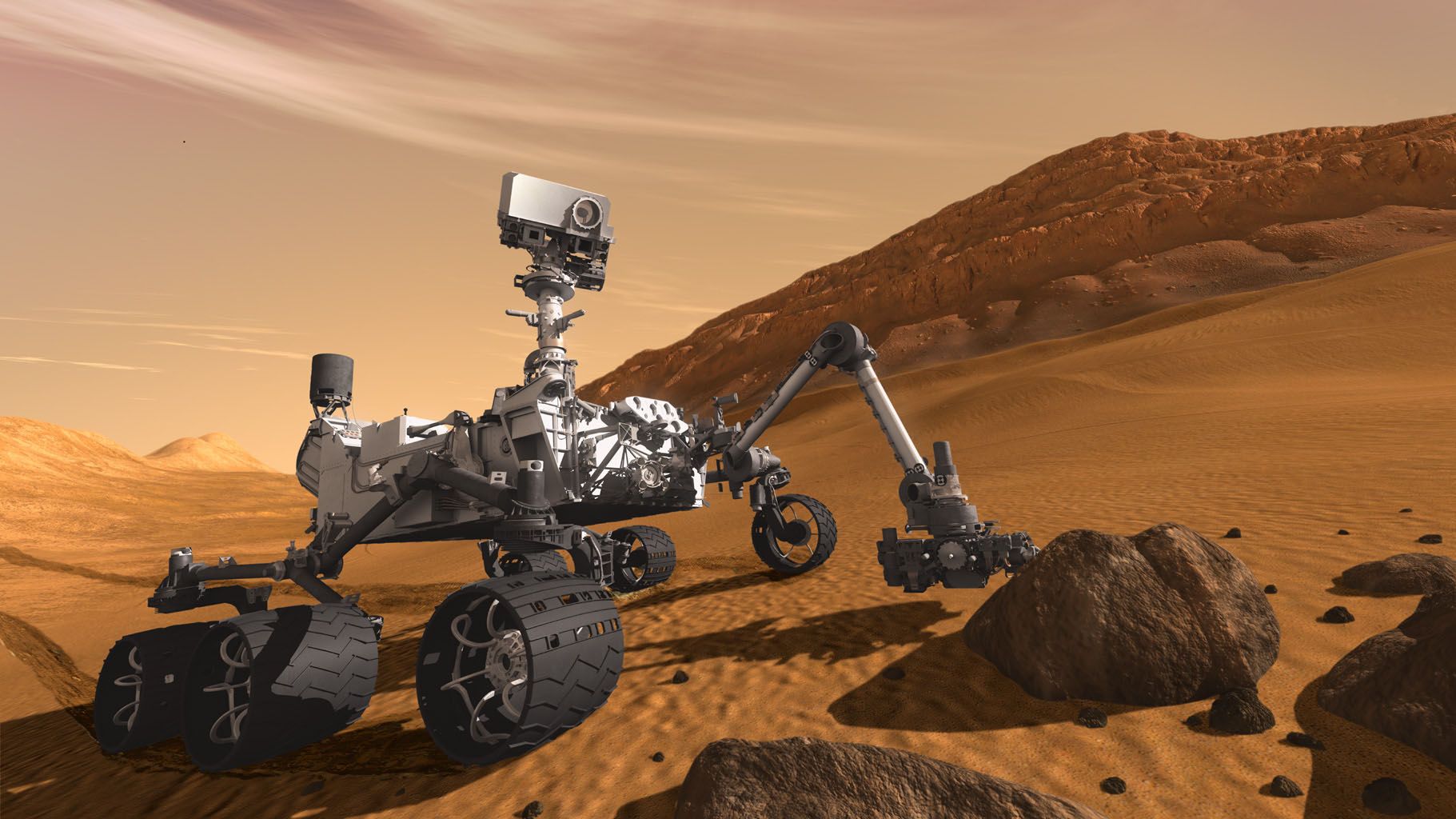
Curiosity is a robotic Mars rover developed by NASA's Jet Propulsion Laboratory for the Mars Science Laboratory mission. It studies the geology, climate, radiation environment, and past habitability of Gale Crater.
The rover carries cameras, remote-sensing instruments, environmental sensors, a robotic arm, a drill, and two internal laboratories. Its principal scientific question is whether ancient Mars had environmental conditions capable of supporting microbial life.
Curiosity was launched in 2011 and landed on Mars in 2012. The mission remains active after operating for far longer than its original primary mission.
Development and launch
NASA developed Mars Science Laboratory as a larger and more capable successor to the Spirit and Opportunity rovers. Curiosity is approximately twice as long and five times as heavy as those vehicles. It also carries more than ten times their mass of scientific instruments.
Jet Propulsion Laboratory manages the mission for NASA and manufactured the rover. Its scientific payload was produced by organizations in the United States, Canada, France, Spain, Germany, Finland, and Russia. NASA selected the name Curiosity through a student competition that received more than 9,000 proposals.
An Atlas V 541 launch vehicle carried the Mars Science Laboratory spacecraft from Cape Canaveral Space Launch Complex 41 on 26 November 2011. Curiosity reached Mars after an interplanetary journey of approximately 570 million km.
Landing
Curiosity landed at Bradbury Landing in Gale Crater on 6 August 2012. The spacecraft used guided atmospheric entry, a parachute, powered descent, and a sky-crane system. During the final stage, the descent vehicle lowered the rover on a 20 m tether and placed it directly onto its six wheels. Cable cutters released the rover after touchdown, and the descent stage flew away from the landing site.
The landing placed Curiosity close to Mount Sharp, officially Aeolis Mons, a layered mountain at the center of Gale Crater. NASA selected the crater because its sedimentary rocks preserve evidence of past water-related environments. An official overview of the active mission is available from NASA Science.
Design
Chassis and mobility
Curiosity has a box-shaped main chassis called the Warm Electronics Box. It protects the computers, analytical instruments, batteries, and other internal equipment from the Martian environment.
The mobility system has six independently powered wheels, each measuring 50 cm in diameter. A rocker-bogie suspension allows the wheels to move over irregular terrain while keeping the rover body comparatively stable. The four corner wheels can steer, enabling Curiosity to make arcing turns or rotate in place.
The rover can cross obstacles approaching 65 cm in height and has approximately 60 cm of ground clearance. Its theoretical maximum driving speed is about 90 m per hour, although normal progress is much slower because routes must account for terrain, wheel slip, visibility, power, and scientific observations. Hazard-avoidance and navigation cameras provide stereoscopic images for route planning and autonomous safety decisions.
Power and thermal control
Curiosity uses a Multi-Mission Radioisotope Thermoelectric Generator instead of solar panels. Heat from the decay of plutonium-238 is converted into electricity, allowing the rover to operate through the Martian day and night and across seasonal changes. The generator produced approximately 110 W of electrical power at the start of the mission, with output gradually declining over time.
Two rechargeable lithium-ion batteries, each rated at about 42 Ah, meet short periods of demand above the generator's continuous output. Waste heat from the generator also helps warm the rover. A pumped-fluid thermal system distributes or rejects heat to maintain suitable temperatures for sensitive components.
Computers and communications
Two redundant Rover Compute Elements use radiation-hardened RAD750 processors and the VxWorks real-time operating system. Each computer has 256 MB of dynamic memory, 2 GB of flash memory, and 256 kB of EEPROM. One computer serves as the primary unit while the other can take over after a fault.
Curiosity receives command sequences from Earth and performs onboard monitoring of navigation, temperature, power, and instrument activity. It can communicate directly with Earth through X-band radio, but most scientific data travels through UHF links to spacecraft orbiting Mars. These orbiters relay the information to Earth at substantially higher data rates than the rover's direct connection.
Robotic arm and sampling equipment
A three-jointed robotic arm extends approximately 2.1 m and carries a rotating turret with five devices. These include the Alpha Particle X-Ray Spectrometer, the Mars Hand Lens Imager, a percussion drill, a motorized brush, and equipment for scooping, sieving, and portioning samples.
The drill produces holes approximately 1.6 cm in diameter and up to 5 cm deep. Powdered rock can be transferred into the CheMin and Sample Analysis at Mars laboratories inside the rover. This arrangement permits Curiosity to examine material from beneath weathered rock surfaces rather than relying only on remote observations.
Scientific instruments
Curiosity's investigation normally begins with panoramic and navigation images. ChemCam can then fire an infrared laser at a target up to approximately 7 m away. Spectrometers analyze the light emitted by the vaporized material to determine its elemental composition. Promising targets can receive closer examination with the robotic arm or be drilled for internal laboratory analysis.
- Mastcam: Two mast-mounted color cameras provide wide-angle and narrow-angle imaging, multispectral observations, and video.
- ChemCam: A laser-induced breakdown spectrometer and Remote Micro Imager analyze and photograph rocks and soil from a distance.
- MAHLI: The Mars Hand Lens Imager produces close-range color images of rocks, soil, and rover components.
- APXS: The Alpha Particle X-Ray Spectrometer determines the elemental composition of material placed near its sensor.
- CheMin: The Chemistry and Mineralogy instrument uses X-ray diffraction and fluorescence to identify and measure minerals in powdered samples.
- SAM: Sample Analysis at Mars uses a gas chromatograph, mass spectrometer, and tunable laser spectrometer to study gases, organic compounds, and isotopes.
- DAN: The Dynamic Albedo of Neutrons instrument searches for hydrogen associated with water or ice near the surface.
- RAD: The Radiation Assessment Detector measures energetic particles during the interplanetary cruise and on the Martian surface.
- REMS: The Rover Environmental Monitoring Station measures pressure, temperature, humidity, wind, and ultraviolet radiation.
- MARDI: The Mars Descent Imager recorded color images during landing and provided geographic context for the touchdown area.
The rover carries 17 cameras in total: eight Hazard Avoidance Cameras, four Navigation Cameras, two Mastcam cameras, MAHLI, MARDI, and the ChemCam Remote Micro Imager.
Operational history
Curiosity began surface operations in August 2012. Early investigations at Yellowknife Bay found chemical and mineral evidence that ancient Gale Crater contained environments suitable for microbial life. The rover later traveled toward and onto the lower slopes of Mount Sharp, examining rock layers formed during different periods of Martian history.
In 2013, the mission team transferred primary operations to the redundant computer after flash-memory problems affected the original active unit. The rover subsequently returned to normal scientific work.
Curiosity has examined sedimentary deposits, wind-shaped terrain, the modern atmosphere, surface radiation, minerals, and organic molecules. Its observations indicate that rivers transported sediment into lakes within Gale Crater billions of years ago. These environments may have persisted for extended periods. The rover has not established that life existed on Mars, and the origin of detected organic compounds remains uncertain. A scientific review of the mission's first eight years is available through Space Science Reviews.
The percussion drill developed an intermittent electrical problem beginning in 2015. A drill-feed fault suspended drilling in December 2016, although driving and other arm operations continued. Engineers developed a revised drilling technique, and Curiosity resumed collecting drilled samples in May 2018.
By mid-2026, Curiosity had traveled more than 36 km across Gale Crater. Images reported in August 2026 showed reddish Martian terrain crossed by slightly raised, nearly hexagonal lines resembling honeycombs. The geometric appearance alone does not establish how the structures formed.
The mission has continued despite declining electrical output and wear to the rover's wheels and mechanisms. Its instruments remain capable of addressing the principal scientific objectives, and the rover continues to investigate the geological record of ancient Martian environments.
Operator
- United States: NASA owns and operates Curiosity. Jet Propulsion Laboratory manages the Mars Science Laboratory mission and coordinates rover commands, engineering, and scientific data distribution.
Specifications (Curiosity rover)
General characteristics
- Type: Robotic Mars exploration rover
- Manufacturer: NASA Jet Propulsion Laboratory
- Length: 2.9 m
- Width: 2.7 m
- Height: 2.2 m
- Mass: 899 kg, including approximately 80 kg of scientific instruments
- Robotic arm length: 2.1 m
- Wheel arrangement: Six independently powered wheels with rocker-bogie suspension
- Wheel diameter: 50 cm
- Ground clearance: Approximately 60 cm
Power and computing
- Power source: Multi-Mission Radioisotope Thermoelectric Generator
- Initial electrical output: Approximately 110 W
- Batteries: Two rechargeable lithium-ion batteries, approximately 42 Ah each
- Main computers: Two redundant radiation-hardened Rover Compute Elements
- Processor: RAD750
- Memory per computer: 256 MB DRAM, 2 GB flash memory, and 256 kB EEPROM
Mobility and communications
- Maximum wheel speed: Approximately 90 m per hour
- Obstacle capability: Approaching 65 cm in height
- Communications: Direct X-band link to Earth and UHF relay links through Mars orbiters
- Launch vehicle: Atlas V 541
- Launch date: 26 November 2011
- Landing date: 6 August 2012
- Landing site: Bradbury Landing, Gale Crater, Mars
Related equipment
- Spirit and Opportunity: Smaller NASA Mars Exploration Rovers that preceded Curiosity and provided experience used in its mobility and surface-operations design.
- Perseverance: NASA's later Mars rover uses a chassis and landing architecture derived from Curiosity while carrying a different scientific payload.
 Argentina
 Armenia
 Australia
 Austria
 Austria-Hungary
 Belgium
 Brazil
 United Kingdom
 Brunei
 Bulgaria
 Canada
 Chile
Chile China
China Colonial America
 Colombia
 Confederate States
 Croatia
 Czech
Czech Denmark
 Egypt
Egypt Finland
 France
 Georgia
 Germany
 German Imperial
 Greece
 Holland
 Hungary
 India
India Indonesia
 Iran
Iran Iraq
Iraq Ireland
 Israel
 Italy
Italy Japan
Japan Japan (1940)
 Jordan
 Kingdom of Italy
 Malaysia
 Mexico
 Myanmar
 Nazi Germany
 Netherlands
 New Zealand
 North Korea
 Norway
 Pakistan
 Peru
Peru Philippines
 Poland
 Portugal
 Prussia
 Romania
 Russia
 Saudi Arabia
 Serbia
 Singapore
 Slovakia
 Slovenia
 South Africa
 South Korea
 Soviet Union
 Spain
Spain Sweden
 Switzerland
 Syria
Syria Taiwan
 Thailand
 Turkey
 UAE
UAE Ukraine
 Vietnam
 Yugoslavia