
History
The NASA James Webb Space Telescope, commonly called Webb or JWST, is a space-based infrared observatory. It was developed under NASA leadership in partnership with the European Space Agency and the Canadian Space Agency.
Webb uses a 6.5 m segmented primary mirror and instruments sensitive to wavelengths from approximately 0.6 to 28.5 μm. Its scientific objectives include studying the first galaxies, galaxy evolution, star and planet formation, exoplanets, and objects within the Solar System.
The observatory was launched on 25 December 2021 and operates near the second Sun–Earth Lagrange point, about 1.5 million km from Earth. Its first full-color scientific images were released in July 2022.
Development
Planning for a successor to the Hubble Space Telescope began during the 1990s. The early program was known as the Next Generation Space Telescope. NASA selected a design optimized for infrared astronomy, with a large deployable mirror and a sunshield capable of maintaining cryogenic operating temperatures.
The observatory received the name James Webb Space Telescope in 2002. NASA Goddard Space Flight Center managed development. Northrop Grumman served as the principal contractor, while numerous industrial, academic, and government organizations contributed components and technical expertise.
ESA supplied the NIRSpec instrument, the optical bench assembly for MIRI, the Ariane 5 launch vehicle, and operational personnel. CSA supplied the Fine Guidance Sensor and the Near-Infrared Imager and Slitless Spectrograph. Construction of the telescope was completed in 2016, followed by integration and extensive environmental, deployment, optical, and thermal testing.
The program experienced substantial technical delays and cost growth. Deployment tests identified problems involving the folded sunshield and other mechanisms. Engineers subsequently repeated tests and refined procedures for the hundreds of actions required to unfold and configure the observatory after launch.
Launch and deployment
Webb launched aboard an Ariane 5 ECA rocket from the Guiana Space Centre in French Guiana on 25 December 2021. During the following weeks, the spacecraft deployed its solar array, antenna, sunshield, secondary mirror, and primary-mirror wings while traveling toward its operational orbit.
The observatory entered a halo orbit around the Sun–Earth L2 region in January 2022. Engineers then aligned the 18 primary-mirror segments and commissioned the scientific instruments. NASA published the observatory's first full-color images and spectroscopic data in July 2022. Mission information and verified technical data are available from the NASA Webb fact sheet and the ESA Webb factsheet.
Design
Optical telescope
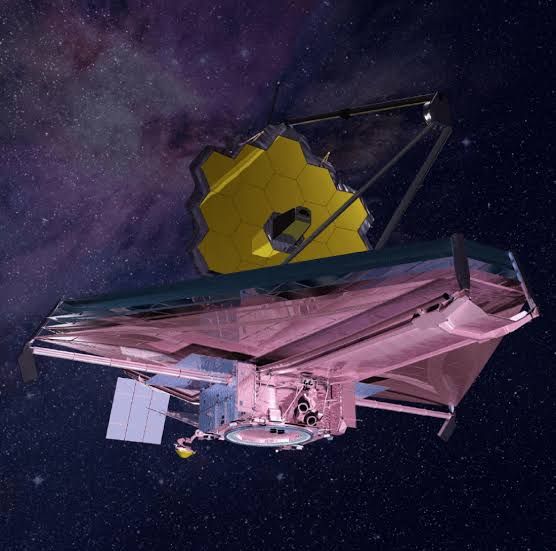
Webb uses a three-mirror anastigmat optical arrangement designed to produce sharply focused images across a wide field. Its primary mirror consists of 18 hexagonal beryllium segments coated with a thin layer of gold to improve infrared reflectivity. Together, the segments form a primary aperture approximately 6.5 m in diameter, with a clear collecting area of about 25 m².
The mirror was divided into segments because a rigid 6.5 m mirror could not fit inside the Ariane 5 payload fairing. Two side sections folded inward for launch and deployed in space. Motorized actuators position the segments with nanometer-scale precision so that they operate as a single optical surface. NIRCam also serves as a wavefront sensor during mirror alignment.
Sunshield and thermal control
A five-layer Kapton sunshield separates Webb's warm spacecraft systems from its telescope and scientific instruments. The deployed shield measures approximately 21.2 m by 14.2 m. Its reflective layers block heat and light from the Sun, Earth, and Moon, allowing the optical telescope to operate below approximately 50 K.
The observatory maintains the sunshield between the telescope and the major external heat sources. This orientation also supports stable optical alignment. MIRI requires a lower temperature than the other instruments and uses a dedicated cryocooler to reach approximately 7 K.
Spacecraft and orbit
Webb operates in a halo orbit around the Sun–Earth L2 region rather than orbiting Earth directly. This location permits the Sun, Earth, and Moon to remain on the same side of the observatory, simplifying thermal protection and providing a comparatively stable observing environment.
The spacecraft bus provides electrical power, communications, attitude control, command processing, data handling, and propulsion. Thrusters perform trajectory corrections, momentum management, and station-keeping. S-band communications support commands and telemetry, while Ka-band communications provide the principal science-data downlink.
Scientific instruments
The Integrated Science Instrument Module carries four principal instrument systems. Together, they provide imaging, spectroscopy, coronagraphy, precise guidance, and observations from long-wavelength visible light through the mid-infrared. Technical descriptions are provided by the ESA instrument overview.
- NIRCam: The Near-Infrared Camera covers approximately 0.6 to 5 μm. It is Webb's primary near-infrared imaging instrument and also supports mirror alignment, coronagraphy, and selected spectroscopic observations.
- NIRSpec: The Near-Infrared Spectrograph covers approximately 0.6 to 5 μm. Its multi-object spectroscopy mode can record spectra from many targets during one observation.
- MIRI: The Mid-Infrared Instrument combines imaging, spectroscopy, and coronagraphy over approximately 5 to 28.3 μm. Its cryocooler permits operation at temperatures lower than those of the near-infrared instruments.
- FGS/NIRISS: The Fine Guidance Sensor enables accurate pointing. The associated Near-Infrared Imager and Slitless Spectrograph provides imaging and spectroscopy, including modes intended for exoplanet observations.
Operational history
The Space Telescope Science Institute operates Webb's scientific program for NASA. Observation proposals are evaluated through a peer-review process, and calibrated data products are distributed through a scientific archive. ESA and CSA personnel also support mission operations.
Webb observes very distant objects whose visible and ultraviolet emissions have been shifted into the infrared by the expansion of the Universe. Infrared observations also penetrate some clouds of gas and dust more effectively than visible light, allowing the telescope to examine star-forming regions, protoplanetary disks, and obscured galactic nuclei.
The observatory has detected compact objects in the early Universe that are informally described as little red dots. Their physical nature remains under investigation. Research has examined whether some represent stages of galaxy and black-hole evolution and whether related systems may later develop structures associated with spiral galaxies. These interpretations remain subjects of continuing analysis rather than settled classifications.
Webb also studies stellar evolution, planetary-system formation, brown dwarfs, comets, minor planets, and exoplanet atmospheres. Spectroscopic measurements allow researchers to identify chemical signatures and investigate the physical conditions of distant astronomical objects.
Operators
- NASA: Leads the mission and manages the observatory through NASA Goddard Space Flight Center. The Space Telescope Science Institute conducts science operations.
- European Space Agency: Mission partner that supplied major instrument components, the launch vehicle, and operational support.
- Canadian Space Agency: Mission partner that supplied FGS/NIRISS and operational support.
Specifications (James Webb Space Telescope)
General characteristics
- Type: Space-based infrared astronomical observatory
- Principal contractor: Northrop Grumman
- Launch mass: Approximately 6,200 kg, including consumables and launch-vehicle adapter
- Launch date: 25 December 2021
- Launch vehicle: Ariane 5 ECA
- Operational location: Halo orbit around the Sun–Earth L2 region, approximately 1.5 million km from Earth
- Designed mission duration: 5 years, with a 10-year goal
Optics and thermal system
- Optical configuration: Three-mirror anastigmat
- Primary mirror diameter: Approximately 6.5 m
- Primary mirror: 18 gold-coated beryllium segments
- Clear collecting area: Approximately 25 m²
- Focal length: 131.4 m
- Wavelength coverage: Approximately 0.6 to 28.5 μm
- Optical resolution: Approximately 0.1 arcsecond
- Sunshield: Five layers, approximately 21.197 m by 14.162 m
- Telescope operating temperature: Below approximately 50 K
Instrument suite
- NIRCam: Near-infrared imaging, coronagraphy, spectroscopy, and wavefront sensing
- NIRSpec: Near-infrared single-object, integral-field, and multi-object spectroscopy
- MIRI: Mid-infrared imaging, spectroscopy, and coronagraphy
- FGS/NIRISS: Fine guidance, near-infrared imaging, and slitless spectroscopy
Additional contractor specifications are available from the Northrop Grumman technical overview.
Related equipment
- Hubble Space Telescope: A space observatory operating primarily at ultraviolet, visible, and near-infrared wavelengths. Webb complements and extends its work at longer infrared wavelengths.
- Spitzer Space Telescope: An earlier infrared space observatory whose scientific and technical experience influenced Webb's development.
 Argentina
 Armenia
 Australia
 Austria
 Austria-Hungary
 Belgium
 Brazil
 United Kingdom
 Brunei
 Bulgaria
 Canada
 Chile
Chile China
China Colonial America
 Colombia
 Confederate States
 Croatia
 Czech
Czech Denmark
 Egypt
Egypt Finland
 France
 Georgia
 Germany
 German Imperial
 Greece
 Holland
 Hungary
 India
India Indonesia
 Iran
Iran Iraq
Iraq Ireland
 Israel
 Italy
Italy Japan
Japan Japan (1940)
 Jordan
 Kingdom of Italy
 Malaysia
 Mexico
 Myanmar
 Nazi Germany
 Netherlands
 New Zealand
 North Korea
 Norway
 Pakistan
 Peru
Peru Philippines
 Poland
 Portugal
 Prussia
 Romania
 Russia
 Saudi Arabia
 Serbia
 Singapore
 Slovakia
 Slovenia
 South Africa
 South Korea
 Soviet Union
 Spain
Spain Sweden
 Switzerland
 Syria
Syria Taiwan
 Thailand
 Turkey
 UAE
UAE Ukraine
 Vietnam
 Yugoslavia