
History
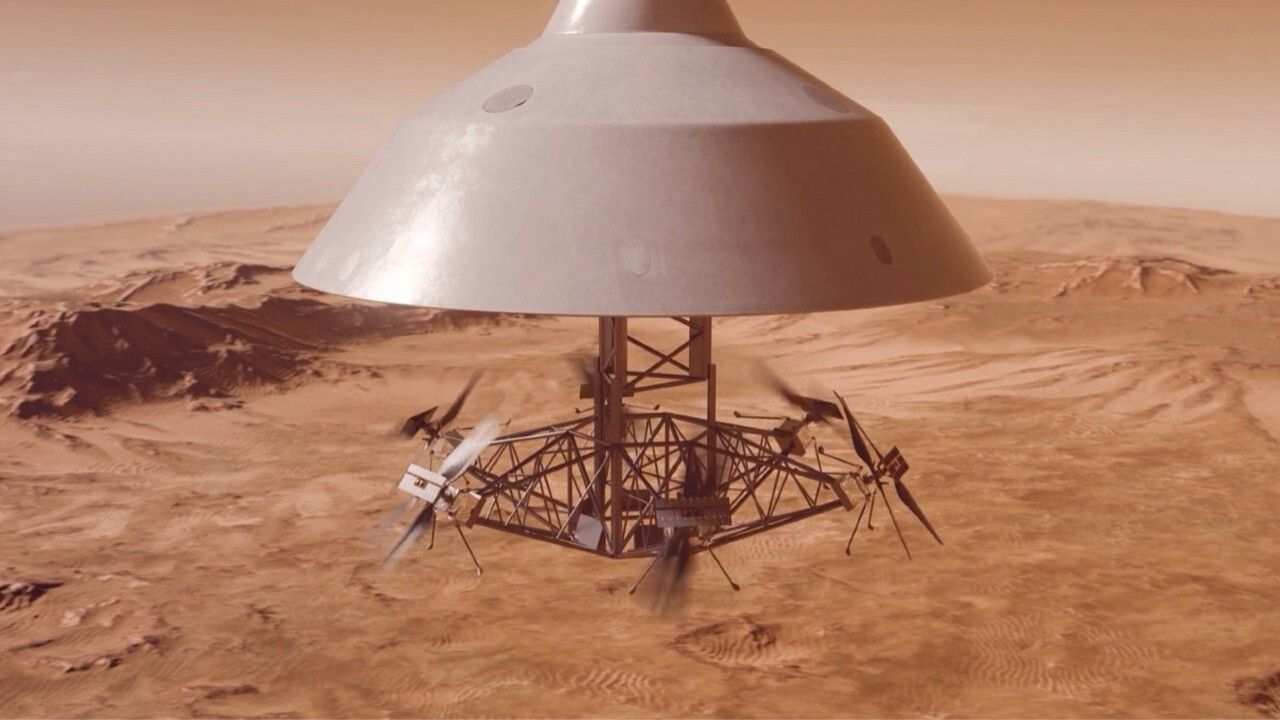
NASA SkyFall is a planned mission that will send three autonomous helicopters to Mars for scientific exploration and landing-site reconnaissance. The rotorcraft will map shallow subsurface ice, study terrain and weather, and collect environmental data relevant to future robotic and human missions.
SkyFall builds on the flight experience of NASA's Ingenuity Mars Helicopter. It adds a larger scientific payload, greater flight range, direct communications through Mars orbiters, and a proposed entry system that releases the helicopters while they are still descending through the atmosphere.
NASA plans to launch the mission in late 2028. After a cruise phase and an initial Mars flyby in 2029, the current mission plan calls for the helicopters to reach the surface following a second approach in autumn 2030.
Development
AeroVironment and NASA's Jet Propulsion Laboratory developed the original SkyFall concept as a successor to Ingenuity. A concept presented in July 2025 described six independently operated helicopters and a possible 2028 launch. The design proposed dispensing with a conventional lander by releasing the aircraft from their entry capsule during descent. Details of this early proposal were reported in the 2025 SkyFall concept report.
NASA formally announced SkyFall during its Ignition event on March 24, 2026. The official mission configuration was reduced to three helicopters. AeroVironment was selected to co-design and co-manufacture the aircraft with JPL. The companies had previously collaborated on Ingenuity, while later work on proposed Mars sample-retrieval helicopters helped increase rotor size, speed, and payload capacity.
The NASA SkyFall mission profile identifies scientific exploration and scouting as the mission's primary objectives. The landing site has not been selected. NASA plans to examine candidate regions through community workshops, with an emphasis on flat, low-elevation terrain that combines manageable hazards with scientifically useful subsurface features.
Rotor testing
NASA tested next-generation Mars helicopter rotors in JPL's 25-Foot Space Simulator. Engineers replaced the chamber atmosphere with low-pressure carbon dioxide to reproduce Martian conditions and exposed the rotating blades to simulated headwinds. The wider test program comprised 137 runs.
During March 2026 testing, a three-bladed experimental rotor reached a tip speed of Mach 1.08 and produced a reported 30 percent increase in lift capability. Engineers also tested the longer two-bladed SkyFall rotor at 3,570 rpm near the speed of sound before applying headwinds. The SkyFall design team incorporated the results into the aircraft's performance requirements. The campaign is described in JPL's rotor test report.
Radar antenna testing
Each helicopter's ground-penetrating radar uses a flexible Vivaldi antenna that extends below the aircraft. The antenna is longer than the landing gear and must bend when the helicopter touches down, then return to its working shape after takeoff. Engineers covered it with polyester and Vectran and reinforced its form with flexible fiberglass tape springs and a lightweight supporting structure.
The complete antenna weighs about 142 g (5 oz). During environmental testing, engineers repeatedly bent it, exposed it to extreme temperatures, and checked its ability to transmit and receive radar signals. It remained functional after 200 simulated Mars landings, more than twice the number then expected during the mission. The development team stated that further work was still required before the antenna could be flight-qualified. Its construction and test program were documented in the SkyFall antenna report.
Design
Airframe and rotors
SkyFall is an uncrewed coaxial rotorcraft derived from Ingenuity technology. It adapts elements of Ingenuity's structure, rotors, electric motors, landing gear, flight software, and autonomous navigation. The aircraft is larger and heavier than the 1.8 kg Ingenuity because it must carry radar, cameras, environmental sensors, and an independent communications system.
The helicopter has a planned height of 52 cm and a mass of 5 kg. Its fuselage measures approximately 24.5 cm long, 22 cm wide, and 21.5 cm high. The counter-rotating rotor blades have a stated diameter of 1.35 m. Large, rapidly rotating blades are required because atmospheric pressure at the Martian surface is only about one percent of Earth's surface pressure.
Autonomy and communications
Each SkyFall helicopter is intended to navigate and conduct flights autonomously. An ultra-low-mass direct-to-orbit radio will communicate through spacecraft orbiting Mars. Unlike Ingenuity, the helicopters will not require a rover or stationary lander to relay commands and scientific data.
Scientific instruments
The principal instrument is a compact ground-penetrating radar designed to distinguish layers of dust, rock, and ice. The official mission profile gives a nominal investigation depth of 0.5 to 3 m, with deeper penetration possible under favorable conditions. Earlier antenna reporting described a maximum design goal of approximately 5 m. Flying close to the surface allows the radar to examine shallow layers that are difficult to resolve from orbit.
The radar may also identify underground voids, lava tubes, and weak regolith layers that could present hazards to future landers. Data on the depth and extent of ice could support studies of Mars's climate history and the assessment of resources for water, oxygen, and propellant production.
A 13-megapixel color camera will collect overlapping images for centimeter-scale three-dimensional terrain maps. Near-infrared cameras will examine the composition of surface regolith. Temperature sensors and measurements made while hovering will characterize air temperature, wind speed, and wind direction at different elevations. A commercial microdosimeter derived from hardware flown on the Lunar Reconnaissance Orbiter will record ionizing-radiation exposure.
Radar antenna
The radar's lightweight Vivaldi antenna resembles a narrow fabric cape beneath the helicopter. It is approximately one and a half times longer than the landing legs. Its flexible construction allows it to move aside during landing, including when it contacts a rock, while tape springs restore its shape after takeoff. This arrangement permits a low antenna position without requiring additional ground clearance or a rigid structure vulnerable to impact.
Entry, descent, and landing
The planned SkyFall maneuver releases the three helicopters in mid-air instead of placing them on Mars with a conventional lander. A parachute and braking rockets will slow the descent stage. The rotorcraft will then separate, fly away, and land independently. The mission is planned for delivery by the Space Reactor-1 Freedom spacecraft, using a flight profile that includes Mars flybys before final deployment.
Program status
SkyFall remains a future mission under development. Launch is scheduled for late 2028, and surface arrival is planned for autumn 2030. The final landing region has not been selected, the flexible radar antenna had not yet completed flight qualification as of August 2026, and the mission plan remains subject to further engineering and program decisions.
NASA expects each helicopter to fly for about 2.5 minutes per sortie and cover approximately 1 to 2 km of ground. Operating as a group, the three aircraft are intended to spread outward from their deployment area and produce combined surface and subsurface maps more quickly than a conventional rover could cover the same region.
Specifications (NASA SkyFall Mars Helicopter)
General characteristics
- Type: Autonomous Mars exploration helicopter
- Mission quantity: Three helicopters
- Height: 52 cm
- Mass: 5 kg
- Fuselage dimensions: 24.5 × 22 × 21.5 cm
- Rotor arrangement: Counter-rotating rotors
- Rotor-blade diameter: 1.35 m
- Industry partner: AeroVironment
- Development authority: NASA Jet Propulsion Laboratory
Planned performance
- Flight duration: Approximately 2.5 minutes per sortie
- Ground distance per flight: Approximately 1 to 2 km
- Nominal radar depth: 0.5 to 3 m, with greater depth possible under favorable conditions
Equipment
- Subsurface sensor: Ground-penetrating radar with flexible Vivaldi antenna
- Visible imaging: 13-megapixel color camera
- Infrared imaging: Near-infrared surface-mapping camera
- Meteorological instruments: Air-temperature, wind-speed, and wind-direction sensing
- Radiation instrument: Microdosimeter
- Communications: Direct link through Mars-orbiting spacecraft
- Navigation: Autonomous flight and landing system
Related equipment
- NASA Ingenuity: The first aircraft to achieve powered, controlled flight on another planet and the principal technological predecessor of SkyFall.
- Mars Sample Retrieval Helicopter concept: An intermediate design effort that developed increased rotor and payload capability later applied to SkyFall.
 Argentina
 Armenia
 Australia
 Austria
 Austria-Hungary
 Belgium
 Brazil
 United Kingdom
 Brunei
 Bulgaria
 Canada
 Chile
Chile China
China Colonial America
 Colombia
 Confederate States
 Croatia
 Czech
Czech Denmark
 Egypt
Egypt Finland
 France
 Georgia
 Germany
 German Imperial
 Greece
 Holland
 Hungary
 India
India Indonesia
 Iran
Iran Iraq
Iraq Ireland
 Israel
 Italy
Italy Japan
Japan Japan (1940)
 Jordan
 Kingdom of Italy
 Malaysia
 Mexico
 Myanmar
 Nazi Germany
 Netherlands
 New Zealand
 North Korea
 Norway
 Pakistan
 Peru
Peru Philippines
 Poland
 Portugal
 Prussia
 Romania
 Russia
 Saudi Arabia
 Serbia
 Singapore
 Slovakia
 Slovenia
 South Africa
 South Korea
 Soviet Union
 Spain
Spain Sweden
 Switzerland
 Syria
Syria Taiwan
 Thailand
 Turkey
 UAE
UAE Ukraine
 Vietnam
 Yugoslavia