
History
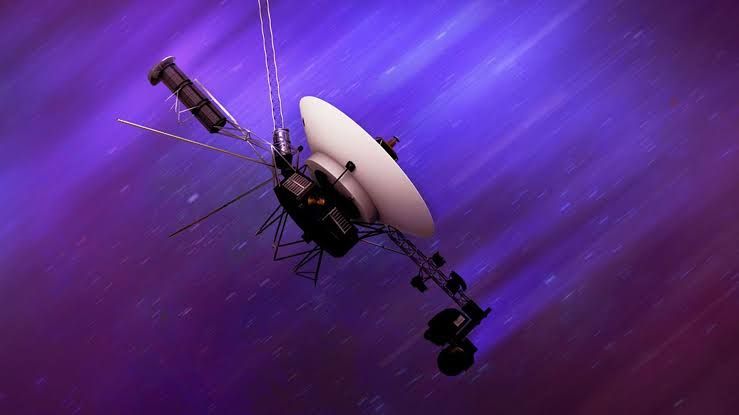
NASA/JPL Voyager 2 is an uncrewed deep-space probe developed to explore the outer Solar System. It completed close-range studies of Jupiter, Saturn, Uranus, and Neptune before beginning an extended interstellar mission.
Voyager 2 remains the only spacecraft to have visited Uranus and Neptune. It crossed the heliopause in 2018 and continues to transmit measurements from interstellar space.
Launched in 1977, the probe has operated far beyond its original five-year mission expectation. NASA and the Jet Propulsion Laboratory have progressively reduced its electrical load to preserve communications and scientific observations.
Development and launch
The mission emerged from studies of a rare alignment of the outer planets during the late 1970s. This alignment allowed a spacecraft to travel between planets with gravity assists, using each encounter to alter its trajectory and increase its speed.
NASA reduced its earlier Grand Tour concept to a pair of Mariner-derived spacecraft intended initially for Jupiter and Saturn. Voyager 2 followed a trajectory that preserved the option of continuing to Uranus and Neptune after completing the first two encounters.
The Jet Propulsion Laboratory constructed Voyager 2 and manages the mission for NASA. The spacecraft launched from Cape Canaveral Launch Complex 41 on 20 August 1977 aboard a Titan IIIE-Centaur launch vehicle. The NASA mission profile identifies its objectives as flybys of Jupiter, Saturn, Uranus, and Neptune, followed by exploration of interstellar space.
Planetary encounters
Voyager 2 passed Jupiter in July 1979. The encounter returned observations of the planet, its rings, magnetic environment, and moons. NASA credits the spacecraft with discovering an additional moon of Jupiter.
The probe reached Saturn in August 1981. After the successful Jupiter and Saturn encounters, NASA extended its flight toward the ice giants. Voyager 2 passed Uranus on 24 January 1986, becoming the first spacecraft to visit that planet. It discovered ten moons and two rings during the encounter.
Voyager 2 passed Neptune on 25 August 1989. It became the first spacecraft to visit Neptune and observed the planet, its rings, magnetic environment, and moons, including Triton. NASA credits the mission with discovering five moons, four rings, and Neptune's Great Dark Spot. Its encounters with Uranus and Neptune remain unique in planetary exploration, as discussed in a mission retrospective.
Interstellar mission
After the Neptune encounter, Voyager 2 began the Voyager Interstellar Mission. It crossed the termination shock in 2007 and passed through the heliopause in November 2018. The heliopause is the outer boundary of the heliosphere, where the influence of the solar wind gives way to the interstellar environment.
Voyager 2 became the second spacecraft, after Voyager 1, to enter interstellar space. Its instruments began making direct measurements of plasma, energetic particles, cosmic rays, magnetic fields, and plasma waves beyond the heliopause.
Design
Spacecraft structure and attitude control
Voyager 2 uses a decagonal spacecraft bus with several instrument booms and a large dish antenna. It is three-axis stabilized, allowing controllers to maintain the orientation of the antenna and scientific instruments without spinning the complete spacecraft.
The attitude and articulation control system originally used gyroscopes, a Sun sensor, a Canopus star tracker, and redundant control equipment. Sixteen Aerojet MR-103 hydrazine thrusters provide attitude control and trajectory correction. The thrusters receive propellant from a spherical titanium tank that held approximately 100 kg of hydrazine at launch.
Electrical power
Three multihundred-watt radioisotope thermoelectric generators produce electricity from heat released by the decay of plutonium-238. Together they generated approximately 470 W at launch. Their output declines over time, reducing the power available to instruments, heaters, communications equipment, and spacecraft systems.
Mission controllers have turned off equipment gradually as the available electrical margin has decreased. This process must preserve enough heat to prevent damage to propulsion lines and other temperature-sensitive components.
Communications and data storage
A 3.7 m high-gain parabolic antenna communicates with NASA's Deep Space Network over S-band and X-band radio links. The spacecraft's increasing distance causes the received signal strength and available data rate to decline.
A digital tape recorder could store approximately 64 MB of data for later transmission when immediate communication was unavailable. Voyager 2 now communicates principally through the Deep Space Network antenna near Canberra, Australia. By 2026, a command required nearly 20 hours to reach the spacecraft, followed by a similar delay before its response reached Earth.
Scientific instruments
The original payload included the Imaging Science System, Radio Science System, infrared interferometer spectrometer and radiometer, ultraviolet spectrometer, magnetometer, plasma spectrometer, Low Energy Charged Particle instrument, Cosmic Ray System, Planetary Radio Astronomy investigation, Photopolarimeter System, and Plasma Wave Subsystem.
Several instruments completed their work during the planetary phase or were later disabled because of faults, operational changes, or declining electrical power. By August 2026, the magnetometer, Cosmic Ray System, and Plasma Wave Subsystem remained in scientific use.
Operational history
Power conservation
NASA ended data-tape-recorder operations in 2007 and terminated the planetary radio astronomy experiment in 2008. Controllers moved to backup thrusters in 2011 to conserve resources.
The plasma science instrument was switched off in September 2024. NASA then turned off the Low Energy Charged Particle instrument in March 2025, leaving three instruments operating.
During 2025 and 2026, JPL engineers prepared a power-reduction procedure informally called the Big Bang. Tests conducted in May and June 2026 examined its electrical and thermal effects. The procedure was implemented on 9 July 2026.
Controllers simultaneously turned off two dedicated heaters and the digital tape recorder, which had remained powered partly for the heat it produced. They activated two alternative heaters and another heat-producing device that consumed less electricity. The spacecraft's software was subsequently updated so that the lower-power configuration would become its default state after entry into safe mode.
The change preserved enough power to operate all three remaining science instruments for at least another year. Reports from Space.com and CNN described the operation after NASA confirmed its success.
Status in 2026
Voyager 2 remained an active extended mission in August 2026 at a distance of approximately 21.35 billion km from Earth. It continued to return scientific information while traveling through interstellar space. Its increasing distance, declining electrical output, thermal condition, and remaining hydrazine determine how long useful operations can continue.
Specifications (Voyager 2)
General characteristics
- Type: Uncrewed planetary and interstellar space probe
- Manufacturer: Jet Propulsion Laboratory
- Operator: NASA/JPL
- Launch mass: 721.9 kg (1,592 lb)
- Launch date: 20 August 1977
- Launch vehicle: Titan IIIE-Centaur
- Launch site: Cape Canaveral Launch Complex 41
Power and propulsion
- Electrical power at launch: Approximately 470 W
- Power source: Three multihundred-watt radioisotope thermoelectric generators
- Attitude-control propulsion: Sixteen Aerojet MR-103 hydrazine thrusters
- Hydrazine at launch: Approximately 100 kg (220 lb)
- Stabilization: Three-axis stabilization
Communications and storage
- High-gain antenna diameter: 3.7 m (12 ft)
- Radio bands: S-band and X-band
- Ground network: NASA Deep Space Network
- Digital tape-recorder capacity: Approximately 64 MB
Active scientific instruments in August 2026
- MAG: Triaxial Fluxgate Magnetometer
- CRS: Cosmic Ray System
- PWS: Plasma Wave Subsystem
 Argentina
 Armenia
 Australia
 Austria
 Austria-Hungary
 Belgium
 Brazil
 United Kingdom
 Brunei
 Bulgaria
 Canada
 Chile
Chile China
China Colonial America
 Colombia
 Confederate States
 Croatia
 Czech
Czech Denmark
 Egypt
Egypt Finland
 France
 Georgia
 Germany
 German Imperial
 Greece
 Holland
 Hungary
 India
India Indonesia
 Iran
Iran Iraq
Iraq Ireland
 Israel
 Italy
Italy Japan
Japan Japan (1940)
 Jordan
 Kingdom of Italy
 Malaysia
 Mexico
 Myanmar
 Nazi Germany
 Netherlands
 New Zealand
 North Korea
 Norway
 Pakistan
 Peru
Peru Philippines
 Poland
 Portugal
 Prussia
 Romania
 Russia
 Saudi Arabia
 Serbia
 Singapore
 Slovakia
 Slovenia
 South Africa
 South Korea
 Soviet Union
 Spain
Spain Sweden
 Switzerland
 Syria
Syria Taiwan
 Thailand
 Turkey
 UAE
UAE Ukraine
 Vietnam
 Yugoslavia