History
MTG-I2, the second Meteosat Third Generation Imager satellite, is a European geostationary weather satellite developed through the European Space Agency for EUMETSAT and built by a European industrial consortium led by Thales Alenia Space. It is designed to provide frequent high-resolution observations for weather forecasting, severe-weather monitoring and climate-related applications over Europe and northern Africa.
MTG-I2 carries the Flexible Combined Imager and Lightning Imager. After commissioning, it is intended to provide the Meteosat Third Generation rapid scan service, producing new observations over Europe and northern Africa every 2.5 minutes. Together with the first MTG imaging satellite and the MTG sounding satellite, it completes the first three-spacecraft MTG system.
The satellite was launched by an Ariane 6 on 27 August 2026 and placed into geostationary transfer orbit. Following separation, communications with the spacecraft were established and preparations began for orbit raising and commissioning before operational service.
Development and testing
The Meteosat Third Generation programme continues the meteorological services previously provided by the Meteosat Second Generation satellites. ESA developed the MTG satellites with European industry to requirements established by EUMETSAT in consultation with the meteorological services of its member states. According to the ESA launch announcement, the industrial consortium was led by Thales Alenia Space, with OHB System in Germany and Leonardo in Italy as principal partners.
In September 2025, the Flexible Combined Imager and Lightning Imager were mounted on the MTG-I2 platform at Thales Alenia Space in Cannes. The completed spacecraft subsequently underwent thermal-vacuum testing. Its final environmental tests were completed in March 2026 and were followed by spacecraft health checks. In April 2026, MTG-I2 was displayed during a media event at the Thales Alenia Space facility in Cannes.
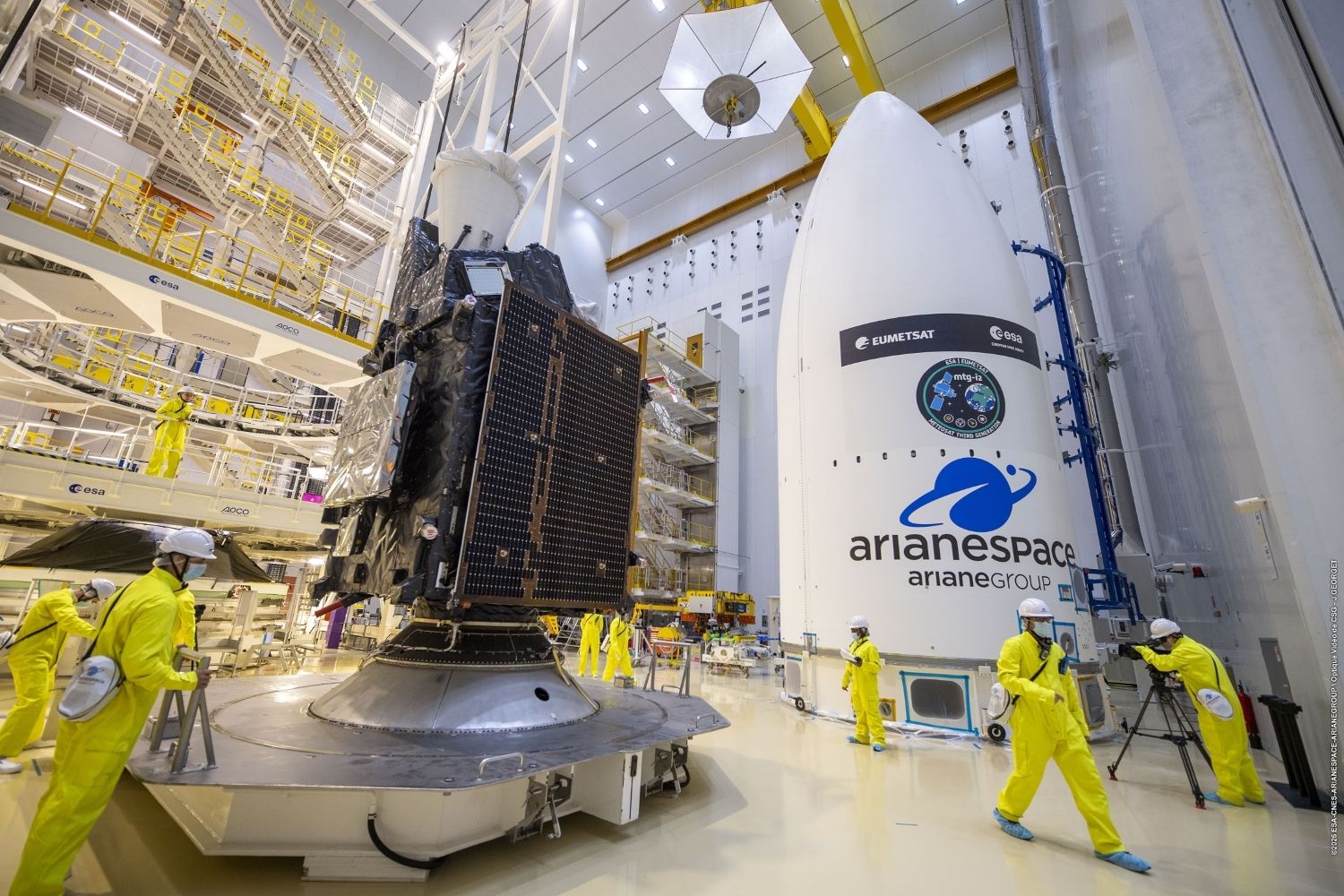
The spacecraft was transported to the Guiana Space Centre in French Guiana for launch preparations. It was removed from its protective casing at the spaceport on 6 July 2026. Preparations included inspection, propellant loading, a fit check with the launch vehicle adapter and encapsulation inside the Ariane 6 payload fairing. ESA documented these final preparations in its pre-launch report.
Launch
MTG-I2 launched from Europe's Spaceport in French Guiana on 27 August 2026 aboard Ariane 6 flight VA270. ESA reported liftoff at 22:11 CEST, or 20:11 UTC. Ariane 6 flew in its two-booster configuration and delivered MTG-I2 toward geostationary transfer orbit. The launch was Ariane 6's ninth mission and its first mission carrying a satellite to geostationary transfer orbit.
The launcher released the approximately 3,800 kg satellite into geostationary transfer orbit about 36 minutes after liftoff. Communication with MTG-I2 was established immediately after separation through the Malindi ground station. ESA also documented the mission in its MTG-I2 launch material.
Design
MTG-I2 is an imaging spacecraft of the Meteosat Third Generation system. It is intended to operate from geostationary orbit approximately 36,000 km above Earth, where its orbital motion can remain synchronized with Earth's rotation and allow continuous observation of the same broad geographic region.
The spacecraft is part of a three-satellite operational architecture comprising two imaging satellites and one sounding satellite. MTG-I2 provides a second imaging spacecraft, adding continuity and operational resilience to the system. EUMETSAT states that the full MTG configuration allows observation of the lifecycle of rapidly developing convective storms using complementary imaging and atmospheric sounding data. The mission concept is described by EUMETSAT.
Flexible Combined Imager
The Flexible Combined Imager, or FCI, is the principal imaging instrument aboard MTG-I2. It supports different scanning modes and is intended to provide the rapid scan service over Europe and northern Africa. This service produces updated high-resolution observations every 2.5 minutes.
The rapid repeat cycle is intended to improve monitoring of fast-developing weather systems. EUMETSAT identifies thunderstorms, dense fog and dust plumes among the phenomena that can be observed. The organisation also states that the 2.5-minute rapid scan service is twice as fast as the service provided by Meteosat-11. The instrument can also scan its broader view of Earth in about 10 minutes.
Lightning Imager
The Lightning Imager, or LI, continuously monitors lightning activity by day and night. From geostationary orbit it can observe lightning over a large portion of the visible Earth disk. The instrument is intended to support short-term forecasting, or nowcasting, of rapidly evolving weather conditions.
Data from the Lightning Imager can be combined with other Meteosat Third Generation observations to improve understanding of developing storms. ESA describes a future MTG weather-cube product that combines imager and sounder data to form three-dimensional representations of phenomena including lightning, winds, internal cloud dynamics and selected atmospheric gases.
Mission applications
MTG-I2 observations are intended to support weather forecasting, early warning and climate monitoring. The rapid imagery is particularly relevant to severe weather developing over short timescales. Applications identified by ESA and EUMETSAT include monitoring thunderstorms, fog, wildfires, atmospheric pollution and other rapidly changing conditions.
The data also support aviation safety by helping meteorological services track hazardous weather. Other stated applications of the wider Meteosat system include hydrology, agriculture, environmental studies, disaster warning and risk prevention.
Program status
Following launch, MTG-I2 entered its launch and early operations phase rather than immediate operational service. The spacecraft was required to deploy its solar arrays, activate its attitude-control systems and conduct a series of propulsion manoeuvres to raise its orbit from the initial geostationary transfer orbit toward its final geostationary position.
ESA stated after launch that the orbit-raising sequence was expected to take about two weeks. Once the spacecraft reaches its final orbit and is correctly oriented toward Earth, it is scheduled to proceed into commissioning. EUMETSAT will operate MTG-I2 after commissioning and distribute its meteorological data to users.
MTG-I2 joins MTG-I1, launched in December 2022, and the MTG sounding satellite launched in July 2025. The first two spacecraft were already commissioned and transferred to EUMETSAT operational service before the launch of MTG-I2. The second imaging satellite is intended to complete the first three-satellite MTG configuration and allow the system to operate at full capacity after its own commissioning.
MTG-I2 is also known as Meteosat-14 according to the MTG-I2 reference entry. ESA states that the spacecraft is expected to remain in orbit for at least eight and a half years.
Specifications (MTG-I2)
General characteristics
- Type: Geostationary meteorological imaging satellite
- Programme: Meteosat Third Generation
- Operator after commissioning: EUMETSAT
- Development authority: European Space Agency
- Prime industrial contractor: Thales Alenia Space-led European consortium
- Launch mass: approximately 3,800 kg
- Launch date: 27 August 2026
- Launch vehicle: Ariane 6, flight VA270
- Initial deployment orbit: Geostationary transfer orbit
- Planned operational orbit: Geostationary orbit, approximately 36,000 km above Earth
- Expected time in orbit: at least eight and a half years
Payload
- Flexible Combined Imager: Multi-mode imaging instrument used for rapid observations of Europe and northern Africa
- Lightning Imager: Instrument for continuous observation of lightning by day and night
Observation capability
- Rapid scan repeat cycle: 2.5 minutes over Europe and northern Africa
- Broader Earth-view scan: approximately 10 minutes
 Argentina
 Armenia
 Australia
 Austria
 Austria-Hungary
 Belgium
 Brazil
 United Kingdom
 United States
 Brunei
 Bulgaria
 Canada
 Chile
Chile China
China Colonial America
 Colombia
 Confederate States
 Croatia
 Czech
Czech Denmark
 Egypt
Egypt Finland
 France
 Georgia
 Germany
 German Imperial
 Greece
 Holland
 Hungary
 India
India Indonesia
 Iran
Iran Iraq
Iraq Ireland
 Israel
 Italy
Italy Japan
Japan Japan (1940)
 Jordan
 Kingdom of Italy
 Malaysia
 Mexico
 Myanmar
 Nazi Germany
 Netherlands
 New Zealand
 North Korea
 Norway
 Pakistan
 Peru
Peru Philippines
 Poland
 Portugal
 Prussia
 Romania
 Russia
 Saudi Arabia
 Serbia
 Singapore
 Slovakia
 Slovenia
 South Africa
 South Korea
 Soviet Union
 Spain
Spain Sweden
 Switzerland
 Syria
Syria Taiwan
 Thailand
 Turkey
 UAE
UAE Ukraine
 Vietnam
 Yugoslavia