History
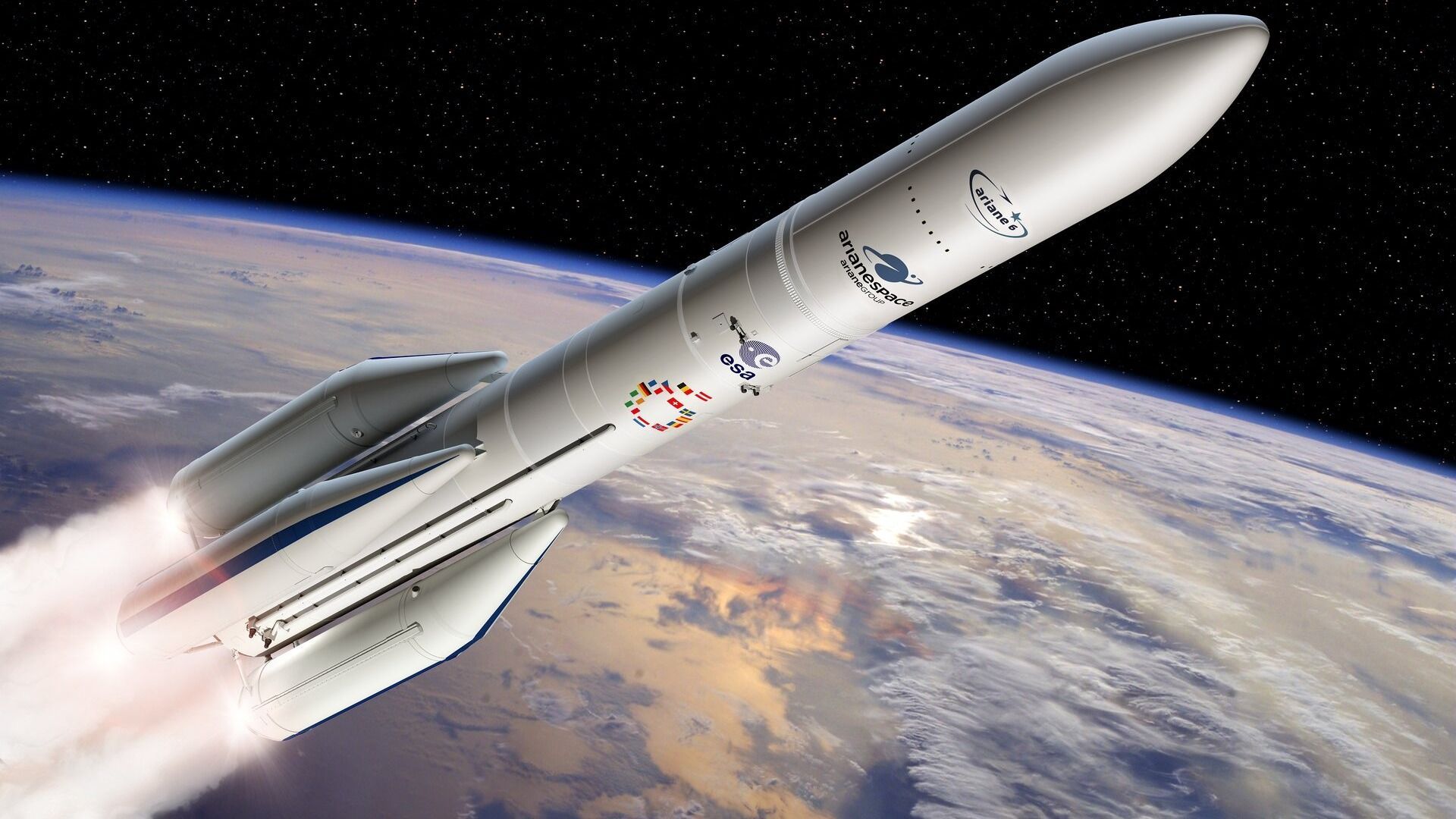
Ariane 6 is a European expendable orbital launch vehicle developed under the authority of the European Space Agency, with ArianeGroup serving as prime contractor and Arianespace operating the launcher. It was created as the successor to Ariane 5 and is intended to provide Europe with independent access to space while supporting institutional and commercial missions.
The launcher is offered in two configurations. Ariane 62 uses two solid rocket boosters, while Ariane 64 uses four. This modular arrangement allows the same launch system to address missions ranging from lighter payloads to heavy spacecraft and multi-satellite deployments.
Ariane 6 made its maiden flight on 9 July 2024 from Europe's Spaceport in French Guiana. By 27 August 2026, it had completed nine launches, including its first mission to geostationary transfer orbit.
Development
The decision to begin development of Ariane 6 was taken at the ESA Council at Ministerial level in December 2014. According to the ESA Ariane 6 overview, the program was intended to respond to changes in the commercial launch market while maintaining European independence in access to space. Development involved an industrial network of several hundred companies in 13 European countries led by ArianeGroup.
The program adopted a two-configuration architecture instead of separate launch vehicles for medium and heavy missions. Ariane 62 was designed around two P120C solid boosters and Ariane 64 around four. Both versions use a cryogenic main stage powered by the Vulcain 2.1 engine and a cryogenic upper stage powered by the reignitable Vinci engine.
Major propulsion elements were qualified before the first orbital mission. Final Vinci qualification tests were completed in October 2018 after an extensive firing program. Vulcain 2.1 completed its qualification process in 2019. The P120C booster completed its final qualification firing at Europe's Spaceport in October 2020.
The first Ariane 6 launch was originally expected earlier, but the program experienced repeated schedule delays. The maiden flight ultimately took place on 9 July 2024 from the Guiana Space Centre at Kourou. The mission deployed several payloads, although an anomaly affecting the upper-stage auxiliary power unit prevented the planned final deorbit burn. The flight nevertheless demonstrated the core propulsion system, upper-stage restart capability during the main mission sequence, and payload deployment.
The second Ariane 6 launch took place on 6 March 2025 and successfully delivered the CSO-3 reconnaissance satellite to orbit. Subsequent missions expanded the launcher's operational record.
2026 MTG-I2 mission
On 27 August 2026, an Ariane 62 launched the 3,800 kg MTG-I2 weather satellite from Kourou. The upper stage released MTG-I2 into geostationary transfer orbit about 36 minutes after liftoff. The flight was Ariane 6's ninth mission and its first mission carrying a payload toward geostationary orbit.
MTG-I2 is part of the Meteosat Third Generation weather satellite system. The mission demonstrated the launcher's ability to perform a geostationary transfer mission in addition to the low- and medium-Earth-orbit missions flown previously. Arianespace was targeting seven to eight Ariane 6 launches during 2026 and planned to increase the annual rate to nine or ten launches in 2027.
Design
Ariane 6 is a modular, two-stage cryogenic launch vehicle supplemented by either two or four solid rocket boosters. ESA describes the launcher as more than 60 m tall, while published launch-vehicle data gives a height of about 63 m. The central core has a diameter of 5.4 m.
Lower stage and boosters
The lower liquid propulsion module uses liquid hydrogen and liquid oxygen and is powered by a single Vulcain 2.1 engine. Vulcain 2.1 is derived from the Vulcain 2 engine used on Ariane 5. Published technical data gives the engine a vacuum thrust of approximately 1,371 kN and a specific impulse of about 432 seconds.
Solid P120C boosters provide additional thrust during the initial phase of flight. Ariane 62 carries two boosters and Ariane 64 carries four. Each P120C is approximately 13.5 m long and 3.4 m in diameter and contains about 142,000 kg of solid propellant. Published data gives an average thrust of about 4,500 kN, a maximum thrust of about 4,650 kN, and a burn time of approximately 135 seconds.
The P120C design uses a carbon-fibre structural casing and is related to the booster technology used for Europe's Vega C launcher. Sharing the booster family between launch systems was intended to support common production infrastructure.
Upper stage
The upper liquid propulsion module is powered by a single Vinci cryogenic engine using liquid oxygen and liquid hydrogen. Vinci can be restarted in flight, allowing the upper stage to conduct multiple burns during one mission. This capability supports deployment of payloads into different target orbits and permits a final disposal burn when mission conditions allow.
Published technical data gives Vinci a vacuum thrust of approximately 180 kN and a specific impulse of about 457 seconds. The upper stage carries approximately 31,000 kg of cryogenic propellant.
Payload system
Ariane 6 can carry single spacecraft, multiple spacecraft, rideshare payloads and constellation deployments. ESA states that payload carriers can accommodate small satellites below 200 kg alongside a primary payload.
The payload fairing is 5.4 m in diameter and is available in approximately 14 m and 20 m lengths. It is made from a carbon-fibre polymer composite and protects spacecraft from aerodynamic, thermal and acoustic loads during ascent.
Launch infrastructure
Ariane 6 operates from a dedicated launch complex at Europe's Spaceport in French Guiana, approximately 4 km west of the former Ariane 5 launch pad. CNES built and operates the Ariane 6 launch facilities. The launcher's main stages are integrated horizontally before transfer to the launch zone.
The launch complex includes a mobile gantry approximately 90 m high, a launch table, exhaust tunnels, lightning-protection masts and a water-deluge system. The site's location near 5 degrees north latitude allows eastward launches to benefit from Earth's rotational velocity.
Operational history
Ariane 6 entered flight operations with its maiden mission in July 2024. The first flight deployed its primary orbital payloads but did not complete the planned final upper-stage disposal maneuver because of an auxiliary power unit anomaly.
The following mission in March 2025 successfully delivered the CSO-3 satellite. Ariane 6 subsequently carried additional institutional and commercial payloads, including broadband satellite missions.
By 27 August 2026, Ariane 6 had flown nine times. Four of those missions took place during 2026 before the end of August, including three launches carrying Amazon broadband satellites and the MTG-I2 weather mission. The MTG-I2 flight was the first Ariane 6 mission to deliver a payload into geostationary transfer orbit.
Variants
- Ariane 62: Configuration using two P120C solid rocket boosters. ESA gives a payload capability of approximately 10.3 tonnes to low Earth orbit and 4.5 tonnes to geostationary transfer orbit.
- Ariane 64: Configuration using four P120C solid rocket boosters for heavier missions. ESA gives a payload capability of approximately 21.6 tonnes to low Earth orbit and 11.5 tonnes to geostationary transfer orbit.
Specifications (Ariane 62)
General characteristics
- Height: approximately 63 m
- Core diameter: 5.4 m
- Solid boosters: 2 P120C
- Main-stage engine: 1 Vulcain 2.1
- Upper-stage engine: 1 Vinci
- Propellants, liquid stages: liquid oxygen and liquid hydrogen
Payload performance
- Low Earth orbit payload: approximately 10.3 tonnes
- Geostationary transfer orbit payload: approximately 4.5 tonnes
Specifications (Ariane 64)
General characteristics
- Height: approximately 63 m
- Core diameter: 5.4 m
- Solid boosters: 4 P120C
- Main-stage engine: 1 Vulcain 2.1
- Upper-stage engine: 1 Vinci
- Propellants, liquid stages: liquid oxygen and liquid hydrogen
Payload performance
- Low Earth orbit payload: approximately 21.6 tonnes
- Geostationary transfer orbit payload: approximately 11.5 tonnes
Related equipment
- Ariane 5: European launch vehicle directly succeeded by Ariane 6.
- Vega C: European launch vehicle that shares the P120C solid-booster family with Ariane 6.
 Argentina
 Armenia
 Australia
 Austria
 Austria-Hungary
 Belgium
 Brazil
 United Kingdom
 United States
 Brunei
 Bulgaria
 Canada
 Chile
Chile China
China Colonial America
 Colombia
 Confederate States
 Croatia
 Czech
Czech Denmark
 Egypt
Egypt Finland
 France
 Georgia
 Germany
 German Imperial
 Greece
 Holland
 Hungary
 India
India Indonesia
 Iran
Iran Iraq
Iraq Ireland
 Israel
 Italy
Italy Japan
Japan Japan (1940)
 Jordan
 Kingdom of Italy
 Malaysia
 Mexico
 Myanmar
 Nazi Germany
 Netherlands
 New Zealand
 North Korea
 Norway
 Pakistan
 Peru
Peru Philippines
 Poland
 Portugal
 Prussia
 Romania
 Russia
 Saudi Arabia
 Serbia
 Singapore
 Slovakia
 Slovenia
 South Africa
 South Korea
 Soviet Union
 Spain
Spain Sweden
 Switzerland
 Syria
Syria Taiwan
 Thailand
 Turkey
 UAE
UAE Ukraine
 Vietnam
 Yugoslavia