
History
Long March 12 and Long March 2C are Chinese orbital launch vehicles developed in different periods for satellite missions. Long March 2C is an established member of China's older hypergolic Long March 2 family, while Long March 12 is a larger new-generation kerosene and liquid-oxygen launcher.
The two vehicles are not variants of one design. They share the Long March name and operation within China's state space sector, but differ in dimensions, propellants, engines, payload capacity, and development lineage.
Both launchers remained active in 2026. A Long March 12 placed another group of Guowang satellite-internet spacecraft into orbit, while a separate Long March 2C mission carried a developmental satellite for the United Arab Emirates.
Long March 2C development
Long March 2C emerged from the Long March 2 line, whose early designs ultimately developed from Chinese ballistic-missile technology. The requirements of orbital launch later produced a dedicated space-launch family with mission-specific upper stages and payload systems.
The first Long March 2C launch took place on 9 September 1982. The vehicle became a long-serving platform for low Earth and Sun-synchronous-orbit missions from the Jiuquan, Taiyuan, and Xichang launch centres. Mission kits and optional upper stages expanded the range of orbits available to the basic two-stage launcher.
Long March 2C also supported international and commercial missions. During the 1990s, the Long March 2C/SD configuration launched Iridium communications satellites in paired payloads, illustrating the vehicle's use with a mission-specific dispenser.
Long March 12 development
The China Aerospace Science and Technology Corporation disclosed Long March 12 in its February 2024 program plan. The Shanghai Academy of Spaceflight Technology developed the medium-lift launcher with a 3.8 m core diameter, the largest diameter then used by a Chinese single-core launch vehicle without side boosters.
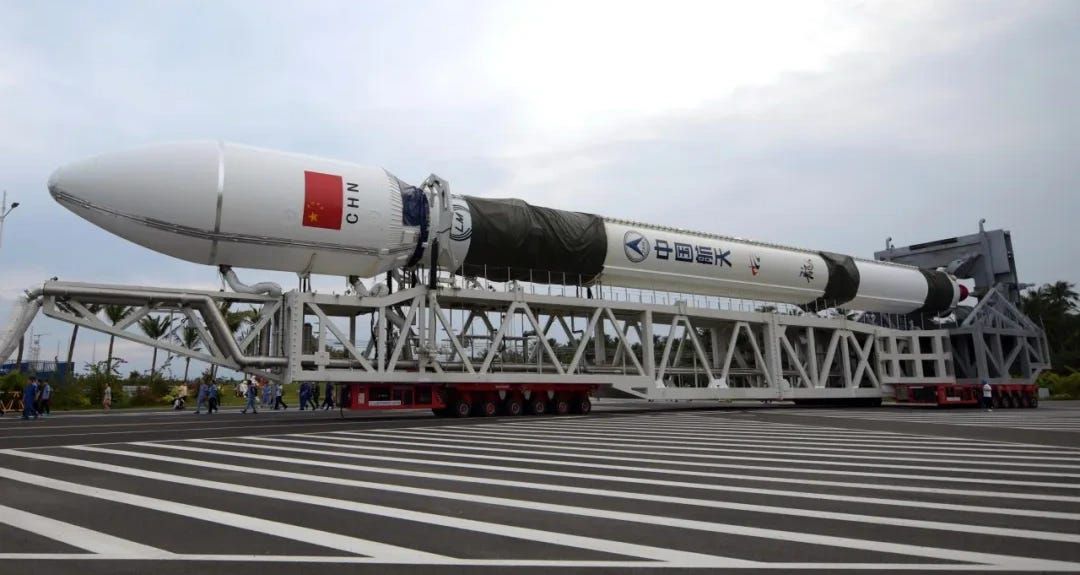
Long March 12 made its first flight on 30 November 2024 from Launch Complex 2 at the new Wenchang Commercial Space Launch Site. It successfully placed two technology-test satellites into orbit. The mission was also the first orbital flight of the YF-100K engine and the first launch from the commercial Wenchang complex.
The launcher subsequently supported deployment of China's Guowang low Earth orbit satellite constellation. Its 4.2 m or 5.2 m payload-fairing options provide substantially more payload volume than older medium-lift vehicles. Contemporary reporting by SpaceNews described the maiden flight and the vehicle's role in expanding Chinese launch capacity.
Design
Long March 2C
The standard Long March 2C is an expendable two-stage launch vehicle. Both stages use unsymmetrical dimethylhydrazine fuel and nitrogen tetroxide oxidizer. These storable hypergolic propellants ignite on contact and permit a mature, relatively simple propulsion system, but they are toxic and require careful handling.
Different mission designations identify payload adapters, dispensers, and upper stages rather than a single unchanging configuration. The YZ-1S version, for example, adds an upper stage and is therefore a three-stage stack. Performance and dimensions must be associated with the exact mission configuration.
Long March 12
Long March 12 is a two-stage, 3.8 m-diameter vehicle using rocket-grade kerosene and liquid oxygen in both stages. Four YF-100K engines power the first stage and together produce approximately 5,000 kN of liftoff thrust. Two YF-115 engines power the second stage with approximately 360 kN combined thrust.
The basic rocket is approximately 62 m tall and has a launch mass of about 430 to 433 tonnes. Published capacity is up to 12,000 kg to a 200 km low Earth orbit, 10,000 kg to a 300 km low Earth orbit, or 6,000 kg to a 700 km Sun-synchronous orbit. Mission performance varies with trajectory and fairing configuration.
The YF-100K is related to engines used across China's newer liquid-propellant launch vehicles and contributes technology to the Long March 10 lunar launcher program. Long March 12 itself is an uncrewed satellite launcher and is not described as human-rated.
Operational history
Long March 2C missions
Long March 2C has operated since 1982 across several Chinese launch sites. It has carried domestic remote-sensing and scientific spacecraft, constellation payloads, and international satellites. Optional upper stages allow payload delivery beyond the capability of the standard two-stage configuration.
In August 2026, a Long March 2C carried a developmental satellite for the United Arab Emirates. This mission occurred separately from the Long March 12 Guowang launch and demonstrated the continued use of the older vehicle alongside China's new-generation rockets.
Long March 12 missions
After its successful 2024 debut, the basic Long March 12 entered a series of low Earth orbit missions, including launches for the Guowang satellite-internet constellation. A further batch was launched in August 2026. The vehicle's combination of payload capacity, large fairings, and access to the commercial Wenchang site is suited to multi-satellite constellation deployment.
Variants
Long March 2C configurations
- Long March 2C — the standard two-stage hypergolic launch vehicle.
- Long March 2C/SD — a configuration developed with a satellite dispenser for paired Iridium launches.
- Long March 2C/SM and SMA — mission configurations incorporating additional orbital-delivery equipment.
- Long March 2C/YZ-1S — a three-stage configuration using the Yuanzheng-1S upper stage.
Long March 12 variants
- Long March 12 — the expendable two-stage kerosene and liquid-oxygen vehicle first flown in 2024.
- Long March 12A — a related 3.8 m-diameter reusable-first-stage development using methane and liquid oxygen; its first flight reached orbit in December 2025, but the initial recovery attempt was unsuccessful.
- Long March 12B — a larger 4.37 m-diameter commercial variant whose first flight occurred in June 2026; the first mission did not attempt stage recovery.
Specifications (Long March 12)
General characteristics
- Type: two-stage medium-lift orbital launch vehicle
- Manufacturer: Shanghai Academy of Spaceflight Technology
- Height: approximately 62 m
- Diameter: 3.8 m
- Launch mass: approximately 430–433 tonnes
- First stage: four YF-100K engines using kerosene and liquid oxygen
- Second stage: two YF-115 engines using kerosene and liquid oxygen
- Payload fairing: 4.2 m or 5.2 m diameter
Performance
- Payload to 200 km low Earth orbit: up to 12,000 kg
- Payload to 300 km low Earth orbit: up to 10,000 kg
- Payload to 700 km Sun-synchronous orbit: up to 6,000 kg
- Liftoff thrust: approximately 5,000 kN
Specifications (Long March 2C/YZ-1S)
General characteristics
- Type: three-stage expendable orbital launch vehicle configuration
- Manufacturer: China Aerospace Science and Technology Corporation
- Length: approximately 42 m
- Diameter: 3.35 m
- Launch mass: approximately 233 tonnes
- Propellants: unsymmetrical dimethylhydrazine and nitrogen tetroxide in the main vehicle
Performance
- Liftoff thrust: approximately 2,962 kN
- Published low Earth orbit capacity: approximately 3,850 kg
 Argentina
 Armenia
 Australia
 Austria
 Austria-Hungary
 Belgium
 Brazil
 United Kingdom
 United States
 Brunei
 Bulgaria
 Canada
 Chile
Chile Colonial America
 Colombia
 Confederate States
 Croatia
 Czech
Czech Denmark
 Egypt
Egypt Finland
 France
 Georgia
 Germany
 German Imperial
 Greece
 Holland
 Hungary
 India
India Indonesia
 Iran
Iran Iraq
Iraq Ireland
 Israel
 Italy
Italy Japan
Japan Japan (1940)
 Jordan
 Kingdom of Italy
 Malaysia
 Mexico
 Myanmar
 Nazi Germany
 Netherlands
 New Zealand
 North Korea
 Norway
 Pakistan
 Peru
Peru Philippines
 Poland
 Portugal
 Prussia
 Romania
 Russia
 Saudi Arabia
 Serbia
 Singapore
 Slovakia
 Slovenia
 South Africa
 South Korea
 Soviet Union
 Spain
Spain Sweden
 Switzerland
 Syria
Syria Taiwan
 Thailand
 Turkey
 UAE
UAE Ukraine
 Vietnam
 Yugoslavia