
History
TJS-27 is a pair of Chinese communication technology test satellites designated TJS-27A and TJS-27B. China publicly describes them as platforms for satellite communications, broadcasting, television, data transmission, and related technology experiments.
The China Academy of Space Technology developed TJS-27A, while the Shanghai Academy of Spaceflight Technology developed TJS-27B. Both organizations operate under the China Aerospace Science and Technology Corporation.
The satellites entered an unusual low Earth orbit in July 2026. Their precise mission remains classified, and independent analysts have suggested that the pair may perform signals-intelligence work rather than a conventional communications mission.
Program background
The Tongxin Jishu Shiyan program began launching satellites in 2015. Earlier TJS spacecraft were placed mainly in geosynchronous orbit, although TJS-13 and TJS-21 used Molniya-type orbits. Public descriptions have generally emphasized communications experiments, while outside assessments have associated different members of the series with signals intelligence, missile warning, and satellite inspection.
TJS-27 represented a distinct development because it consisted of two spacecraft placed in low Earth orbit. TJS-27A and TJS-27B were also produced by different academies. Public information does not establish whether they share the same spacecraft design or payload.
Launch
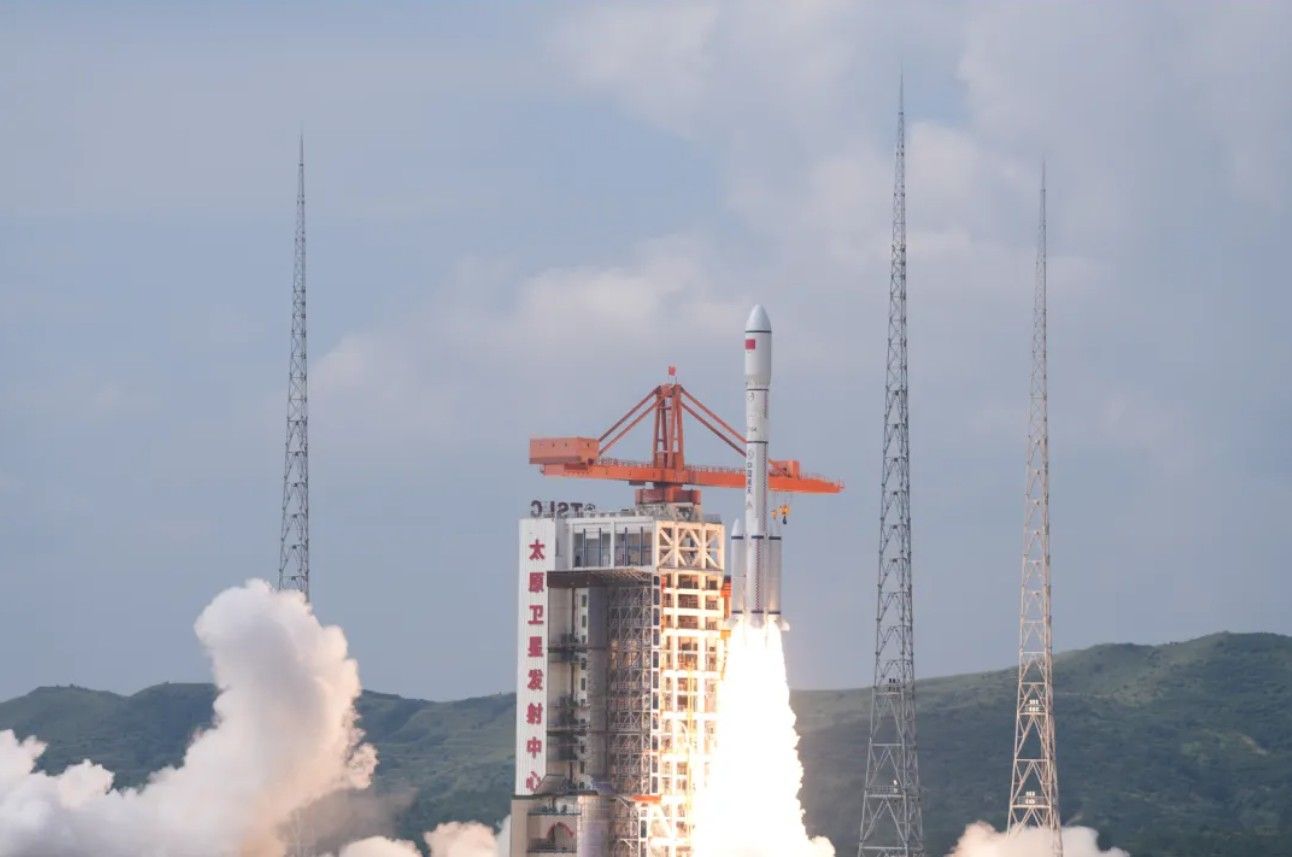
A Long March 6A rocket carrying both satellites lifted off from the Taiyuan Satellite Launch Center at 01:00 UTC on 30 July 2026. The China Aerospace Science and Technology Corporation subsequently announced that the launch had succeeded and identified the payloads as TJS-27A and TJS-27B. A detailed account of the mission was published by SpaceNews.
The launch vehicle combined a liquid-propellant core with solid-propellant boosters. It delivered the two satellites to orbits approximately 1,153 km above Earth at an inclination of about 64.8 degrees.
Design
China has not published the dimensions, mass, power system, communications bands, payload arrangement, or expected service life of either satellite. The available information therefore identifies the pair primarily through their manufacturers, public mission description, and orbital characteristics.
The orbital arrangement is notable within the TJS program. Most earlier TJS satellites operated in geosynchronous orbit, but TJS-27A and TJS-27B entered inclined low Earth orbits. Analysts noted that this orbital regime can support time-difference-of-arrival techniques. Such techniques compare the arrival time of a radio signal at separated satellites to estimate the location of its source.
This observation has led to assessments that the pair could collect electronic or signals intelligence. The interpretation remains unconfirmed. It is also unknown whether the two satellites will operate only as a coordinated pair, form part of a later constellation, or demonstrate another mission architecture.
Operational history
United States tracking data identified both spacecraft after launch in closely associated orbits. Initial reporting placed them near an altitude of 1,153 km with an inclination of 64.8 degrees. Tracking data for TJS-27A subsequently listed a perigee of approximately 1,156 km, an apogee of approximately 1,166 km, an inclination of 64.79 degrees, and an orbital period of about 108.42 minutes. The public catalog entry can be viewed through KeepTrack.
No confirmed operational activity, formation geometry, or payload emissions had been publicly described immediately after deployment. China did not identify a military operator or disclose whether the satellites had completed on-orbit testing.
Variants
- TJS-27A: Satellite developed by the China Academy of Space Technology and launched as the first identified member of the pair.
- TJS-27B: Companion satellite developed by the Shanghai Academy of Spaceflight Technology and launched on the same mission.
Operators
- China: The state launched and publicly acknowledged both satellites. Their precise operating organization and military command relationship have not been disclosed.
Specifications (TJS-27 satellite pair)
General characteristics
- Number of satellites: Two
- Designations: TJS-27A and TJS-27B
- TJS-27A developer: China Academy of Space Technology
- TJS-27B developer: Shanghai Academy of Spaceflight Technology
- Publicly stated functions: Satellite communications, broadcasting, television, data transmission, and technology experiments
Launch and orbit
- Launch date: 30 July 2026 UTC
- Launch vehicle: Long March 6A
- Launch site: Taiyuan Satellite Launch Center
- Orbit: Low Earth orbit near 1,153 km altitude
- Inclination: Approximately 64.8 degrees
- TJS-27A cataloged perigee and apogee: Approximately 1,156 km and 1,166 km
- TJS-27A cataloged orbital period: Approximately 108.42 minutes
Related equipment
- TJS satellite series: A Chinese program publicly presented as communication technology testing but associated by outside analysts with several classified mission types.
- Yaogan satellites: Chinese remote-sensing and reconnaissance spacecraft; analysts have compared the TJS-27 orbital regime with that used by some earlier Yaogan signals-intelligence missions.
- Tianlian: China's separate geostationary data-relay satellite system. Tianlian-3 (01) launched only hours before TJS-27 but was not part of the TJS-27 mission.
 Argentina
 Armenia
 Australia
 Austria
 Austria-Hungary
 Belgium
 Brazil
 United Kingdom
 United States
 Brunei
 Bulgaria
 Canada
 Chile
Chile Colonial America
 Colombia
 Confederate States
 Croatia
 Czech
Czech Denmark
 Egypt
Egypt Finland
 France
 Georgia
 Germany
 German Imperial
 Greece
 Holland
 Hungary
 India
India Indonesia
 Iran
Iran Iraq
Iraq Ireland
 Israel
 Italy
Italy Japan
Japan Japan (1940)
 Jordan
 Kingdom of Italy
 Malaysia
 Mexico
 Myanmar
 Nazi Germany
 Netherlands
 New Zealand
 North Korea
 Norway
 Pakistan
 Peru
Peru Philippines
 Poland
 Portugal
 Prussia
 Romania
 Russia
 Saudi Arabia
 Serbia
 Singapore
 Slovakia
 Slovenia
 South Africa
 South Korea
 Soviet Union
 Spain
Spain Sweden
 Switzerland
 Syria
Syria Taiwan
 Thailand
 Turkey
 UAE
UAE Ukraine
 Vietnam
 Yugoslavia