History
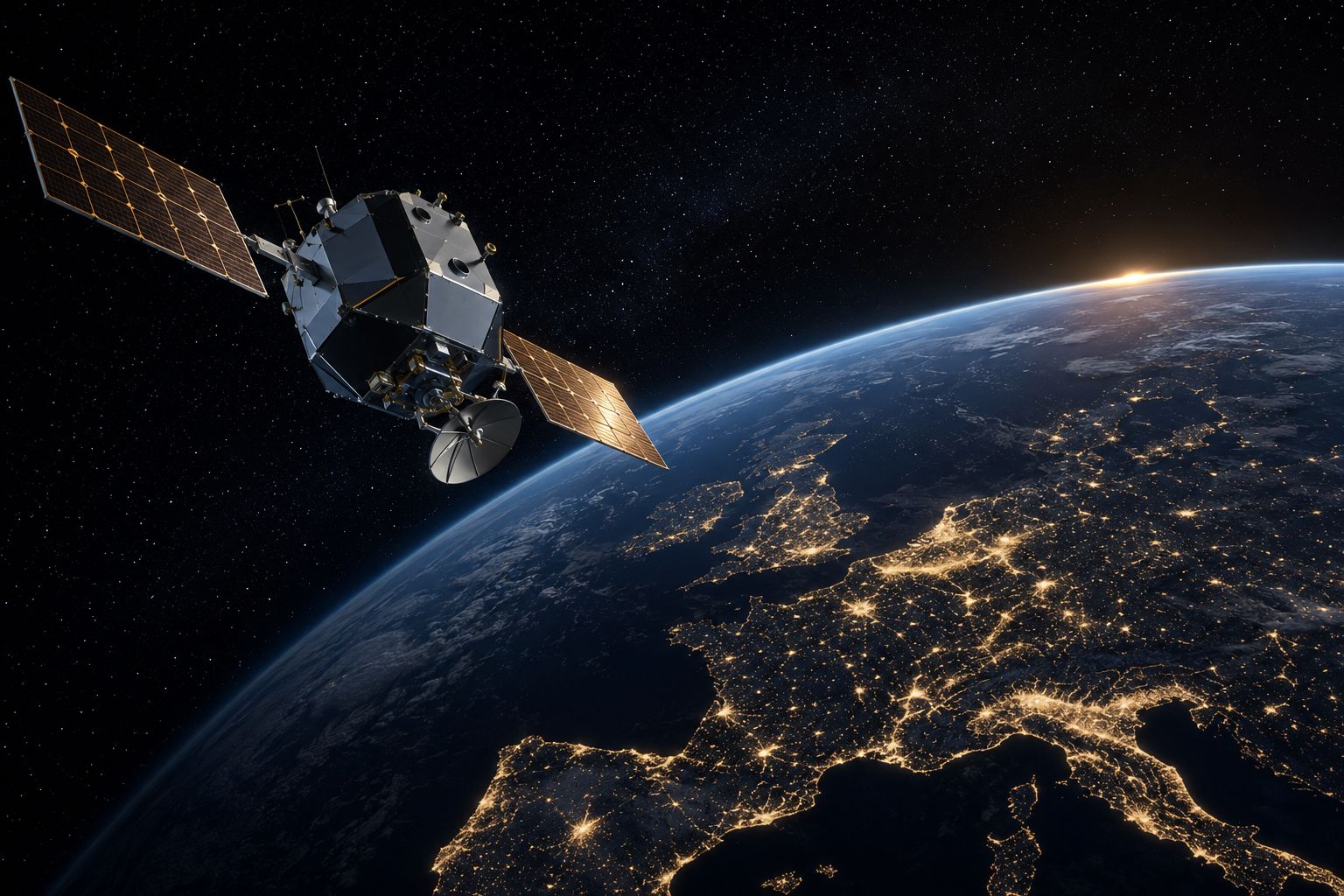
IRIS², formally Infrastructure for Resilience, Interconnectivity and Security by Satellite, is the European Union's planned secure communications constellation. It is intended to provide sovereign and resilient connectivity for governments, defence and security forces, emergency services, businesses and civilian users.
The system will use satellites in low Earth orbit and medium Earth orbit. The reinforced main constellation announced in August 2026 comprises 348 satellites: 330 in low Earth orbit and 18 in medium Earth orbit.
IRIS² is being developed as a public-private partnership led by the European Commission with support from the European Space Agency, the EU Agency for the Space Programme, the SpaceRISE consortium and European manufacturers.
Program development
The European Union initiated the IRIS² program in 2022 as part of its effort to reduce dependence on non-European communications infrastructure. The constellation is intended to complement the EU's Copernicus Earth-observation program and Galileo navigation system.
On 16 December 2024, the European Commission signed a 12-year concession contract with SpaceRISE. The consortium consists of SES, Eutelsat and Hispasat. The agreement established a legally binding partnership to design, build, deploy and operate the space and ground segments.
Following the concession award, the partners refined the architecture, security requirements and allocation of industrial work. Negotiations known as Rendezvous 1 began in January 2026 and concluded on 6 August 2026.
On 7 August 2026, the Commission and SpaceRISE signed an implementation agreement that moved IRIS² into full-scale deployment. According to the European Space Agency, the agreement added 66 low-orbit satellites and increased the main constellation from 282 to 348 spacecraft.
The expansion is intended to increase secure governmental capacity by 60 percent within the European Union and by 54 percent globally. The additional spacecraft will support defence, security and emergency-response requirements. The European Commission describes IRIS² as a network for reliable connectivity across Europe and beyond, including remote regions and crisis conditions.
Industrial organization
ESA oversees technical implementation, including development, qualification and in-orbit validation. SpaceRISE is responsible for delivering and operating the shared infrastructure. Airbus Defence and Space, Thales Alenia Space, OHB and Aerospacelab are among the principal industrial participants.
Eutelsat leads the low Earth orbit segment. Its assigned portion includes 264 satellites with dual military Ka-band and commercial Ku-band payloads, plus the 66 additional military Ka-band satellites. The company stated that Airbus Defence and Space, Thales Alenia Space and Aerospacelab would provide manufacturing capacity for the LEO spacecraft.
Hispasat has been selected to lead the ground segment, including antennas, control systems, terrestrial network connections and facilities for managing the different orbital layers. The reported value of this ground work is €1.6 billion.
Funding
The expanded architecture requires additional public and private investment. ESA stated that financing would combine EU budget resources for 2028–2034 with contributions from EU member states and participating countries. Poland committed €656 million, Hungary €500 million and Spain announced planned investments of €1.6 billion to €2 billion.
Eutelsat plans to invest €2.23 billion in shared IRIS² infrastructure and €1.16 billion in commercial infrastructure between 2027 and 2034. The company's August 2026 program statement says this investment will provide access to more than twice the capacity of its current OneWeb network.
Published estimates of the overall program cost differ. Euractiv reported a value of around €10 billion, while Breaking Defense reported more than €15.6 billion. The official ESA announcement confirmed that the expansion would require additional investment but did not state a revised total program cost.
Design
Multi-orbit architecture
IRIS² combines low Earth orbit and medium Earth orbit satellites within one communications system. The LEO layer is intended to provide high-capacity, low-latency coverage. The MEO layer can provide broader coverage and reduce the number of satellite handovers required to maintain a connection.
The reinforced main constellation consists of 330 LEO satellites and 18 MEO satellites. Optional elements may be added for specific missions. The architecture will use inclined orbits and dynamically allocate communications capacity according to demand.
Communications payloads
The 264 principal LEO spacecraft assigned to Eutelsat will carry dual military Ka-band and commercial Ku-band payloads. The 66 added LEO satellites will use military Ka-band payloads. Beamforming antennas will direct coverage and capacity toward selected service areas.
The constellation is planned to support 5G non-terrestrial network technology. This allows satellite links to operate as part of communications systems based on 5G standards. Fibre-optic inter-satellite links will route data between spacecraft, extend service availability and reduce dependence on ground infrastructure.
Ground segment and terminals
The secure ground segment will include distributed control facilities, antenna infrastructure and connections to terrestrial networks. These facilities will manage the constellation's different orbital layers and connect satellite services with governmental and commercial networks.
The program also plans smaller and lighter user terminals than those associated with earlier satellite systems. Detailed terminal dimensions and performance figures have not been published in the supplied program information.
Security and resilience
IRIS² is intended to preserve communications during emergencies, disruption of terrestrial infrastructure and security operations. Authorized governmental users in EU member states and participating countries will receive secure and continuous connectivity. Norway and Iceland are identified as participating non-EU countries.
The combination of orbital layers, inter-satellite links, distributed ground facilities and dedicated governmental capacity is intended to improve resilience. These capabilities remain planned because the constellation has not yet entered operational service.
Program status
As of August 2026, IRIS² had entered industrial execution but had not launched its operational constellation. The next work includes completing the detailed design, manufacturing satellites, procuring launch services and constructing secure ground infrastructure.
The first launches are planned for 2029. Operational connectivity services are expected to become available progressively from that year. Eutelsat states that the first Ka-band-only satellites will launch from 2029 and that the commercial Ku-band LEO constellation is planned to become fully operational by mid-2032.
The program does not yet have operational users in the conventional sense. Its planned governmental user community includes EU member states, Norway and Iceland, while commercial services are to be supplied through the SpaceRISE operators.
Specifications (reinforced IRIS² constellation)
General characteristics
- Type: Secure multi-orbit satellite communications constellation
- Program authority: European Commission
- Technical implementation: European Space Agency
- Concession consortium: SpaceRISE, comprising SES, Eutelsat and Hispasat
- Main constellation: 348 satellites
- Low Earth orbit segment: 330 satellites
- Medium Earth orbit segment: 18 satellites
- Principal LEO payload group: 264 satellites with military Ka-band and commercial Ku-band payloads
- Additional LEO layer: 66 satellites with military Ka-band payloads
- Planned first launches: 2029
- Planned commercial Ku-band LEO completion: Mid-2032
Network features
- Architecture: Combined low Earth orbit and medium Earth orbit network
- Antennas: Beamforming antennas for dynamic capacity allocation
- Network standard: Planned support for 5G non-terrestrial networks
- Inter-satellite connectivity: Fibre-optic links
- Services: Secure governmental communications and commercial connectivity
- Participating countries outside the EU: Norway and Iceland
 Argentina
 Armenia
 Australia
 Austria
 Austria-Hungary
 Belgium
 Brazil
 United Kingdom
 United States
 Brunei
 Bulgaria
 Canada
 Chile
Chile China
China Colonial America
 Colombia
 Confederate States
 Croatia
 Czech
Czech Denmark
 Egypt
Egypt Finland
 France
 Georgia
 Germany
 German Imperial
 Greece
 Holland
 Hungary
 India
India Indonesia
 Iran
Iran Iraq
Iraq Ireland
 Israel
 Italy
Italy Japan
Japan Japan (1940)
 Jordan
 Kingdom of Italy
 Malaysia
 Mexico
 Myanmar
 Nazi Germany
 Netherlands
 New Zealand
 North Korea
 Norway
 Pakistan
 Peru
Peru Philippines
 Poland
 Portugal
 Prussia
 Romania
 Russia
 Saudi Arabia
 Serbia
 Singapore
 Slovakia
 Slovenia
 South Africa
 South Korea
 Soviet Union
 Spain
Spain Sweden
 Switzerland
 Syria
Syria Taiwan
 Thailand
 Turkey
 UAE
UAE Ukraine
 Vietnam
 Yugoslavia