
History
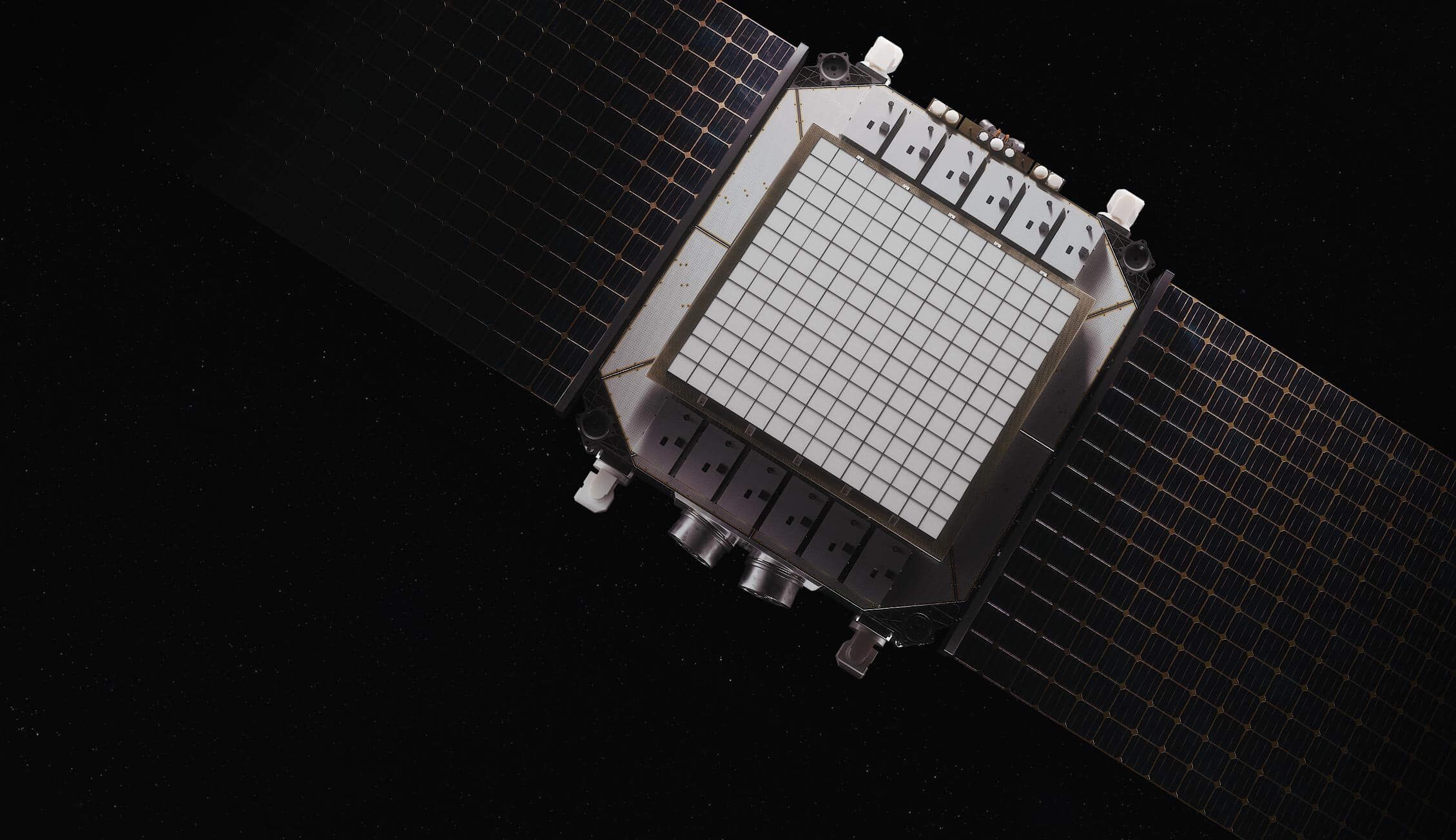
The K2 Space laser-communications satellite platform is a planned two-spacecraft demonstration for the United States Space Force. Each K2 satellite will carry an Enterprise Space Terminal as a hosted payload for testing direct optical communication between military systems in orbit.
The Space Force awarded K2 Space a $22.9 million contract for the demonstration. K2 Space will procure and integrate the terminals, arrange the launch of both satellites, and operate the spacecraft during the orbital test.
The demonstration is scheduled for completion by 2028. It is intended to evaluate equipment that could support military sensor and communications networks distributed across low, medium, and higher Earth orbits.
Enterprise Space Terminal program
The Enterprise Space Terminal program began in 2024 as an approximately $100 million effort to develop and evaluate interoperable optical communications hardware from multiple suppliers. Space Systems Command selected CACI International, General Atomics, and Viasat as Phase 3 terminal suppliers. The Space Force has not disclosed which supplier or suppliers will provide the two units for the K2 mission.
K2 Space received the satellite demonstration award through the FreeSol Broad Agency Announcement, a contracting mechanism for commercial technologies and research proposals. The contract was announced on 31 July 2026. The flight experiment is funded through the Space-Based Sensing and Targeting portfolio, which also oversees elements of the planned Space Data Network.
The award followed K2 Space's selection for the Overhead Persistent Infrared Space Modernization Initiative. That research and development program supports technologies associated with space-based missile warning and defense. Details of the demonstration contract were reported by SpaceNews.
Design
The demonstration configuration consists of two K2 satellite buses. Each spacecraft will host one Enterprise Space Terminal. The terminal is the mission payload, while the satellite bus provides supporting services required for operation.
Hosted payload integration
As hosted payloads, the optical terminals will depend on their K2 spacecraft for electrical power, thermal control, pointing, communications, and other platform functions. K2 Space is responsible for integrating the terminals with the satellite buses and operating both spacecraft during the test.
The available contract information does not identify the exact K2 bus configuration, terminal manufacturer, orbital altitude, spacecraft mass, electrical output, or terminal data rate. It also does not state whether both satellites will carry terminals from the same supplier.
Optical communications
The terminals will use tightly focused laser beams to transmit data directly between spacecraft. Such links require precise acquisition, pointing, and tracking because satellites can be separated by thousands of miles while moving relative to one another.
Optical crosslinks can transfer information between orbital systems without first routing every transmission through a ground station. The military application is intended to help move missile-warning, tracking, targeting, and other sensor data among spacecraft, terrestrial systems, and military users.
Program status
As of the contract announcement in 2026, the two-satellite system was a planned demonstration rather than an operational constellation. Procurement, payload integration, launch, orbital operation, and testing remained within the scope of the award. Completion was scheduled by 2028.
K2 Space is also supplying satellite platforms for other communications projects. SES selected K2 buses for its planned meoSphere medium Earth orbit network, which is separate from the Space Force demonstration. That commercial program demonstrates the company's broader approach to high-power, multi-mission buses and hosted payloads, as described by SES.
Operators
- United States Space Force: Customer for the planned two-satellite orbital demonstration. K2 Space will operate the spacecraft during the test.
Specifications (military demonstration configuration)
General characteristics
- Manufacturer and integrator: K2 Space
- Configuration: Two satellite buses carrying hosted optical communications payloads
- Payload: One Enterprise Space Terminal on each satellite
- Payload support: Spacecraft power, thermal control, pointing, communications, and associated bus services
Mission
- Primary function: Orbital demonstration of direct laser communications between military space systems
- Planned spacecraft operations: Conducted by K2 Space
- Scheduled completion: 2028
- Contract value: $22.9 million
 Argentina
 Armenia
 Australia
 Austria
 Austria-Hungary
 Belgium
 Brazil
 United Kingdom
 Brunei
 Bulgaria
 Canada
 Chile
Chile China
China Colonial America
 Colombia
 Confederate States
 Croatia
 Czech
Czech Denmark
 Egypt
Egypt Finland
 France
 Georgia
 Germany
 German Imperial
 Greece
 Holland
 Hungary
 India
India Indonesia
 Iran
Iran Iraq
Iraq Ireland
 Israel
 Italy
Italy Japan
Japan Japan (1940)
 Jordan
 Kingdom of Italy
 Malaysia
 Mexico
 Myanmar
 Nazi Germany
 Netherlands
 New Zealand
 North Korea
 Norway
 Pakistan
 Peru
Peru Philippines
 Poland
 Portugal
 Prussia
 Romania
 Russia
 Saudi Arabia
 Serbia
 Singapore
 Slovakia
 Slovenia
 South Africa
 South Korea
 Soviet Union
 Spain
Spain Sweden
 Switzerland
 Syria
Syria Taiwan
 Thailand
 Turkey
 UAE
UAE Ukraine
 Vietnam
 Yugoslavia