
History
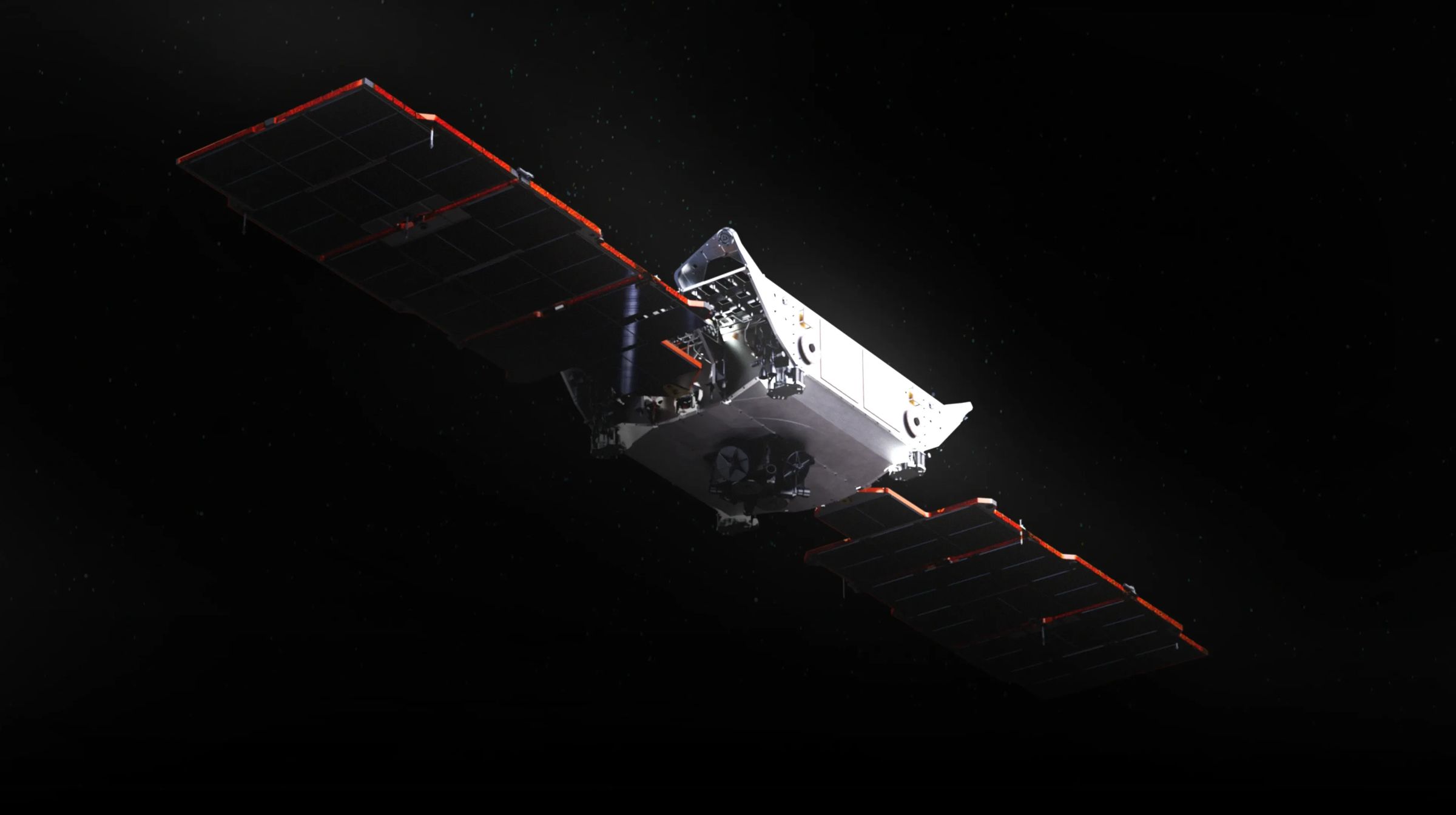
Impulse Space Mira is a reusable-design orbital transfer spacecraft developed in the United States for payload hosting, satellite deployment, and rapid orbital maneuvers. It can operate as a free-flying spacecraft after separation from its launch vehicle.
Mira combines high-thrust chemical propulsion with precise attitude control. Its missions include last-mile payload delivery, hosted operations, collision avoidance, proximity operations, and space domain awareness.
The spacecraft entered orbit during the LEO Express 1 mission in November 2023. Two later missions introduced internally developed systems and an upgraded configuration intended for operations from low Earth orbit to geostationary orbit and beyond.
Development and first mission
Impulse Space developed the original Mira from a clean-sheet design to orbital operation in approximately 15 months. The first operational vehicle, also identified as Impulse 1 or Mira SN2, launched from Vandenberg Space Force Base aboard a SpaceX Falcon 9 on 11 November 2023.
During LEO Express 1, Mira deployed a customer payload and raised its apogee by 150 km in 75 seconds. The mission also demonstrated collision avoidance and high-thrust orbital maneuvering. A mission chronology is available from Gunter's Space Page.
LEO Express 2 launched on 14 January 2025. It demonstrated additional internally developed technology, rapid maneuvers, collision avoidance, and long-duration payload hosting.
Upgraded Mira
In August 2024, Impulse Space announced an updated Mira design for geostationary and other high-energy orbits. The company planned to use the larger Helios kick stage to transport Mira beyond low Earth orbit. The manufacturer's upgrade announcement described improved radiation tolerance, avionics, and electrical power.
By August 2025, the first upgraded spacecraft had been completed and tested with its customer payloads installed. The configuration added radiation-tolerant avionics, improved radios and antennas, reaction wheels, larger solar arrays, a larger propellant tank, revised thrusters, updated software, cybersecurity provisions, and a redesigned payload bay. Contemporary reports stated that the solar arrays produced more than twice the power of the earlier design and that propulsion changes increased delta-V by about 25 percent. The upgraded vehicle was assigned to LEO Express 3, as reported by SpaceNews and SmallSat News.
LEO Express 3 launched on 28 November 2025 aboard a Falcon 9. Although this mission operated in low Earth orbit, its Mira vehicle incorporated systems intended to support later missions in medium Earth orbit, geostationary orbit, cislunar space, and other high-energy destinations.
United States Space Force contracts
The United States Space Force selected upgraded Mira spacecraft for the VICTUS SURGO and VICTUS SALO tactically responsive space missions. VICTUS SURGO is intended to use Helios to deliver Mira to geostationary orbit with a commercial optical payload. VICTUS SALO is intended to operate in low Earth orbit with a payload supplied by MIT Lincoln Laboratory.
In July 2026, the Space Force awarded Impulse Space a $27.77 million modification to Small Business Innovation Research Phase III contract FA8809-25-C-B001. The modification increased the contract's total value from approximately $35 million to $62.8 million and added two Mira spacecraft.
The additional vehicles will host government-furnished payloads for space domain awareness characterization in low Earth orbit. The payload identities and detailed missions were not disclosed. Space Systems Command expects contract work to be completed by 31 March 2030, and $19.75 million in fiscal 2025 procurement funding was obligated when the modification was awarded.
Design
Mission architecture
Mira is a maneuverable, uncrewed spacecraft that can remain attached to hosted payloads or deploy satellites after reaching the required orbit. Its high-thrust propulsion permits comparatively rapid changes in velocity instead of the gradual orbit changes associated with low-thrust electric propulsion.
The upgraded spacecraft is designed for payload hosting, constellation deployment, last-mile delivery, responsive maneuvers, rendezvous and proximity operations, and space domain awareness. It can be launched through rideshare services or transported to higher orbits by Helios.
Propulsion
Mira uses eight Impulse Space Saiph bipropellant engines arranged as four pairs. Each engine produces 26 N of thrust, giving the spacecraft 208 N of total available thrust. The engines can operate together or independently and support pulsed operation.
The propulsion system burns nitrous oxide and ethane. Impulse Space describes this combination as storable and non-toxic. The engines can perform cold starts, allowing a dormant spacecraft to initiate a maneuver when required.
Attitude control
The upgraded Mira provides six-degree-of-freedom control through four reaction wheels and 20 cold-gas thrusters. Reaction wheels support fine pointing and slew rates greater than 1 degree per second, while the reaction-control thrusters can produce slew rates of 5 degrees per second.
Manufacturer data specifies pointing accuracy better than 10 arcseconds at one standard deviation and jitter of 2 arcseconds per second over a one-second interval.
Payload accommodation
Mira can carry payloads weighing up to 300 kg in a volume exceeding 1 cubic metre. The payload interface uses a 4-by-4-inch grid bolt pattern. Supported arrangements include custom adapters, clusters of small satellites, and as many as nine 16U CubeSat deployers.
The upgraded payload bay was redesigned to increase usable customer volume. The spacecraft can retain a hosted payload throughout a mission or release payloads after orbital repositioning.
Power, avionics, and communications
The upgraded spacecraft supplies up to 350 W of orbit-average electrical power at end of life through an unregulated 28 V system. Its avionics include radiation-tolerant components, upgraded software, and single-fault tolerance across all subsystems.
Standard payload data interfaces include Gigabit Ethernet and RS-422. For geostationary missions, the stated communications rates are 4 Mbit/s downlink through X-band and 400 kbit/s uplink through S-band.
Operational history
LEO Express 1 entered orbit in November 2023 and demonstrated payload deployment, collision avoidance, and a rapid 150 km apogee increase. LEO Express 2 followed in January 2025 with additional in-house systems, hosted payload operations, and high-thrust maneuvers.
LEO Express 3 entered orbit in November 2025 with the first upgraded Mira configuration. The current manufacturer profile lists three flown missions and describes Mira as flight-proven.
The Space Force missions and the two additional spacecraft ordered in 2026 extend Mira's role into national-security payload hosting. The newly ordered vehicles are intended for low-Earth-orbit characterization missions through 2030, but their government payloads remain undisclosed.
Variants
- Original Mira: Initial low-Earth-orbit configuration flown on LEO Express 1 and LEO Express 2. It established the spacecraft's payload deployment, hosted mission, collision-avoidance, and high-thrust maneuvering capabilities.
- Upgraded Mira: Revised base configuration introduced on LEO Express 3. It has radiation-tolerant avionics, reaction wheels, improved communications, larger solar arrays, an expanded propellant tank, updated propulsion, and a redesigned payload bay for low and high-energy orbits.
Operators
- Impulse Space: Manufacturer and operator of Mira spacecraft on the LEO Express missions.
Specifications (upgraded Mira)
General characteristics
- Payload capacity: Up to 300 kg
- Payload volume: More than 1 m³
- Payload interface: 4-by-4-inch grid bolt pattern; custom adapters available
- CubeSat capacity: Up to nine 16U deployers
- Design life: 5 years, including operations in geostationary orbit
- Supported orbits: Low Earth, medium Earth, geostationary, cislunar, and higher-energy trajectories
- Launch compatibility: Helios, SpaceX rideshare, ESPA Grande, and Ariane ASPRA
Propulsion and performance
- Main propulsion: Eight Saiph bipropellant engines
- Thrust per engine: 26 N
- Total available thrust: 208 N
- Propellants: Nitrous oxide and ethane
- Delta-V with 300 kg payload: 550 m/s
- Delta-V with 200 kg payload: 650 m/s
- Delta-V with 100 kg payload: 850 m/s
Attitude control and electrical systems
- Attitude-control equipment: Four reaction wheels and 20 cold-gas thrusters
- Pointing accuracy: Better than 10 arcseconds at one standard deviation
- Reaction-wheel slew rate: Greater than 1 degree per second
- Thruster slew rate: 5 degrees per second
- Jitter: 2 arcseconds per second over 1 second
- Orbit-average power: Up to 350 W at end of life
- Electrical supply: 28 V unregulated
Data and communications
- Payload data interfaces: 1000BASE-T Ethernet and RS-422
- Geostationary downlink: 4 Mbit/s through X-band
- Geostationary uplink: 400 kbit/s through S-band
- Redundancy: Single-fault tolerant across all subsystems
 Argentina
 Armenia
 Australia
 Austria
 Austria-Hungary
 Belgium
 Brazil
 United Kingdom
 Brunei
 Bulgaria
 Canada
 Chile
Chile China
China Colonial America
 Colombia
 Confederate States
 Croatia
 Czech
Czech Denmark
 Egypt
Egypt Finland
 France
 Georgia
 Germany
 German Imperial
 Greece
 Holland
 Hungary
 India
India Indonesia
 Iran
Iran Iraq
Iraq Ireland
 Israel
 Italy
Italy Japan
Japan Japan (1940)
 Jordan
 Kingdom of Italy
 Malaysia
 Mexico
 Myanmar
 Nazi Germany
 Netherlands
 New Zealand
 North Korea
 Norway
 Pakistan
 Peru
Peru Philippines
 Poland
 Portugal
 Prussia
 Romania
 Russia
 Saudi Arabia
 Serbia
 Singapore
 Slovakia
 Slovenia
 South Africa
 South Korea
 Soviet Union
 Spain
Spain Sweden
 Switzerland
 Syria
Syria Taiwan
 Thailand
 Turkey
 UAE
UAE Ukraine
 Vietnam
 Yugoslavia