
History
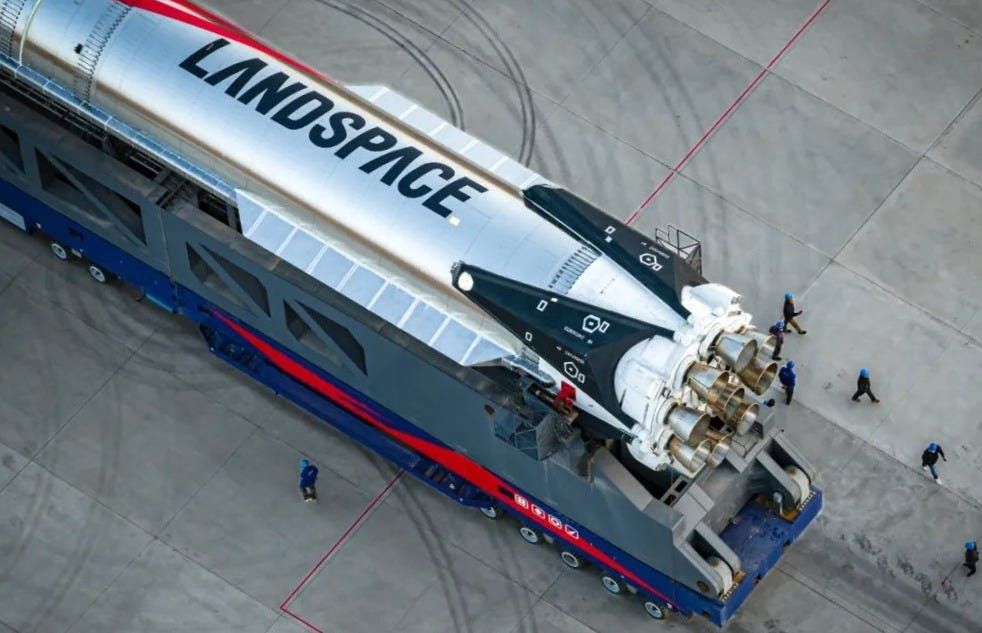
The LandSpace Zhuque-3, also written ZQ-3, is a Chinese two-stage orbital launch vehicle with a recoverable first stage. It uses liquid methane and liquid oxygen and is intended to place large payloads into low Earth orbit.
LandSpace developed Zhuque-3 as a larger successor to its Zhuque-2 launch vehicle. The program combines a stainless-steel structure, clustered methane engines, aerodynamic grid fins and powered vertical landing technology.
Zhuque-3 completed its first orbital mission in December 2025, although its first-stage recovery attempt was unsuccessful. A second launch and landing attempt was targeted for 10 August 2026.
Development
LandSpace was founded in 2015 after China opened parts of its space industry to private investment. Its first rocket, the solid-propellant Zhuque-1, failed during its only launch in 2018. The company subsequently concentrated on liquid methane and liquid oxygen propulsion. In July 2023, Zhuque-2 became the first rocket using this propellant combination to reach orbit, according to Reuters.
LandSpace began flight testing reusable-rocket technology with the Zhuque-3 VTVL-1 vertical-takeoff and vertical-landing demonstrator. A test in January 2024 reached approximately 350 m. During a second test in September 2024, the vehicle climbed to approximately 10 km, restarted its engine in flight and completed a powered landing. Four grid fins and reaction-control thrusters guided the vehicle. It touched down about 1.7 m from the target center at approximately 1.65 m/s.
Assembly of the first Zhuque-3 Y1 orbital vehicle was reported complete by April 2025. In June, LandSpace conducted a 45-second firing of all nine first-stage engines. Contemporary reporting described the initial vehicle as approximately 66 m tall, with a possible later extension of about 10 m and more powerful engines. Further development details were reported by Space.com.
Maiden orbital flight
Zhuque-3 Y1 lifted off from LandSpace Launch Pad 96B at the Dongfeng Commercial Aerospace Innovation Pilot Zone in Jiuquan on 3 December 2025. The two-stage vehicle completed its orbital mission. The flight also included China's first first-stage vertical-recovery attempt associated with an orbital launch.
The returning first stage completed high-altitude gliding, attitude adjustment, grid-fin deployment, a re-entry burn and aerodynamic deceleration. An anomaly occurred after the landing burn. The stage did not achieve a soft landing, and its debris fell near the edge of the landing pad, approximately 40 m from its center.
LandSpace reported that the flight validated most of the planned recovery technologies. These included the nine-engine propulsion system, laser-welded stainless-steel tanks, separation without pyrotechnic devices, grid-fin control and integrated guidance, navigation and control. The company's February 2026 technical presentation is available through the United Nations Office for Outer Space Affairs.
Design
Configuration and structure
Zhuque-3 is a two-stage, medium-to-heavy orbital launch vehicle. Both stages use stainless-steel structures and liquid methane and liquid oxygen propellants. The first stage is designed for vertical recovery and reuse, while the second stage continues toward orbit.
The developed configuration has a common stage diameter of 4.5 m and a payload fairing with a diameter of 5.2 m. Four deployable grid fins provide aerodynamic control during atmospheric return. Four landing legs support the first stage after touchdown.
Propulsion
The first stage uses a cluster of nine LandSpace Tianque engines. Initial Zhuque-3 vehicles were associated with the TQ-12A, while the later full-size configuration is planned to use nine higher-thrust TQ-12B engines. Both versions burn methane and liquid oxygen.
The second stage is planned to use one TQ-15B methane-oxygen engine. During the maiden mission, the second stage performed multiple burns for orbit insertion and terminal velocity correction before passivation.
Recovery system
After separation, the first stage follows a controlled atmospheric-return trajectory. Reaction-control thrusters and grid fins adjust its attitude and flight path. A re-entry burn reduces speed before aerodynamic deceleration, and a final engine burn is intended to produce a vertical landing.
LandSpace intends to recover stages either downrange or at the launch site. The company has stated a goal of flying an individual first stage up to 20 times, although this remains a planned capability and had not been demonstrated by the maiden flight.
Program status
Zhuque-3 reached orbit on its maiden flight, but first-stage recovery remained under development after the unsuccessful December 2025 landing attempt. LandSpace planned to modify the recovery sequence before the next flight. A second launch and landing attempt was targeted for 10 August 2026.
The vehicle is intended to support commercial satellite missions and the deployment of large low-orbit constellations. Routine reuse, rapid turnaround and a high launch frequency remain program objectives rather than demonstrated operational capabilities.
Variants
- Zhuque-3 VTVL-1: Vertical-takeoff and vertical-landing demonstrator used for low-altitude and 10 km recovery tests during 2024.
- Zhuque-3 Y1: First orbital flight vehicle. It completed its orbital mission on 3 December 2025 but did not recover its first stage.
- Full-size Zhuque-3: Planned 76.6 m configuration with nine TQ-12B first-stage engines and the program's maximum stated payload capacities.
Specifications (full-size Zhuque-3)
General characteristics
- Stages: Two
- Height: 76.6 m
- Stage diameter: 4.5 m
- Fairing diameter: 5.2 m
- Takeoff mass: Approximately 660 tonnes
- Takeoff thrust: Approximately 900 tonnes-force
- First-stage engines: Nine TQ-12B liquid methane and liquid oxygen engines
- Second-stage engine: One TQ-15B liquid methane and liquid oxygen engine
- Grid fins: Four
- Landing legs: Four
Payload capacity
- Low Earth orbit, expendable mission: Up to 21.3 tonnes
- 450 km low Earth orbit, downrange recovery: Up to 18.3 tonnes
- Low Earth orbit, return to launch site: Up to 12.5 tonnes
Related equipment
- LandSpace Zhuque-2: Smaller methane-oxygen launch vehicle that preceded Zhuque-3 and became the first rocket using this propellant combination to reach orbit.
- SpaceX Falcon 9: Partially reusable orbital launch vehicle with an operationally proven first-stage recovery system and a broadly comparable mission concept.
 Argentina
 Armenia
 Australia
 Austria
 Austria-Hungary
 Belgium
 Brazil
 United Kingdom
 United States
 Brunei
 Bulgaria
 Canada
 Chile
Chile Colonial America
 Colombia
 Confederate States
 Croatia
 Czech
Czech Denmark
 Egypt
Egypt Finland
 France
 Georgia
 Germany
 German Imperial
 Greece
 Holland
 Hungary
 India
India Indonesia
 Iran
Iran Iraq
Iraq Ireland
 Israel
 Italy
Italy Japan
Japan Japan (1940)
 Jordan
 Kingdom of Italy
 Malaysia
 Mexico
 Myanmar
 Nazi Germany
 Netherlands
 New Zealand
 North Korea
 Norway
 Pakistan
 Peru
Peru Philippines
 Poland
 Portugal
 Prussia
 Romania
 Russia
 Saudi Arabia
 Serbia
 Singapore
 Slovakia
 Slovenia
 South Africa
 South Korea
 Soviet Union
 Spain
Spain Sweden
 Switzerland
 Syria
Syria Taiwan
 Thailand
 Turkey
 UAE
UAE Ukraine
 Vietnam
 Yugoslavia