
History
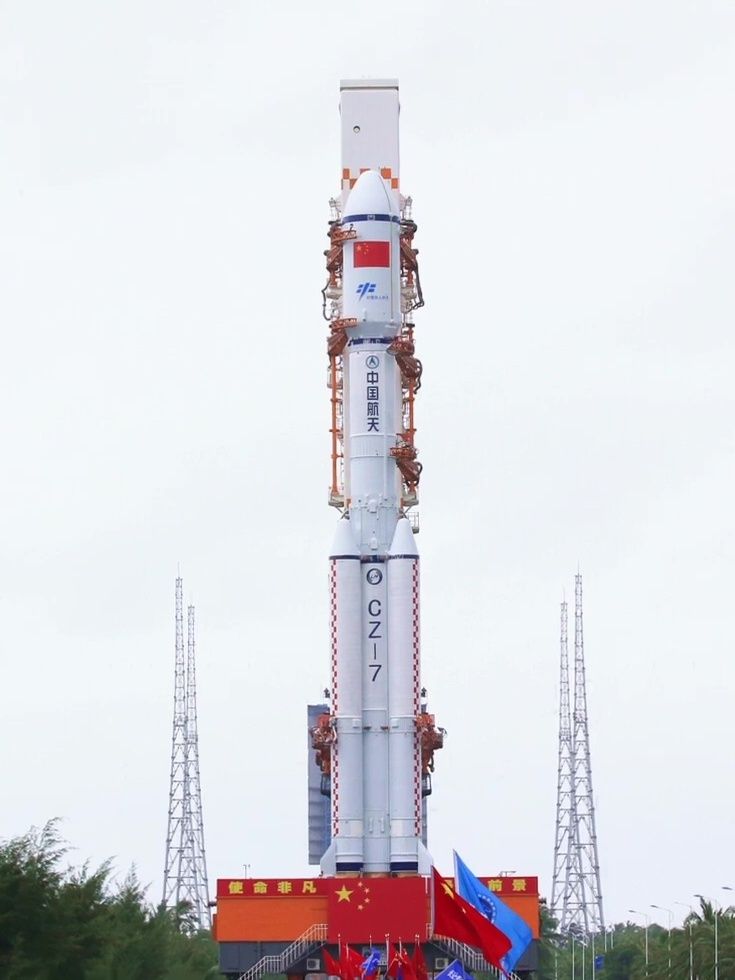
The CALT Long March 7A, also known as Chang Zheng 7A or CZ-7A, is a Chinese three-stage orbital launch vehicle developed for missions to high-energy orbits. It is manufactured by the China Academy of Launch Vehicle Technology and combines kerosene and liquid-oxygen lower stages with a liquid-hydrogen and liquid-oxygen upper stage.
The vehicle is a derivative of the Long March 7. Its additional cryogenic third stage, adapted from technology used on the Long March 3B series, gives the Long March 7A the capability to place payloads into geostationary transfer orbit and to support missions beyond Earth orbit.
The Long March 7A first flew in March 2020. Its maiden mission failed, but the rocket returned successfully in March 2021 and subsequently completed more than a dozen successful missions before another launch failure in August 2026.
Development and maiden flight
The Long March 7A was developed as a higher-energy variant of the standard Long March 7. The standard vehicle was primarily designed to support cargo launches for China's space station, while the 7A added a third stage suitable for geostationary transfer orbit missions. According to SpaceNews, the launcher retained the Long March 7 kerosene and liquid-oxygen core and four side boosters while incorporating a modified cryogenic stage derived from the Long March 3B series.
The first Long March 7A launch took place in March 2020 and failed. SpaceNews reported that a loss of pressure occurred after first-stage separation and led to an engine malfunction. The vehicle returned to flight on March 11, 2021. On that mission it successfully placed the Shiyan-9 experimental technology satellite into geosynchronous transfer orbit.
Long March 7A launches continued after the successful 2021 return to flight. An August 2024 mission carrying ChinaSat-4A was described by China Space Updates as the eighth launch of a Long March 7A. That mission also illustrated the vehicle's principal use for launching communications spacecraft toward high orbit.
August 2026 failure
On August 10, 2026, a Long March 7A carrying the ChinaSat-4B satellite lifted off from the Wenchang space launch site in Hainan. Chinese state reporting described an in-flight anomaly and confirmed that the mission was unsuccessful. Reuters reported that launch video showed the rocket being completely destroyed at relatively low altitude and speed, with neither the satellite nor debris reaching orbit.
Independent reporting indicated that the breakup occurred less than 90 seconds after liftoff. SatNews placed the event at approximately 85 seconds after launch, before the normal separation of the boosters and core stage. The 2026 accident was the first reported Long March 7A failure since the unsuccessful maiden flight in 2020. Chinese authorities said the cause was under investigation.
Design
The Long March 7A is a three-stage expendable launch vehicle with four strap-on boosters. It stands approximately 60.1 m tall and has a reported fully fueled launch mass of about 573 metric tons. The main first- and second-stage structures have a diameter of 3.35 m. The third stage has a diameter of 3 m, while each side booster has a diameter of 2.25 m.
Lower stages and boosters
The first stage and four boosters use rocket-grade kerosene and liquid oxygen. The core first stage is powered by two YF-100 engines, while each of the four strap-on boosters uses one YF-100. The second stage also burns kerosene and liquid oxygen and uses four YF-115 engines. These propulsion technologies distinguish the newer Long March family from older Chinese launch vehicles that relied heavily on toxic hypergolic propellants.
Third stage
The third stage uses liquid hydrogen and liquid oxygen and is powered by two YF-75 engines. This cryogenic upper stage provides the additional energy required for high-orbit missions. SpaceNews described it as a stage modified from the older Long March 3B series.
Mission capability
The Long March 7A is designed principally for high-orbit missions. Reported payload capacity is up to 7,000 kg to geostationary transfer orbit. China Space Updates also reports a capacity of up to 5,000 kg on a trans-lunar trajectory. The vehicle has therefore been presented as suitable for communications satellites as well as lunar and other deep-space missions.
Operational history
The Long March 7A's operational record began with the failed March 2020 maiden flight. The successful March 2021 Shiyan-9 mission demonstrated the design's ability to reach geosynchronous transfer orbit. More than a dozen successful launches followed before the August 2026 ChinaSat-4B mission failed.
Reuters described the Long March 7A as a medium-lift rocket used mainly to send communications satellites to high orbit. Because its role differs from launch vehicles used for large low-Earth-orbit satellite deployments, specialists cited by Reuters assessed that the August 2026 failure would not necessarily disrupt the wider pace of China's low-orbit launch activity.
Variants
- Long March 7: The standard launch vehicle from which the Long March 7A was developed. It uses the same basic kerosene and liquid-oxygen core and four side boosters and has been used for cargo missions associated with China's space station.
- Long March 7A: Three-stage high-energy derivative of the Long March 7 with an added cryogenic upper stage for geostationary transfer orbit and other high-energy missions.
Specifications (Long March 7A)
General characteristics
- Type: Three-stage expendable orbital launch vehicle
- Manufacturer: China Academy of Launch Vehicle Technology
- Height: 60.1 m
- Core diameter: 3.35 m
- Third-stage diameter: 3 m
- Booster diameter: 2.25 m
- Launch mass: Approximately 573 metric tons
- Boosters: Four
Propulsion
- First stage: Two YF-100 engines using kerosene and liquid oxygen
- Boosters: One YF-100 engine on each booster using kerosene and liquid oxygen
- Second stage: Four YF-115 engines using kerosene and liquid oxygen
- Third stage: Two YF-75 engines using liquid hydrogen and liquid oxygen
Performance
- Payload to geostationary transfer orbit: Up to 7,000 kg
- Reported payload to trans-lunar trajectory: Up to 5,000 kg
Related equipment
The Long March 7A belongs to China's wider Long March launch-vehicle family. A general history of the family is available from Space.com. The Long March 7 provides the 7A's basic core and booster architecture, while the additional cryogenic upper stage draws on technology associated with the Long March 3B series.
 Argentina
 Armenia
 Australia
 Austria
 Austria-Hungary
 Belgium
 Brazil
 United Kingdom
 United States
 Brunei
 Bulgaria
 Canada
 Chile
Chile Colonial America
 Colombia
 Confederate States
 Croatia
 Czech
Czech Denmark
 Egypt
Egypt Finland
 France
 Georgia
 Germany
 German Imperial
 Greece
 Holland
 Hungary
 India
India Indonesia
 Iran
Iran Iraq
Iraq Ireland
 Israel
 Italy
Italy Japan
Japan Japan (1940)
 Jordan
 Kingdom of Italy
 Malaysia
 Mexico
 Myanmar
 Nazi Germany
 Netherlands
 New Zealand
 North Korea
 Norway
 Pakistan
 Peru
Peru Philippines
 Poland
 Portugal
 Prussia
 Romania
 Russia
 Saudi Arabia
 Serbia
 Singapore
 Slovakia
 Slovenia
 South Africa
 South Korea
 Soviet Union
 Spain
Spain Sweden
 Switzerland
 Syria
Syria Taiwan
 Thailand
 Turkey
 UAE
UAE Ukraine
 Vietnam
 Yugoslavia