
History
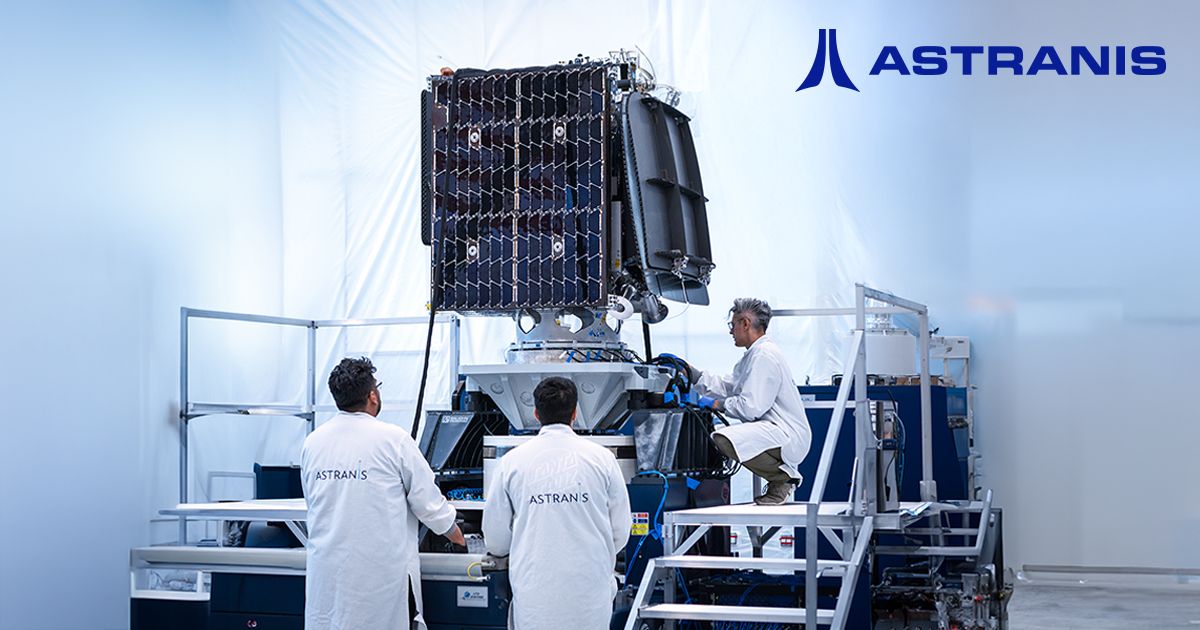
Astranis Perceptor is a planned surveillance spacecraft for monitoring and inspecting satellites in geostationary orbit and other strategic high orbits. It is based on the company's flight-proven MicroGEO satellite platform.
The spacecraft is intended to improve space domain awareness by observing orbital activity, characterizing other spacecraft, and investigating anomalies affecting friendly satellites. Astranis is developing Perceptor for government, national-security, and commercial missions.
Astranis announced Perceptor on 13 August 2026 as an expansion of its work beyond broadband communications. The company identified limited awareness of activity around critical infrastructure in higher orbits as the principal reason for developing the spacecraft. The announcement followed operational experience with MicroGEO communications satellites in geostationary orbit.
In April 2026, the United States Space Force selected Astranis as one of 14 companies eligible to compete for task orders under the Andromeda contract vehicle. The program supports RG-XX, a planned next-generation constellation for surveillance in geostationary orbit. Perceptor gives Astranis a named spacecraft for this broader mission area, although the available sources do not confirm a Perceptor contract or operator.
The spacecraft was publicly presented as a design under development rather than an operational system. No prototype completion, launch date, or first-mission schedule had been announced as of its unveiling. Contemporary descriptions are available from SpaceNews and Space.com.
Design
MicroGEO platform
Perceptor uses the Astranis MicroGEO platform, which was originally employed for communications missions. MicroGEO spacecraft are considerably smaller than traditional multi-ton geostationary satellites. Reusing an established platform is intended to reduce development risk and permit production on Astranis' existing satellite manufacturing line.
The Perceptor mission payload replaces the communications-focused role of the standard platform with sensors for detecting, observing, and characterizing spacecraft and other activity in high orbits. The published information does not identify the sensor types, their resolution, or their operating ranges.
Observation and inspection
The onboard sensor suite is intended to support flybys of other satellites. Observations from different angles could help operators assess another spacecraft's configuration or behavior and investigate anomalies on friendly spacecraft.
Multiple Perceptor spacecraft are designed to operate cooperatively. Distributed observations from different locations could provide several viewing angles and make it more difficult for another spacecraft to avoid surveillance. Astranis describes this as a proliferated architecture rather than reliance on a small number of large spacecraft.
Propulsion and maneuvering
Perceptor is designed to use electric propulsion to travel across the geostationary arc. Astranis states that each spacecraft will be able to reposition dozens of times during its mission lifetime. This mobility is intended to let the spacecraft respond to activity in different orbital locations instead of remaining near one fixed longitude.
Electric propulsion uses electrical energy to accelerate propellant and generally provides greater propellant efficiency than conventional chemical propulsion. The available information does not disclose Perceptor's propellant capacity, thrust, specific impulse, maneuver duration, or total velocity-change capability.
Mission
Perceptor's principal mission is space domain awareness: detecting, tracking, and characterizing objects and activity in orbit. Planned tasks include monitoring satellites, conducting inspection flybys, assessing spacecraft behavior, and assisting with anomaly investigations.
The spacecraft is primarily associated with geostationary orbit, approximately 35,786 km (22,236 mi) above Earth's equator. At this altitude, a satellite's orbital period matches Earth's rotation, allowing it to remain above approximately the same longitude. Astranis also describes Perceptor as suitable for other strategic high orbits.
The system is presented as dual-use equipment. Potential applications include government and military surveillance as well as commercial monitoring and inspection. Prospective customers are not classified as operators because no procurement or deployment has been confirmed.
Program status
Perceptor remained under development when it was announced in 2026. Astranis had not disclosed a completed Perceptor spacecraft, launch provider, mission schedule, confirmed order, or planned service-entry year. Its MicroGEO base platform already had operational heritage in geostationary orbit, but that does not mean the specialized Perceptor configuration was operational.
Specifications (Astranis Perceptor)
General characteristics
- Type: Planned space-domain-awareness and satellite-inspection spacecraft
- Manufacturer: Astranis Space Technologies
- Base platform: Astranis MicroGEO
- Primary operating region: Geostationary orbit and other strategic high orbits
- Propulsion: Electric propulsion
- Payload: Sensor suite for observing and characterizing spacecraft and orbital activity
Planned capabilities
- Inspection: Multi-angle flybys of other spacecraft
- Anomaly support: External observation of friendly spacecraft experiencing problems
- Maneuvering: Repositioning across the geostationary arc dozens of times over the spacecraft's planned mission lifetime
- Cooperative operations: Coordinated missions involving multiple Perceptor spacecraft
- Production: Intended for manufacture on Astranis' existing MicroGEO production line
 Argentina
 Armenia
 Australia
 Austria
 Austria-Hungary
 Belgium
 Brazil
 United Kingdom
 Brunei
 Bulgaria
 Canada
 Chile
Chile China
China Colonial America
 Colombia
 Confederate States
 Croatia
 Czech
Czech Denmark
 Egypt
Egypt Finland
 France
 Georgia
 Germany
 German Imperial
 Greece
 Holland
 Hungary
 India
India Indonesia
 Iran
Iran Iraq
Iraq Ireland
 Israel
 Italy
Italy Japan
Japan Japan (1940)
 Jordan
 Kingdom of Italy
 Malaysia
 Mexico
 Myanmar
 Nazi Germany
 Netherlands
 New Zealand
 North Korea
 Norway
 Pakistan
 Peru
Peru Philippines
 Poland
 Portugal
 Prussia
 Romania
 Russia
 Saudi Arabia
 Serbia
 Singapore
 Slovakia
 Slovenia
 South Africa
 South Korea
 Soviet Union
 Spain
Spain Sweden
 Switzerland
 Syria
Syria Taiwan
 Thailand
 Turkey
 UAE
UAE Ukraine
 Vietnam
 Yugoslavia