
History
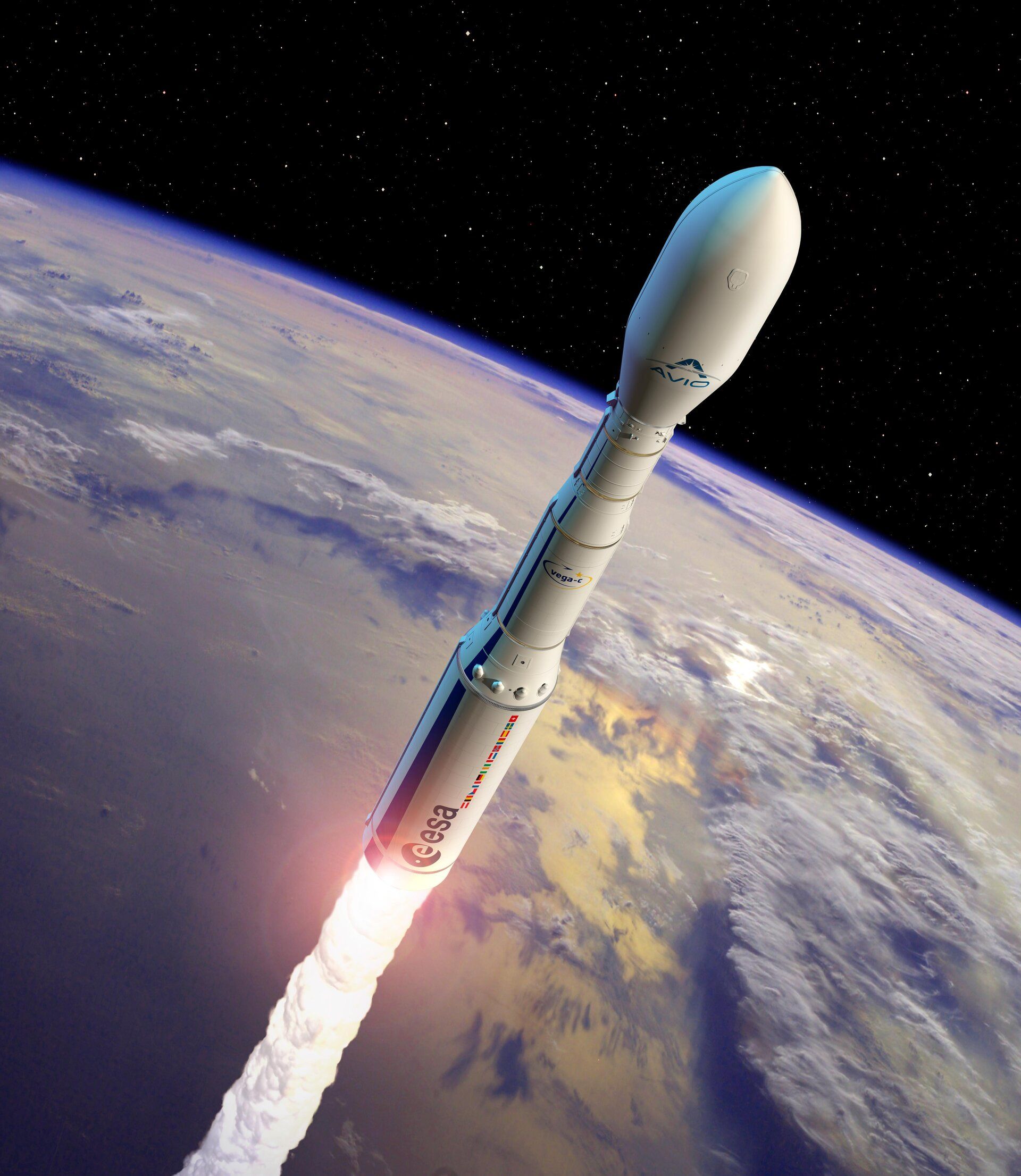
Vega-C is a European expendable orbital launch vehicle developed under the European Space Agency programme, with Italy's Avio serving as prime contractor and design authority. It succeeds the original Vega launcher and was created to provide higher payload performance, greater payload volume and more flexible mission configurations.
The launcher is a single-body, four-stage vehicle with three solid-propellant stages and a reignitable liquid-propellant upper stage. It operates from Europe's Spaceport at the Guiana Space Centre in French Guiana and is intended primarily for missions to low Earth, polar and Sun-synchronous orbits.
Vega-C made its successful maiden flight on 13 July 2022. Following the failure of its second mission in December 2022, the launcher underwent corrective work and returned successfully to flight on 5 December 2024. By September 2026 it was again conducting European institutional Earth-observation missions.
Development
The European Space Agency approved Vega-C development in December 2014 as an evolution of the original Vega launch system. The programme retained the basic four-stage arrangement but introduced two substantially upgraded lower stages, an enlarged payload fairing and an improved upper stage.
Avio leads the launcher programme as prime contractor and design authority. ESA owns the Vega-C programme, while companies and agencies from several European countries contribute to its development and operation. Participating states listed by ESA include Austria, Belgium, the Czech Republic, France, Germany, Ireland, Italy, the Netherlands, Norway, Romania, Spain, Sweden and Switzerland.
The first stage became the P120C solid rocket motor, replacing Vega's smaller P80. The P120C was developed as a common component shared with Ariane 6, where versions of the same motor serve as strap-on boosters. The second stage was replaced by the more powerful Zefiro-40. The Zefiro-9 third stage was retained, while the AVUM upper stage evolved into the AVUM+ configuration with greater propellant capacity.
Flight history
Vega-C's maiden flight on 13 July 2022 successfully placed the LARES 2 satellite and six additional spacecraft into orbit. The second mission, launched on 21 December 2022, failed after a malfunction involving the Zefiro-40 second stage. Two Pléiades Neo Earth-imaging satellites were lost.
The failure led to a prolonged interruption in Vega-C launches while the second-stage motor was investigated and modified. According to the Guiana Space Centre, Vega-C successfully returned to flight on 5 December 2024.
Commercial and operational responsibility also changed. Arianespace initially marketed and operated Vega-C launches. ESA later moved toward direct commercialization by Avio, and by 2026 Avio had begun taking over launch operations.
On 14 September 2026, Vega-C launched the FLEX and Copernicus Sentinel-3C Earth-observation satellites from Kourou, French Guiana. Both spacecraft were successfully released at an altitude of about 820 km, with deployment completed within 116 minutes of launch. The mission demonstrated Vega-C's continued role in European institutional Earth-observation missions. Contemporary mission reporting is available from Space.com.
Design
Vega-C is approximately 35 m tall and has a launch mass of about 210 tonnes. It uses no strap-on boosters. Propulsion is provided sequentially by the P120C, Zefiro-40 and Zefiro-9 solid stages, followed by the liquid-propellant AVUM+ upper stage.
First stage
The P120C first stage replaces the P80 used by the original Vega. ESA states that its monolithic carbon-fibre structure weighs about 8 tonnes and contains 143.6 tonnes of solid propellant. During a burn lasting about two minutes, the motor provides an average thrust of approximately 4,500 kN.
The P120C was designed as a common propulsion element for Vega-C and Ariane 6. This commonality allows the same basic motor technology to support both European launcher families.
Second and third stages
The Zefiro-40 second stage contains about 36.2 tonnes of solid propellant and produces an average thrust of approximately 1,304 kN. It replaced the smaller second stage used on the original Vega and is one of the principal sources of Vega-C's increased performance.
The third stage is the Zefiro-9, derived directly from Vega. It burns about 10 tonnes of solid propellant before separating from the upper stage.
AVUM+ upper stage
The AVUM+, or Attitude Vernier Upper Module, is a reignitable liquid-propellant upper stage responsible for attitude control, precise orbital insertion and deployment of payloads. ESA states that AVUM+ carries about 740 kg of propellant and that its main engine provides an average thrust of approximately 2.42 kN.
The engine can be restarted several times during a mission, allowing Vega-C to place multiple payloads into required orbits. After spacecraft deployment, AVUM+ can perform a final burn to lower its orbit and reduce the amount of hardware left in space.
Payload fairing and adapters
Vega-C uses a carbon-fibre polymer composite payload fairing approximately 3.3 m in diameter and more than 9 m high. The fairing provides roughly twice the payload volume available on the original Vega and protects spacecraft from aerodynamic, acoustic and thermal loads during atmospheric flight.
Several payload accommodation systems are available. The Small Spacecraft Mission Service dispenser supports rideshare missions with combinations ranging from CubeSats to mini-satellites of up to about 400 kg. Vespa-C is intended for missions carrying two larger passengers, while the Vampire adapter is used for a single large payload.
Launch infrastructure
Vega-C launches from the Vega complex at Europe's Spaceport in French Guiana. The facilities were modified for the larger and heavier launcher, including changes to the mobile gantry, crane, platforms, structural reinforcements and fluid services. The French space agency CNES maintains the launch facilities.
Program status
Vega-C is an active European launch system. ESA describes it as part of Europe's independent space transportation capability and as a complement to Ariane 6. Avio serves as prime contractor and design authority and has been taking over commercial exploitation and launch responsibilities previously handled by Arianespace.
The launcher is intended for single-satellite missions, dual-payload missions and rideshares. Its principal applications include scientific spacecraft, Earth-observation satellites and other missions requiring access to low Earth, polar and Sun-synchronous orbits.
Future developments associated with the Vega family include missions with the reusable Space Rider spacecraft and orbital-transfer concepts. ESA also continues development of Vega-E, which is intended to replace Vega-C's Zefiro-9 and AVUM+ stages with a new upper-stage architecture. These developments are separate from the current Vega-C configuration.
Specifications (Vega-C)
General characteristics
- Type: European expendable orbital launch vehicle
- Configuration: Single-body four-stage launcher
- Height: approximately 34.8-35 m
- Diameter: approximately 3.4 m
- Lift-off mass: approximately 210 tonnes
- First stage: P120C solid rocket motor
- Second stage: Zefiro-40 solid rocket motor
- Third stage: Zefiro-9 solid rocket motor
- Fourth stage: AVUM+ reignitable liquid-propellant upper stage
- Launch site: Europe's Spaceport, Guiana Space Centre, French Guiana
Propulsion
- P120C propellant: approximately 143.6 tonnes of solid propellant according to ESA
- P120C average thrust: approximately 4,500 kN
- P120C burn time: about two minutes
- Zefiro-40 propellant: approximately 36.2 tonnes of solid propellant
- Zefiro-40 average thrust: approximately 1,304 kN
- Zefiro-9 propellant: approximately 10 tonnes of solid propellant
- AVUM+ propellant: approximately 740 kg
- AVUM+ main-engine average thrust: approximately 2.42 kN
Payload performance
- Sun-synchronous orbit payload: approximately 2.3 tonnes according to ESA
- Low Earth orbit payload: approximately 3.3 tonnes according to ESA
- Polar-orbit payload: approximately 2.5 tonnes according to ESA
Published payload figures vary with orbital altitude, inclination and mission assumptions. The Guiana Space Centre, for example, gives a figure of about 2.2 tonnes to a 700 km polar orbit. Such values therefore describe different reference missions rather than a single universal payload limit.
Related equipment
- Vega: The predecessor on which Vega-C is based.
- Ariane 6: European launch vehicle that shares the P120C propulsion technology with Vega-C.
- Vega-E: Planned later evolution of the Vega family using a new upper-stage architecture.
Additional background on the launcher's development and flight history is available in the Vega-C reference article.
 Argentina
 Armenia
 Australia
 Austria
 Austria-Hungary
 Belgium
 Brazil
 United Kingdom
 United States
 Brunei
 Bulgaria
 Canada
 Chile
Chile China
China Colonial America
 Colombia
 Confederate States
 Croatia
 Czech
Czech Denmark
 Egypt
Egypt Finland
 France
 Georgia
 Germany
 German Imperial
 Greece
 Holland
 Hungary
 India
India Indonesia
 Iran
Iran Iraq
Iraq Ireland
 Israel
 Japan
Japan Japan (1940)
 Jordan
 Kingdom of Italy
 Malaysia
 Mexico
 Myanmar
 Nazi Germany
 Netherlands
 New Zealand
 North Korea
 Norway
 Pakistan
 Peru
Peru Philippines
 Poland
 Portugal
 Prussia
 Romania
 Russia
 Saudi Arabia
 Serbia
 Singapore
 Slovakia
 Slovenia
 South Africa
 South Korea
 Soviet Union
 Spain
Spain Sweden
 Switzerland
 Syria
Syria Taiwan
 Thailand
 Turkey
 UAE
UAE Ukraine
 Vietnam
 Yugoslavia