
History
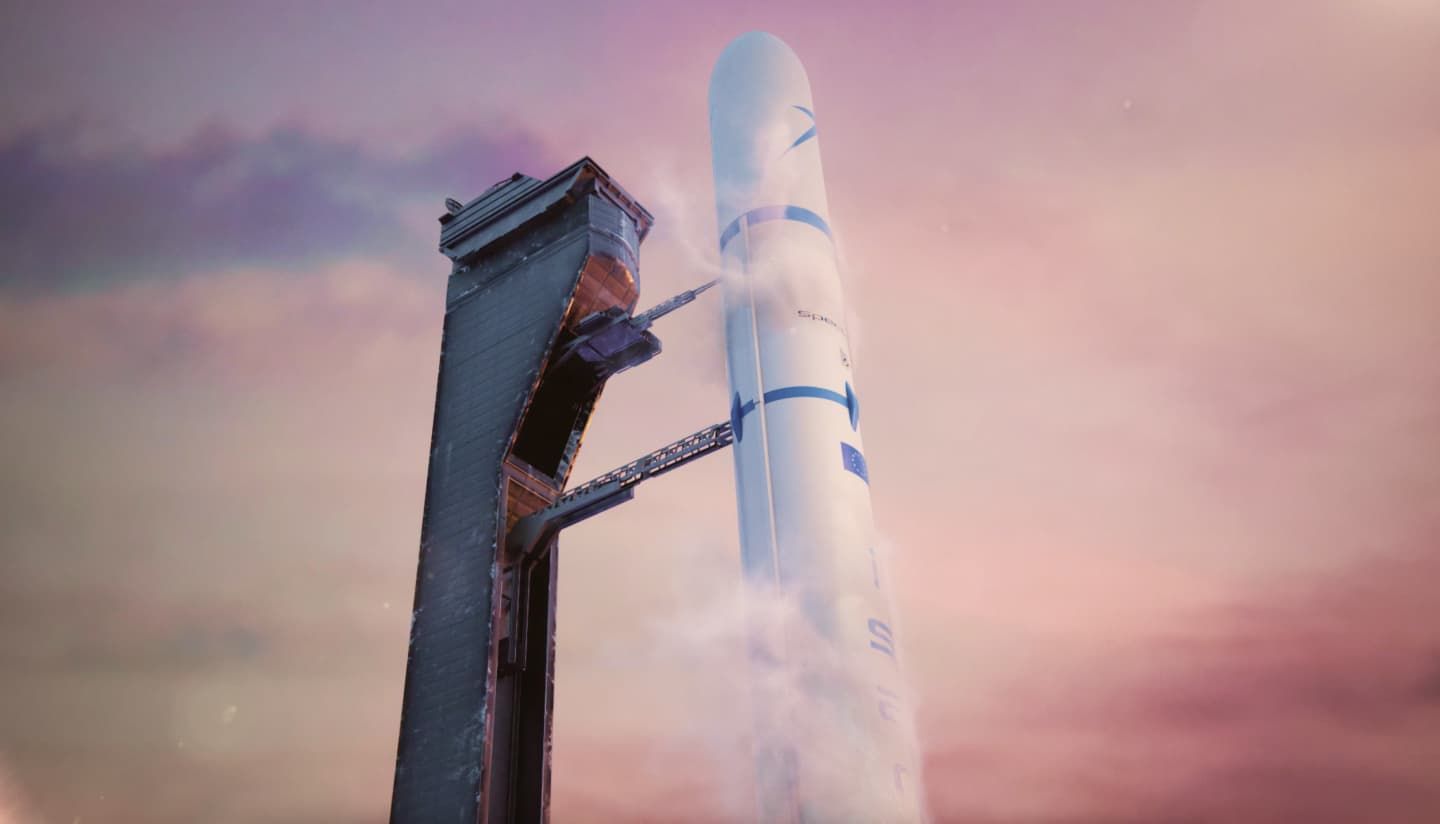
Isar Aerospace Spectrum is a German two-stage orbital launch vehicle developed for small and medium satellites and satellite constellations. The vehicle is 28 m long and 2 m in diameter, with a stated payload capability of up to 1,000 kg to low Earth orbit.
Spectrum is designed and manufactured largely in-house by Isar Aerospace. Its propulsion system uses liquid oxygen and propane, and the two stages employ ten Aquila engines in total.
The rocket made its first flight from Andøya Spaceport in Norway in March 2025. That test ended after about 30 seconds, but a second Spectrum launched from Andøya on 5 September 2026 and successfully reached orbit with payloads aboard.
Development and testing
Isar Aerospace developed Spectrum as a commercial orbital launcher intended to serve small and medium satellite missions. According to the company's Spectrum information, the launch vehicle and its Aquila engines were developed and manufactured in-house.
By March 2023, Isar Aerospace had reported extensive hot-fire testing of the Aquila engine. The engine family uses high-pressure turbopump-fed propulsion. Spectrum's first stage carries nine engines, while its second stage uses one engine.
A static-fire test of the first flight vehicle was conducted on 21 February 2025. The first launch attempt scheduled for 24 March was scrubbed because of high winds. Spectrum eventually lifted off from Andøya Spaceport on 30 March 2025. The test vehicle cleared the launch pad but lost control several seconds later and fell into the sea. The flight lasted about 30 seconds. Although the rocket was destroyed, the test provided flight data for subsequent missions.
The second Spectrum was prepared as a qualification flight carrying actual payloads. The European Space Agency described the mission as carrying five commercial and educational CubeSats together with an experiment intended to demonstrate technologies in orbit and provide educational experience.
On 5 September 2026, Spectrum launched from Andøya Spaceport at 22:12 CEST. The rocket reached orbit just over seven minutes after liftoff. The mission was Spectrum's first successful orbital flight and its first flight carrying payloads. Deutsche Welle reported the achievement as the first time a privately developed rocket had reached orbit from continental Europe.
Design
Spectrum is a two-stage liquid-propellant orbital launch vehicle. It is 28 m long and 2 m in diameter. Isar Aerospace states that it can carry up to 1,000 kg to low Earth orbit and up to 700 kg to Sun-synchronous orbit.
Structure
The rocket uses a carbon-composite structure. Its compact dimensions are combined with liquid oxygen and propane propulsion, which Isar Aerospace selected for the vehicle's Aquila engine system.
Propulsion
The first stage is powered by nine Aquila engines. The second stage uses a single Aquila engine. The engines are high-pressure turbopump-fed units designed and manufactured by Isar Aerospace.
The second-stage engine has multi-ignition capability. This allows the engine to be shut down and restarted when required by the mission profile, reducing the need for a separate kick stage for some missions.
Payload capability
Spectrum is intended for small and medium satellites, including constellation deployment missions. The manufacturer's stated maximum payload is 1,000 kg to low Earth orbit and 700 kg to Sun-synchronous orbit.
Operational history
Spectrum's first flight on 30 March 2025 was a test mission without a payload. The rocket successfully lifted off and cleared the launch site, but the vehicle lost control shortly afterward and was destroyed after falling into the sea.
The second flight on 5 September 2026 was both a qualification mission and Spectrum's first payload-carrying flight. It carried five CubeSats and one non-deploying technology experiment and successfully reached orbit. The flight established Spectrum as an operationally demonstrated orbital launch vehicle, although Isar Aerospace was still working toward expanded production and future commercial missions after the qualification launch.
Specifications (Spectrum)
General characteristics
- Type: Two-stage orbital launch vehicle
- Length: 28 m
- Diameter: 2 m
- Stages: 2
- First-stage engines: 9 Aquila engines
- Second-stage engines: 1 Aquila engine
- Propellants: Liquid oxygen and propane
Payload performance
- Payload to low Earth orbit: Up to 1,000 kg
- Payload to Sun-synchronous orbit: Up to 700 kg
Upper-stage capability
- Engine restart: Multi-ignition second-stage engine capable of shutdown and restart according to mission requirements
 Argentina
 Armenia
 Australia
 Austria
 Austria-Hungary
 Belgium
 Brazil
 United Kingdom
 United States
 Brunei
 Bulgaria
 Canada
 Chile
Chile China
China Colonial America
 Colombia
 Confederate States
 Croatia
 Czech
Czech Denmark
 Egypt
Egypt Finland
 France
 Georgia
 German Imperial
 Greece
 Holland
 Hungary
 India
India Indonesia
 Iran
Iran Iraq
Iraq Ireland
 Israel
 Italy
Italy Japan
Japan Japan (1940)
 Jordan
 Kingdom of Italy
 Malaysia
 Mexico
 Myanmar
 Nazi Germany
 Netherlands
 New Zealand
 North Korea
 Norway
 Pakistan
 Peru
Peru Philippines
 Poland
 Portugal
 Prussia
 Romania
 Russia
 Saudi Arabia
 Serbia
 Singapore
 Slovakia
 Slovenia
 South Africa
 South Korea
 Soviet Union
 Spain
Spain Sweden
 Switzerland
 Syria
Syria Taiwan
 Thailand
 Turkey
 UAE
UAE Ukraine
 Vietnam
 Yugoslavia