
History
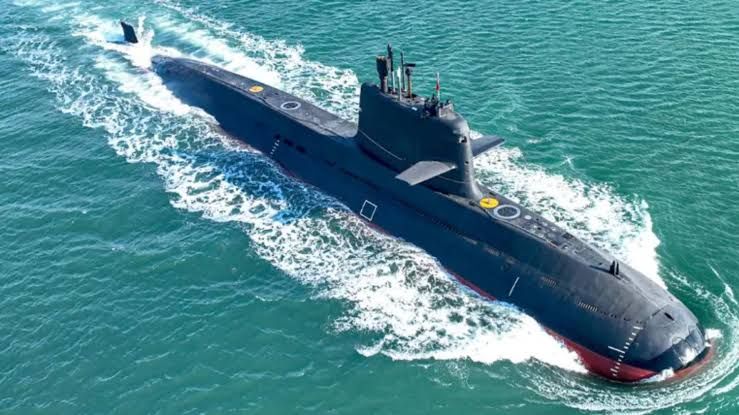
The Hangor class is a Chinese-designed diesel-electric attack submarine class acquired by the Pakistan Navy. It is derived from the Chinese Type 039A/B Yuan-class family and incorporates air-independent propulsion to increase submerged endurance.
Pakistan ordered eight submarines under a 2015 agreement with China Shipbuilding & Offshore International Company. Four boats were assigned to construction in China, while four are being built at Karachi Shipyard & Engineering Works in Pakistan under a technology-transfer arrangement.
The lead boat, PNS Hangor, was launched in China on 26 April 2024 and commissioned at Sanya on 30 April 2026. It arrived in Karachi in June 2026 and subsequently entered operational service with the Pakistan Navy.
Construction programme
Wuchang Shipbuilding Industry Group constructed the first four submarines in China. PNS Hangor was followed by PNS Shushuk, launched on 15 March 2025, PNS Mangro on 15 August 2025, and PNS Ghazi on 17 December 2025. The remaining four submarines are being constructed in Pakistan by Karachi Shipyard & Engineering Works. This 4+4 arrangement is intended to transfer submarine construction experience and supporting industrial capability to Pakistan.
Construction of the first Pakistani-built boat began with steel cutting in December 2021. Work on subsequent locally built submarines has continued as the Chinese-built boats progressed through launch, sea trials, commissioning, and handover.
Design
The Hangor class is an export derivative of the Type 039A family of conventional attack submarines. The design uses a streamlined teardrop-shaped hull intended primarily for submerged operation. Externally, the class retains several characteristics associated with the Yuan-class family, including sail-mounted diving planes and a cruciform stern arrangement.
The submarines use diesel-electric propulsion supplemented by an air-independent propulsion system. AIP permits a conventional submarine to remain submerged for longer periods at low speed without running its diesel engines through a snorkel. The exact AIP configuration installed in the Pakistani boats has not been officially detailed in the supplied evidence, although the related Chinese Yuan-class family uses Stirling-based AIP technology.
The lead submarine has six bow-mounted torpedo tubes. The class is intended to employ heavyweight torpedoes and anti-ship cruise missiles. PNS Hangor also has a stern-mounted anti-countermeasure dispenser system. Claims that the class will operationally carry the Babur-3 submarine-launched cruise missile remain unconfirmed, and no publicly verified nuclear mission for the Hangor class is established in the supplied evidence.
Operational history
PNS Hangor was commissioned into the Pakistan Navy on 30 April 2026 in Sanya, China. After reaching Karachi in June 2026, the submarine entered operational service.
On 27 September 2026, PNS Hangor carried out the first publicly disclosed missile firing by the lead boat after commissioning. During the exercise in the North Arabian Sea, the submarine successfully engaged a designated long-range target with an anti-ship cruise missile. The specific missile type was not identified in the supplied evidence.
Operators
- Pakistan Navy: Eight Hangor-class submarines were ordered. Four were allocated to construction in China and four to construction in Pakistan under a technology-transfer programme. PNS Hangor entered service in 2026.
Specifications (Hangor class)
General characteristics
- Type: Diesel-electric attack submarine with air-independent propulsion
- Displacement: 2,800 tonnes
- Length: 76 m
- Draught: 6.2 m
Armament
- Torpedo tubes: Six bow-mounted tubes
- Weapons: Heavyweight torpedoes and anti-ship cruise missiles
Related equipment
- Type 039A/B Yuan class: Chinese diesel-electric attack submarine family from which the Hangor class is derived.
 Argentina
 Armenia
 Australia
 Austria
 Austria-Hungary
 Belgium
 Brazil
 United Kingdom
 United States
 Brunei
 Bulgaria
 Canada
 Chile
Chile Colonial America
 Colombia
 Confederate States
 Croatia
 Czech
Czech Denmark
 Egypt
Egypt Finland
 France
 Georgia
 Germany
 German Imperial
 Greece
 Holland
 Hungary
 India
India Indonesia
 Iran
Iran Iraq
Iraq Ireland
 Israel
 Italy
Italy Japan
Japan Japan (1940)
 Jordan
 Kingdom of Italy
 Malaysia
 Mexico
 Myanmar
 Nazi Germany
 Netherlands
 New Zealand
 North Korea
 Norway
 Pakistan
 Peru
Peru Philippines
 Poland
 Portugal
 Prussia
 Romania
 Russia
 Saudi Arabia
 Serbia
 Singapore
 Slovakia
 Slovenia
 South Africa
 South Korea
 Soviet Union
 Spain
Spain Sweden
 Switzerland
 Syria
Syria Taiwan
 Thailand
 Turkey
 UAE
UAE Ukraine
 Vietnam
 Yugoslavia