
History
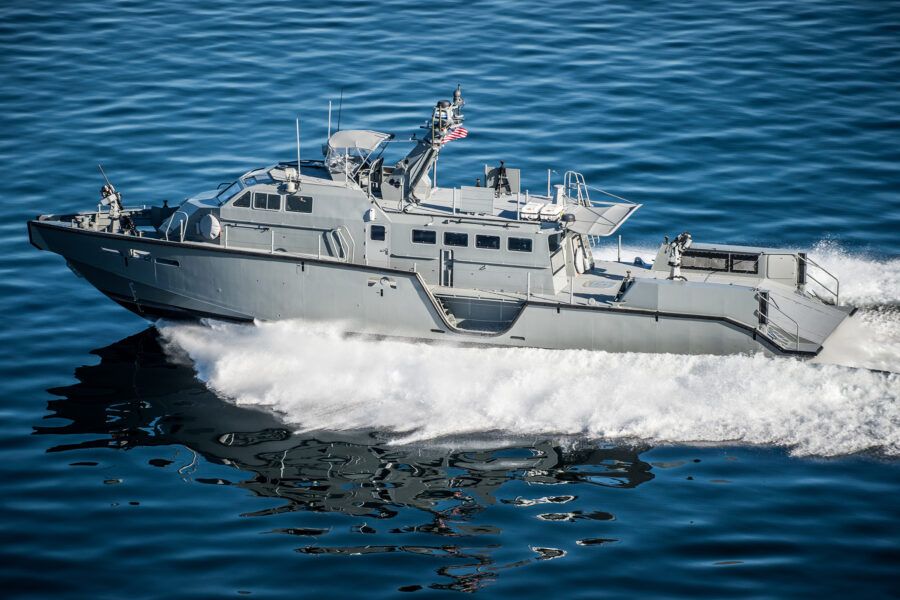
The Mk VI Patrol Boat is a class of high-speed patrol vessel designed and built by SAFE Boats International (SBI) for the United States Navy. It was the first mission-specific patrol boat designed for the Navy since the mid-1980s, replacing the smaller Riverine Command Boat for open-water and near-shore littoral operations. The boat represents a shift in Navy focus from Cold War-era blue-water engagements toward brown-water littoral warfare. Despite its designation, the Mk VI is not a successor to the Mark V Special Operations Craft operated by Special Warfare Combatant Crewmen from 1998 to 2012.
A one-off Coastal Command Boat (CCB) prototype, 65 feet (20 m) long, was delivered to the Navy in 2013 to develop systems, procedures, and requirements for the production Mark VI. It was deployed to the U.S. 5th Fleet in Bahrain in February 2014 to evaluate tactics in advance of the Mark VI's planned deployment and was returned to the United States for deactivation in 2018 after the final Mark VI arrived in Bahrain.
SAFE Boats delivered the first of 12 production boats to the Navy in August 2014. Coastal Riverine Group Two (CRG 2) took ownership of the first two on 8 September 2015. Two boats were forward-deployed to Bahrain in April 2016 to support 5th Fleet operations in the Persian Gulf. Coastal Riverine Group One (CRG 1) received two boats in 2016 and deployed them to Guam in 2017. A third boat was sent to Bahrain in 2018. Delivery of the full complement of 12 was completed by the end of 2018. The Navy had originally planned to acquire 48 boats but limited the order to 12 due to reliability concerns and high maintenance costs.
In June 2020, the U.S. State Department approved a Foreign Military Sales case for up to 16 Mk VI patrol boats for Ukraine. Twelve were ordered in January 2022 and are being built at SBI's facility in Tacoma, Washington. The Ukrainian boats are armed with 30 mm naval guns in place of the 25 mm weapons fitted to U.S. Navy boats. In 2026, the Michigan National Guard began using an ex-Navy Mk VI acquired through the Defense Logistics Agency on Lake Huron for maritime surface warfare training.
During Bayonet Quest 26, conducted from 26 September to 6 October 2026 in Michigan, the U.S. Army tested the Mk VI patrol boat alongside autonomous fixed-wing aircraft and unmanned surface vessels as part of a Pacific-focused formation. The boat served as a mobile hub for launch, recovery, and coordination of crewed and uncrewed systems in a littoral environment. A UAV was recovered on the fantail while the boat remained underway, and unmanned surface craft formed up with the crewed vessel. The boat was operated by a SIX Maritime crew. The Army has not publicly released the full list of autonomous systems, software architecture, or command-and-control suite used during the trials. Visible unmanned surface vessels appear consistent with Saronic's 24-foot Corsair (35+ knots, 1,000+ nautical mile range) and, in one case, the Ukrainian MAGURA V5 (5.5 m, approximately 42 knots, 450 nautical mile range), though the Army has not confirmed these identifications.
Design
The Mk VI has a fully aluminum hull measuring 84.8 ft (25.8 m) in length and 20.5 ft (6.2 m) in beam, with a draft of less than 5 ft (1.5 m). The design is derived from SBI's 780 Archangel class. Advanced lightweight armor plating protects the crew compartment, engines, and fuel tanks. The boat fits inside the well decks of landing helicopter docks, amphibious transport docks, and landing ship docks for transport and deployment. Its mast lowers to reduce overall height for well-deck entry.
The propulsion system integrates two MTU 16V2000 M94 diesel engines producing a combined 5,200 hp, driving two Hamilton HM651 water jets. The engines can burn both marine-grade diesel and JP-5 aviation fuel. Sprint speed exceeds 35 knots (Navy data); other sources cite a maximum of 45 knots. Range is over 600 nautical miles. The shallow draft permits operation close to shore in littoral waters and the boat can operate in brown, green, or blue water.
Standard armament consists of two remotely operated Mk 38 Mod 2 25 mm chain guns, four MK 50 Gun Weapon System mounts (a shipboard adaptation of the M153 CROWS remote turret allowing operators to engage from a below-deck station), and six crew-served M2HB .50 caliber machine guns. Gun mounts can be configured with M240 7.62 mm machine guns, M134 miniguns, or Mk 19 40 mm grenade launchers depending on mission requirements. Provision exists for guided missile mounts, including the BGM-176B Griffin.
The interior accommodates 10 crew members in two five-person teams plus an eight-person Visit, Board, Search, and Seizure team, for a total complement of 18. The pilothouse features shock-mitigating seats with integrated work stations to reduce injury and fatigue. A reconfigurable main aft cabin can be arranged for special operations forces operators, a medical triage area, berthing, or unmanned systems operations. The boat is fully networked with a C4SI (command, control, communications, computing, surveillance, and intelligence) suite including flat-screen monitors throughout. The rear deck and stern support launch and recovery of small boats, unmanned aerial vehicles, unmanned surface vehicles, and unmanned underwater vehicles.
Operational history
Two Mk VI patrol boats were forward-deployed to Bahrain in April 2016 under Task Force 56, marking the first use of the class in a combat area. They replaced the less capable Riverine Command Boats previously assigned to the 5th Fleet. In 2017, CRG 1 boats were deployed to Guam. A third boat was sent to Bahrain in 2018, completing the initial Gulf deployment. In December 2018, two Mark VI boats completed a 500 nautical mile transit demonstrating long-range endurance.
In 2021 the Navy planned to retire the 12 Mark VI boats but cancelled the decision in April 2021. The boats entered a period of funding uncertainty in 2022, and the Navy stated in December 2022 that it would not request funding for Mk VI operations in FY2023 or beyond. Several boats were stored at a Fairlead facility in Newport News, Virginia. The Navy indicated that the Littoral Combat Ship would fulfill the roles previously associated with the Mark VI.
In 2026, an ex-Navy Mk VI was transferred to the Michigan National Guard through the Defense Logistics Agency, where it is used on Lake Huron to simulate fast-attack boat operations and support pilot training in maritime surface warfare. The same year, the boat participated in Bayonet Quest 26 with autonomous drones, demonstrating its evolving role as a crewed-uncrewed teaming platform for distributed littoral operations in support of Pacific-focused Army formations.
Variants
- Mk VI Patrol Boat (U.S. Navy standard) – 12 boats built 2014–2018, armed with Mk 38 Mod 2 25 mm chain guns and M2HB .50 cal machine guns.
- Coastal Command Boat (CCB) – One-off developmental prototype, 65 ft (20 m) long, delivered 2013. Engine, armament, and systems otherwise identical to the Mk VI, though the smaller size gives over 24 hours endurance at cruise speed. Deployed to Bahrain 2014–2018 for tactical evaluation, then deactivated due to unique configuration and parts-support challenges.
- Ukrainian FMS variant – 12 boats ordered under Foreign Military Sales in January 2022, built in Tacoma, Washington. Armed with 30 mm naval guns in place of the U.S. Navy 25 mm Mk 38. Sources differ on the specific 30 mm weapon: U.S. Navy materials identify the Mk 44 Bushmaster II, while other references cite the MSI Systems Seahawk A2A2.
Operators
- United States Navy – 12 Mk VI patrol boats, in service from 2015. Forward deployments to Bahrain and Guam ended; boats placed in storage or transferred by 2026 due to funding decisions.
- Ukraine – 12 boats ordered (of 16 approved) in January 2022. Built in Tacoma, Washington. Deliveries expected to be completed by March 2026. Armed with 30 mm naval guns.
- U.S. Army (Michigan National Guard) – At least one ex-Navy Mk VI acquired in 2026 for maritime training and autonomous systems integration on Lake Huron.
Specifications (U.S. Navy Mk VI Patrol Boat)
General characteristics
- Type: High-speed patrol boat
- Built: 2014–2018 (12 boats)
- Builder: SAFE Boats International, Tacoma, Washington
- Displacement: 144,000 lb (65,300 kg) light; 170,000 lb (77,100 kg) full load
- Length: 84.8 ft (25.8 m) LOA
- Beam: 20.5 ft (6.2 m)
- Draft: less than 5 ft (1.5 m)
- Complement: 10 crew + 8 passengers (18 total)
- Cost: US$15 million per boat
Performance
- Propulsion: 2 × MTU 16V2000 M94 diesel engines, 5,200 hp combined; 2 × Hamilton HM651 water jets
- Speed: 25+ knots cruise; 35+ knots sprint (Navy data); 45 knots maximum cited by other sources
- Range: over 600 nautical miles
Armament
- Naval guns: 2 × Mk 38 Mod 2 25 mm remotely operated chain guns
- Remote weapon systems: 4 × MK 50 Gun Weapon System (.50 cal)
- Crew-served weapons: 6 × M2HB .50 cal machine guns; mounts configurable for M240 7.62 mm, M134 minigun, or Mk 19 40 mm grenade launcher
Systems
- Sensors and C4SI: Full networked command, control, communications, computing, surveillance, and intelligence suite with flat-screen monitors
- Protection: Advanced lightweight armor around crew compartment, engines, and fuel tanks
- Unmanned systems support: Rear deck and stern for UAV, USV, UUV, and CRRC launch and recovery
- Transportability: Fits well decks of LHD, LPD, and LSD amphibious ships; mast lowers for deck entry
Related equipment
- Riverine Command Boat – Predecessor patrol boat replaced by the Mk VI in Task Force 56 littoral operations.
- 40-foot Patrol Boat (40PB) – Smaller Navy harbor and river sentry boat built by Metal Shark; not a direct Mk VI replacement but fills a complementary coastal security role.
- Combatant Craft Medium – U.S. Special Operations Command small boat in procurement for Special Operations Forces, with a proposed Mark 50 remote gun similar to the Mk VI's remote weapon system.
 Argentina
 Armenia
 Australia
 Austria
 Austria-Hungary
 Belgium
 Brazil
 United Kingdom
 Brunei
 Bulgaria
 Canada
 Chile
Chile China
China Colonial America
 Colombia
 Confederate States
 Croatia
 Czech
Czech Denmark
 Egypt
Egypt Finland
 France
 Georgia
 Germany
 German Imperial
 Greece
 Holland
 Hungary
 India
India Indonesia
 Iran
Iran Iraq
Iraq Ireland
 Israel
 Italy
Italy Japan
Japan Japan (1940)
 Jordan
 Kingdom of Italy
 Malaysia
 Mexico
 Myanmar
 Nazi Germany
 Netherlands
 New Zealand
 North Korea
 Norway
 Pakistan
 Peru
Peru Philippines
 Poland
 Portugal
 Prussia
 Romania
 Russia
 Saudi Arabia
 Serbia
 Singapore
 Slovakia
 Slovenia
 South Africa
 South Korea
 Soviet Union
 Spain
Spain Sweden
 Switzerland
 Syria
Syria Taiwan
 Thailand
 Turkey
 UAE
UAE Ukraine
 Vietnam
 Yugoslavia