
History
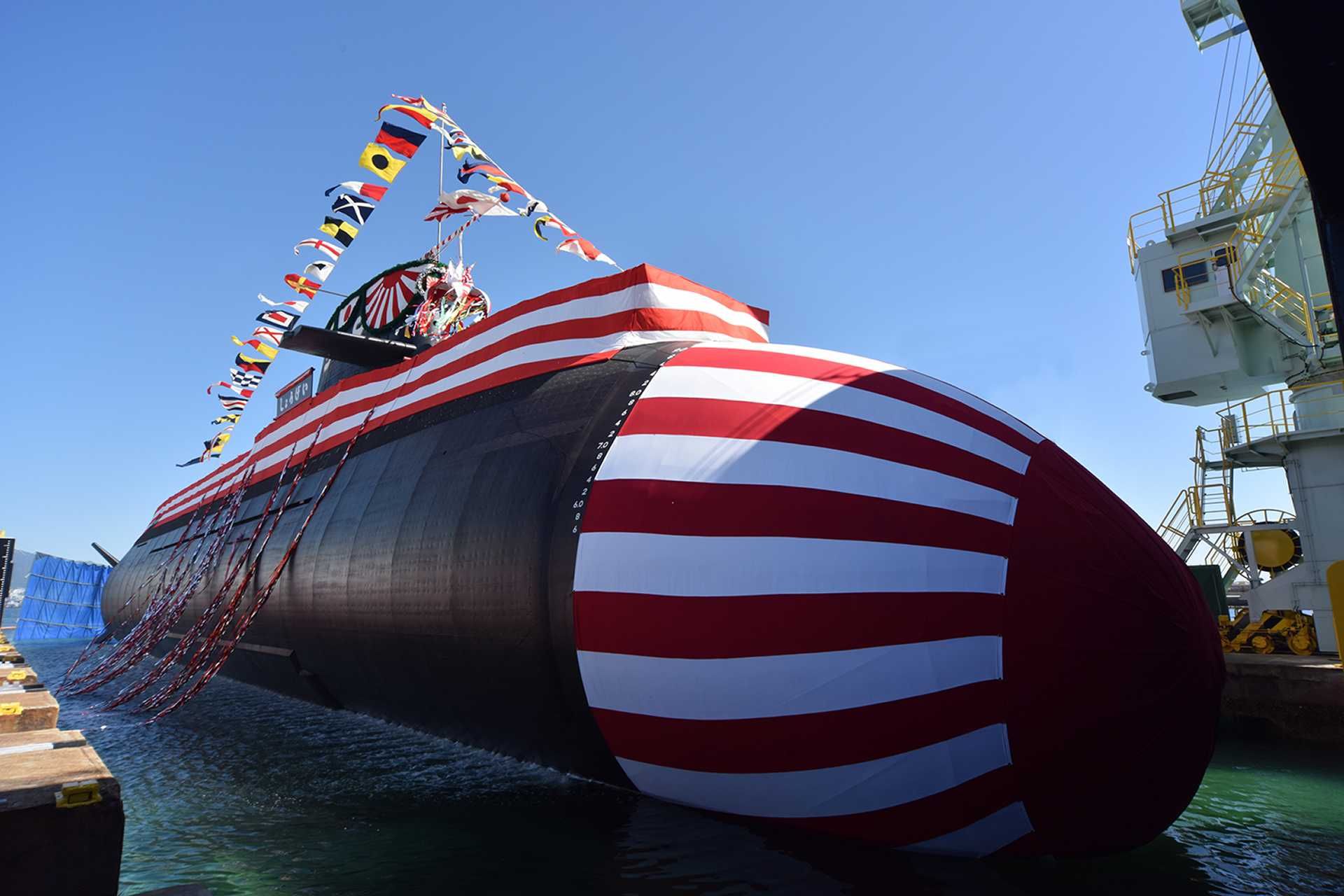
The JS Shogei (SS-519) is the seventh Taigei-class diesel-electric attack submarine constructed for the Japan Maritime Self-Defense Force (JMSDF). Laid down on 17 April 2024 at Mitsubishi Heavy Industries (MHI) Kobe shipyard in Hyogo Prefecture, the vessel was launched on 8 October 2026 in a ceremony attended by 300 participants. The launch marked the fourth Taigei-class submarine built by MHI and the 32nd submarine constructed at the Kobe facility since World War II. Following outfitting and sea trials, the submarine is scheduled for formal commissioning in March 2028. Construction cost ¥80.5 billion (approximately $509 million).
The Taigei-class continues Japan's three-decade transition from lead-acid batteries toward larger lithium-ion energy reserves. Japan began submarine lithium-ion battery research in fiscal 1997 and first introduced the technology operationally aboard the Soryu-class submarine JS Oryu in March 2020. Unlike the first ten Soryu-class submarines, which used Stirling air-independent propulsion (AIP) engines for underwater operation, the Taigei-class relies on stored lithium-ion battery energy when submerged and diesel generators when snorkeling.
Specifications
The JS Shogei measures 84 meters in length, 9.1 meters in beam, and 10.4 meters in hull depth, with a standard displacement of 3,000 tonnes and a crew of 70.
Propulsion combines two Kawasaki 12V 25/31 diesel generators and high-capacity lithium-ion battery storage driving a single propeller shaft, for a total output of 4,413 kW (6,000 metric horsepower). Reported maximum submerged speed reaches 20 knots (37 km/h). The lithium-ion batteries allow the submarine to remain submerged longer, operate at higher speeds on battery power, and recharge faster than earlier lead-acid systems, reducing time spent at snorkeling depth and exposure to detection.
Armament consists of six 533 mm bow torpedo tubes capable of deploying Type 18 heavyweight torpedoes and UGM-84L Harpoon Block II anti-ship missiles with a reported range of 248 kilometers (134 nautical miles). The submarine also carries torpedo countermeasures derived from equipment introduced aboard the final four Soryu-class submarines.
The sensor suite includes the ZQQ-8 integrated sonar combining a conformal bow array, flank arrays, and a fiber-optic towed array, processed by the OYX-1 subsystem with contacts displayed on the ZQX-12 tactical system for classification, tracking, and weapon employment. Additional equipment comprises the NZLR-2 electronic support system for detecting electromagnetic emissions, the ZPS-6H navigation radar, and non-hull-penetrating optronic masts that transmit imagery electronically rather than requiring a conventional optical tube through the pressure hull. Floating machinery mounts, developed between 2007 and 2014, decouple machinery vibrations from the hull to reduce acoustic signature and improve resistance to external shock.
 Argentina
 Armenia
 Australia
 Austria
 Austria-Hungary
 Belgium
 Brazil
 United Kingdom
 United States
 Brunei
 Bulgaria
 Canada
 Chile
Chile China
China Colonial America
 Colombia
 Confederate States
 Croatia
 Czech
Czech Denmark
 Egypt
Egypt Finland
 France
 Georgia
 Germany
 German Imperial
 Greece
 Holland
 Hungary
 India
India Indonesia
 Iran
Iran Iraq
Iraq Ireland
 Israel
 Italy
Italy Japan (1940)
 Jordan
 Kingdom of Italy
 Malaysia
 Mexico
 Myanmar
 Nazi Germany
 Netherlands
 New Zealand
 North Korea
 Norway
 Pakistan
 Peru
Peru Philippines
 Poland
 Portugal
 Prussia
 Romania
 Russia
 Saudi Arabia
 Serbia
 Singapore
 Slovakia
 Slovenia
 South Africa
 South Korea
 Soviet Union
 Spain
Spain Sweden
 Switzerland
 Syria
Syria Taiwan
 Thailand
 Turkey
 UAE
UAE Ukraine
 Vietnam
 Yugoslavia