
History
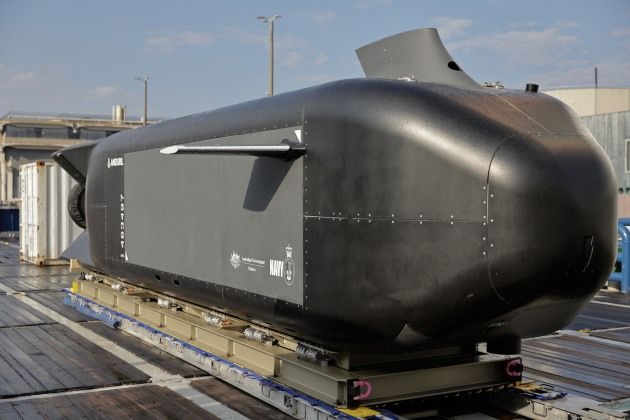
Anduril Industries signed a contract with the Royal Australian Navy and the Defence Science and Technology Group (DSTG) in May 2022 to produce three prototype extra-large autonomous undersea vehicles over a three-year period. The program was designated Ghost Shark in December 2022. The first prototype, designated Alpha, was publicly revealed in Sydney in April 2024; at the unveiling, Anduril Australia and the Department of Defence stated the project was on budget and ahead of schedule, with trials having been underway for an undisclosed period. Three prototypes were ordered for the Royal Australian Navy and one for the United States Navy. In mid-2024, a Ghost Shark was transported to Hawaii aboard a Royal Australian Air Force C-17A Globemaster III for trials during Exercise RIMPAC.
In August 2024, the Australian Government and Anduril reached an agreement to co-fund initial preparations for large-scale domestic production, with Defence contributing an additional A$20.1 million to the A$140 million already jointly invested. On 20 August 2025, Minister for Defence Industry Pat Conroy announced the Department of Defence was negotiating full-rate production, noting the three-prototype contract had been delivered a year earlier than scheduled. On 10 September 2025, Minister for Defence Richard Marles announced the acquisition of a fleet of dozens of Ghost Shark vehicles under an A$1.7 billion investment for the fleet (the total contract value was given as A$1.8 billion), with in-service entry planned from early 2026. More than 40 Australian companies participate in the Ghost Shark supply chain, and Anduril has invested A$60 million in a robotic manufacturing facility in Australia.
On 19 October 2026, the Australian government announced three new payload capabilities for Ghost Shark and released the first public photographs of the vehicle's payload bay, taken during a visit to the Anduril Australia factory in Sydney by Minister Conroy. The payloads are to be demonstrated during Exercise Maritime Big Play Pacific in San Diego, an AUKUS Pillar II activity focused on advanced maritime capabilities and interoperability.
Design
Ghost Shark does not employ a conventional pressure hull. Its interior uses a flooded design with sealed waterproof zones protecting key propulsion, navigation, and payload systems, an approach that improves range and endurance and permits operation at extreme depths. The vehicle is highly modular: the nose and tail are distinct sections joined by an expandable mid-section, and the payload bay can be reconfigured using different-sized modular hull sections to suit varying mission requirements.
Propulsion, navigation, and mission decision-making are controlled by Anduril's Lattice artificial-intelligence and machine-learning software framework, which builds on technology developed for the company's smaller Dive-LD autonomous underwater vehicle. The prototype revealed at Fleet Base East in Sydney Harbour measured more than two metres in height and substantially exceeded the Dive-LD's 5.8-metre length; estimated overall dimensions are approximately 12 metres in length and 2 metres in draught. The vehicle can be launched from onshore sites or from warships, and has been transported in a standard shipping container aboard a C-17A airlifter.
Payload and Capabilities
Following classified trials, the Department of Defence approved three payload options for Ghost Shark, announced on 19 October 2026:
- Sea-mine deployment: up to 12 sea mines per mission. A Rheinmetall Asteria 533-mm-diameter mine was displayed alongside a Ghost Shark during the announcement; the Asteria is remotely controlled via an acoustic link and is optimised for the defence of harbours, straits, ports, and other critical areas.
- Aerial drone launch: Anduril ALTIUS fixed-wing, tube-launched drones can be deployed in numbers to conduct intelligence, surveillance, and reconnaissance or strike missions. The Department has not disclosed which specific ALTIUS variants will be loaded; Anduril offers the ALTIUS-600 and ALTIUS-700 for ISR and the ALTIUS-600M and ALTIUS-700M for strike. The ALTIUS-600 has an overall weight of approximately 9–12 kg (20–27 lb) including a payload of 1.4–3.2 kg (3–7 lb), a maximum range of approximately 440 km (275 miles), and an endurance of at least four hours; unarmed variants are designed to be recoverable and reusable, although the practicality of recovery after launch from a UUV is unclear.
- Seabed supply caches: Ghost Shark can position equipment and supplies on the seabed for later retrieval, supporting forces operating in areas where conventional resupply is difficult or risky. The cache payloads, under development by DSTG, are expected to take the form of capsules.
Ghost Shark is intended to complement the Royal Australian Navy's crewed submarine fleet by assuming resource-intensive clandestine intelligence, surveillance, and signal-intelligence missions as well as offensive tasks such as covert sea-mine laying. Under AUKUS Pillar II, Australia, the United Kingdom, and the United States are collaborating on Ghost Shark and its associated capabilities, with the three nations having pledged to develop interchangeable payloads for undersea unmanned platforms. The operational concept includes deployment from a shipping container or launch from the back of a small vessel using a crane; Minister Conroy noted that a range of other countries had expressed interest in acquiring the vehicle. Australia's 2026 National Defence Strategy allocates up to A$5.8 billion over the decade to autonomous and uncrewed undersea warfare capabilities, of which the A$1.7 billion Ghost Shark fleet investment forms a component.
 Argentina
 Armenia
 Austria
 Austria-Hungary
 Belgium
 Brazil
 United Kingdom
 United States
 Brunei
 Bulgaria
 Canada
 Chile
 China
 Colonial America
 Colombia
 Confederate States
 Croatia
 Czech
 Denmark
 Egypt
 Finland
 France
 Georgia
 Germany
 German Imperial
 Greece
 Holland
 Hungary
 India
 Indonesia
 Iran
 Iraq
 Ireland
 Israel
 Italy
 Japan
 Japan (1940)
 Jordan
 Kingdom of Italy
 Malaysia
 Mexico
 Myanmar
 Nazi Germany
 Netherlands
 New Zealand
 North Korea
 Norway
 Pakistan
 Peru
 Philippines
 Poland
 Portugal
 Prussia
 Romania

 Russia
 Saudi Arabia
 Serbia
 Singapore
 Slovakia
 Slovenia
 South Africa
 South Korea
 Soviet Union
 Spain
 Sweden
 Switzerland
 Syria
 Taiwan
 Thailand
 Turkey
 UAE
 Ukraine
 Vietnam
 Yugoslavia