
History
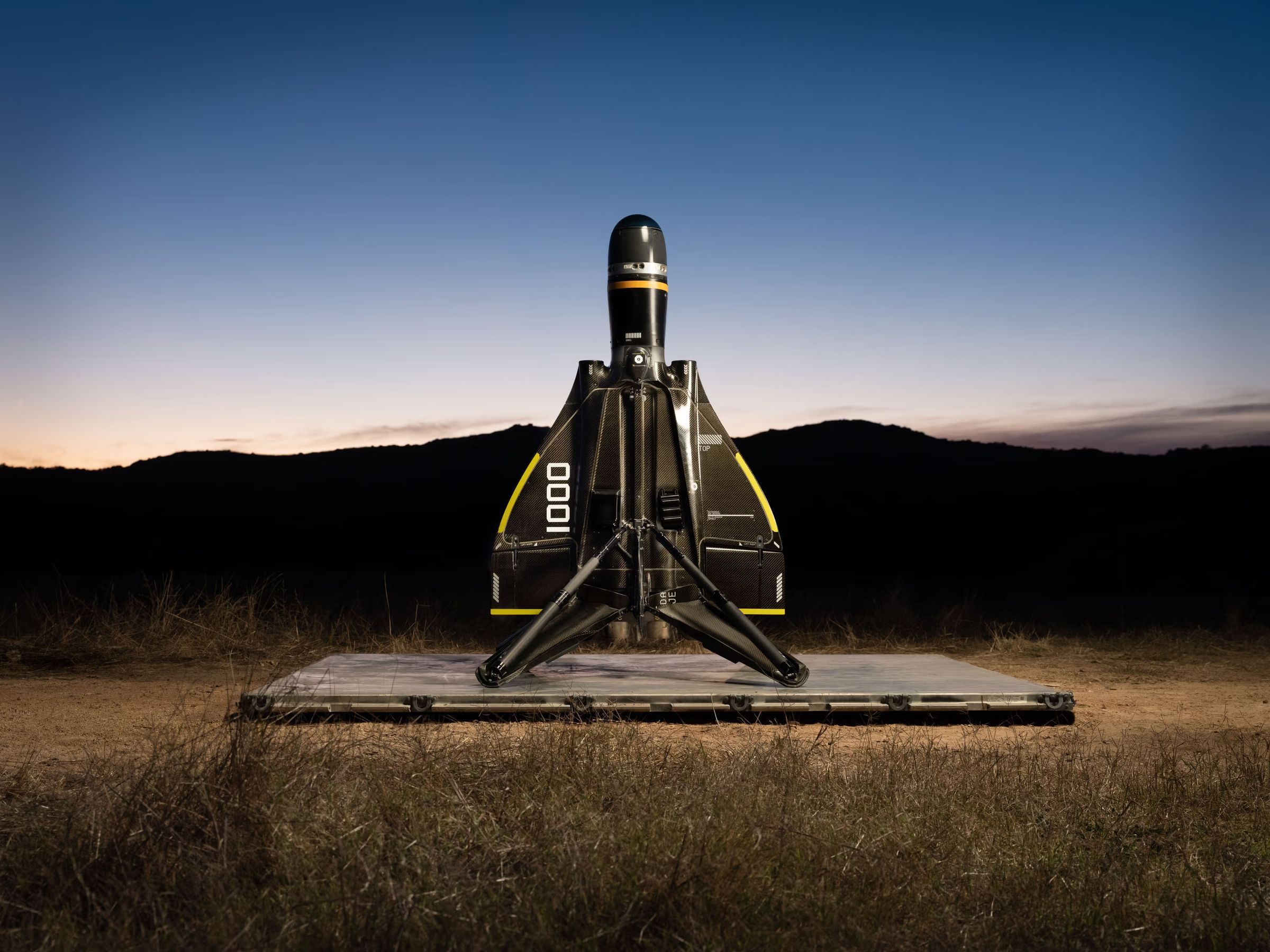
Anduril Industries, a California-based defence technology company, revealed the Roadrunner in December 2023, after approximately two years of development. The company initially described the platform as a "reusable missile" falling between a munition and a conventional uncrewed aircraft. Two variants were presented: the baseline Roadrunner, positioned as an intelligence, surveillance, and reconnaissance (ISR) and airborne sensing platform, and the Roadrunner-M, a low-cost drone interceptor armed with a high-explosive warhead.
According to Anduril, the Roadrunner has been deployed for combat evaluation since January 2024. In October 2024, the Pentagon awarded Anduril a $250 million contract for delivery of at least 500 Roadrunner-M units; the funding was linked to the US Army's research, development, test, and evaluation account, though the specific receiving branch was not identified. In March 2025, the US Navy announced its intent to equip some Arleigh Burke class destroyers with Roadrunner-M alongside Coyote Block 2 loitering interceptors, providing a more cost-effective defence option against low- and medium-performance attack drones than expending full-sized surface-to-air missiles.
In September 2026, Anduril submitted a petition to the Federal Aviation Administration (FAA) requesting permission to conduct developmental test flights of the ISR Roadrunner variant at an access-controlled private test range in rural west Texas, on land leased by the company. The exact location is withheld from public documents. Anduril stated that a dedicated private range is needed to supplement existing flight testing on US government-owned facilities, citing the need to fly many sorties in close succession on its own schedule so that development is not gated by the availability of federal test infrastructure. The company is requesting a renewable three-year approval. Although Anduril's website describes the Roadrunner as an autonomous air vehicle, the FAA filing indicates that developmental flight testing will be overseen by a certified remote pilot-in-command at a local ground control station, with a qualified safety pilot able to assume direct manual control at any time via an independent controller on a separate radio link.
Kuwait has requested permission from the US government to purchase Roadrunner-M units alongside Anduril's smaller Anvil drone interceptor, Lattice software, and other products. The total package was valued at nearly $2 billion by the US State Department, which approved the possible sale in June 2026. Specific quantities have not been revealed and a contract has not been finalised. Anduril's Arsenal-1 production line is slated to come online by the end of 2026.
Variants
Roadrunner — The baseline variant is configured for ISR and airborne sensing missions. Its payload consists of installed sensing, computing, and communications equipment, with no releasable stores and no hazardous material other than fuel. The platform can be equipped with modular payloads including EO/IR gimbals, SIGINT sensors, electronic warfare systems, or communications relay equipment.
Roadrunner-M — A dedicated surface-to-air loitering interceptor equipped with a high-explosive warhead. It is primarily intended to counter unmanned aerial systems but can also engage cruise missiles or low-flying manned aircraft. After launch, Roadrunner-M can loiter in a designated area for potential targets. On operator command it can autonomously attack an identified target or return to base for reuse if no engagement occurs or the mission is aborted.
Specifications
Exact performance figures such as range, top speed, or loiter time have not been made public. Confirmed physical and design characteristics include:
- Length: approximately 1.5 m (5 ft)
- Wing configuration: delta wing
- Propulsion: two internally designed thrust-vectoring turbojet engines
- Launch: vertical from a ground-based container (Nest) under its own power
- Recovery: vertical landing using retractable landing struts
- Flight regime: high subsonic speed with high-G manoeuvring capability
- Modular payload bay for mission-specific equipment
Anduril stated at the December 2023 unveiling that the cost per air vehicle was in the "low hundreds of thousands" of dollars, with expectations of further reduction once the platform enters large-scale production.
 Argentina
 Armenia
 Australia
 Austria
 Austria-Hungary
 Belgium
 Brazil
 United Kingdom
 Brunei
 Bulgaria
 Canada
 Chile
Chile China
China Colonial America
 Colombia
 Confederate States
 Croatia
 Czech
Czech Denmark
 Egypt
Egypt Finland
 France
 Georgia
 Germany
 German Imperial
 Greece
 Holland
 Hungary
 India
India Indonesia
 Iran
Iran Iraq
Iraq Ireland
 Israel
 Italy
Italy Japan
Japan Japan (1940)
 Jordan
 Kingdom of Italy
 Malaysia
 Mexico
 Myanmar
 Nazi Germany
 Netherlands
 New Zealand
 North Korea
 Norway
 Pakistan
 Peru
Peru Philippines
 Poland
 Portugal
 Prussia
 Romania
 Russia
 Saudi Arabia
 Serbia
 Singapore
 Slovakia
 Slovenia
 South Africa
 South Korea
 Soviet Union
 Spain
Spain Sweden
 Switzerland
 Syria
Syria Taiwan
 Thailand
 Turkey
 UAE
UAE Ukraine
 Vietnam
 Yugoslavia