
History
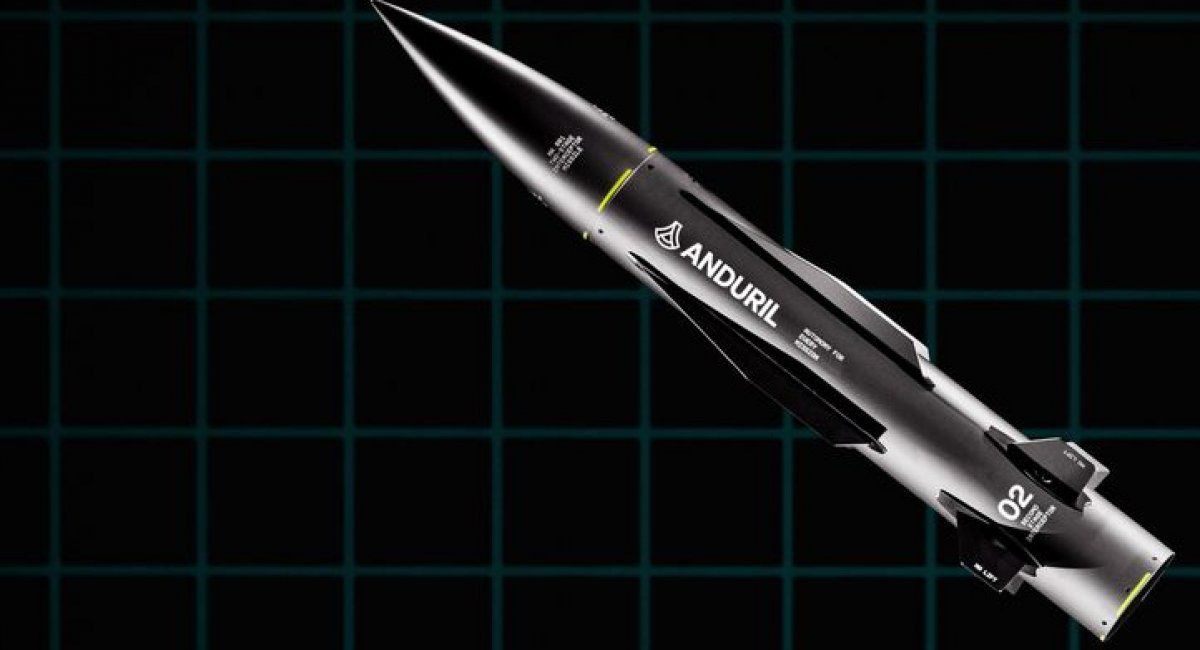
Anduril Industries unveiled the Steelfin family of surface-to-air interceptor missiles on 12 October 2026. The company stated it has been developing the system for several years with investment from multiple customers and has completed ballistic testing using representative air vehicles. Flight testing of Steelfin variants is planned to begin in 2027. Anduril has not previously developed or produced a surface-to-air missile, though its Roadrunner system provides experience in countering aerial threats including loitering munitions.
Anduril is planning near-term production on the order of several thousand missiles annually, using a shared production base across variants with capacity designed to expand or shift according to demand. Full-rate production is targeted for late 2028 or early 2029. The company stated it is working with a number of customers to field the system.
Design
Steelfin uses a two-stage architecture comprising a first-stage solid-rocket booster, which determines range and flight characteristics, and a second-stage terminal interceptor. All variants share a common baseline airframe, avionics, software, flight control system, and interfaces. The modular, open-system design allows different rocket motors, seekers, and terminal-stage components to be swapped to tailor configurations to specific missions. Both hit-to-kill and blast-fragmentation terminal-stage interceptors are planned for the family.
Anduril is looking at 10-inch, 18-inch, and 21-inch boosters, as well as quad-pack and dual-pack configurations for the Mk 41 Vertical Launch System. The system is designed for compatibility with existing launch infrastructure including the M903A2 launcher, Mk 41 VLS, Typhon, and emerging containerized launchers, and with fire-control systems including AEGIS and the Army’s Integrated Battle Command System (IBCS). The family is intended to address cruise missiles, ballistic missiles, and hypersonic missiles across a mission spectrum ranging from point defense and lower-tier integrated air and missile defense to upper-tier ballistic missile defense.
The stated speed range is supersonic to hypersonic depending on booster configuration, with engagement range also configuration-dependent. Anduril has not disclosed detailed performance specifications or engagement envelopes. In cost positioning stated by Steve Milano, the company’s lead for Air Dominance and Strike, the PAC-3-type configuration is expected to provide approximately 80 percent of PAC-3 capability at less than half the cost of the PAC-3 MSE; a higher-performance configuration is described as capable of performing the full THAAD mission at a fraction of its cost; and a lower-cost variant is positioned to provide greater than 80 percent of the capability of the SM-2 Block IIIC interceptor at approximately one-third its cost. Reference unit prices cited for comparison are approximately $15.5 million (THAAD), $5.3 million (PAC-3 MSE), and $2.5 million (SM-2 Block IIIC).
 Argentina
 Armenia
 Australia
 Austria
 Austria-Hungary
 Belgium
 Brazil
 United Kingdom
 Brunei
 Bulgaria
 Canada
 Chile
Chile China
China Colonial America
 Colombia
 Confederate States
 Croatia
 Czech
Czech Denmark
 Egypt
Egypt Finland
 France
 Georgia
 Germany
 German Imperial
 Greece
 Holland
 Hungary
 India
India Indonesia
 Iran
Iran Iraq
Iraq Ireland
 Israel
 Italy
Italy Japan
Japan Japan (1940)
 Jordan
 Kingdom of Italy
 Malaysia
 Mexico
 Myanmar
 Nazi Germany
 Netherlands
 New Zealand
 North Korea
 Norway
 Pakistan
 Peru
Peru Philippines
 Poland
 Portugal
 Prussia
 Romania
 Russia
 Saudi Arabia
 Serbia
 Singapore
 Slovakia
 Slovenia
 South Africa
 South Korea
 Soviet Union
 Spain
Spain Sweden
 Switzerland
 Syria
Syria Taiwan
 Thailand
 Turkey
 UAE
UAE Ukraine
 Vietnam
 Yugoslavia