
History
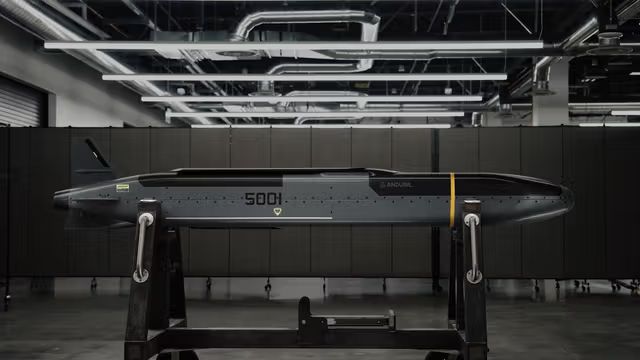
The Anduril Barracuda is a family of autonomous, jet-powered precision-strike missiles developed by Anduril Industries in the United States. The family is intended to provide comparatively producible long-range strike weapons that can be adapted to different launch platforms and mission requirements.
The Barracuda family includes the Barracuda-100M, Barracuda-250M and Barracuda-500M. The largest model is intended for strikes at ranges exceeding 926 km (500 nmi), while smaller members are configured for more compact launch installations.
Development grew from work associated with the U.S. Enterprise Test Vehicle program and subsequently expanded into air- and surface-launched missile configurations. By 2026, Barracuda had also attracted European interest, including manufacturing cooperation in Poland and a prospective acquisition by Latvia.
Development
In June 2024, the U.S. Air Force Armament Directorate and Defense Innovation Unit launched the Enterprise Test Vehicle program to develop a modular and readily producible test air vehicle. The program emphasized commercial components, reduced manufacturing complexity and an architecture that could support subsystem changes without requiring complete redesign of the vehicle.
Anduril was selected as one of four companies participating in the program. A Barracuda-500 autonomous air vehicle completed a flight test in September 2024. The test included a surface launch, approximately 30 minutes of flight and automatic terminal guidance toward a GPS-defined target. Anduril publicly introduced the wider Barracuda family in December 2024.
In April 2025, the Barracuda-500 advanced within the Enterprise Test Vehicle program for further evaluation of its adaptability to Weapon Open System Architecture standards. During 2025, a surface-launched Barracuda-500 also demonstrated a launcher, missile and booster configuration.
The design philosophy emphasizes simplified production. Anduril has stated that Barracuda uses fewer parts and manufacturing tools than many conventional long-range precision weapons, with the objective of enabling production at greater scale.
European programs
By 2026, Poland was developing an industrial relationship with Anduril for Barracuda-500M production. In July 2026, Anduril and Wojskowe Zakłady Lotnicze Nr 2 signed a strategic agreement intended to establish production at facilities in Bydgoszcz. The planned program was expected to increase Polish industrial participation progressively.
In September 2026, Latvia indicated that it was moving toward an acquisition of Barracuda long-range missiles. Latvian President Edgars Rinkēvičs stated that the country was looking forward to completing the acquisition. The exact variant, quantity, contract value and delivery schedule had not been publicly specified. The Barracuda-500M and its surface-launched SLB-500M configuration are relevant to the requirement, but the Latvian selection had not been confirmed publicly.
Design
Barracuda is designed as a modular family rather than a single missile configuration. The vehicles use jet propulsion and autonomous flight functions, with different sizes intended for different aircraft and surface-launch installations.
The largest Barracuda-500 class combines cruise-missile range with the ability to remain airborne for extended periods. Its architecture is intended to support changes in mission systems and payloads while retaining a common basic vehicle and production approach.
Launch configurations
The Barracuda-500M can be configured for air or surface launch. The air-launched version has received the U.S. military designation AGM-189A. The corresponding surface-launched configuration is designated SLB-500M and uses a booster for launch from the ground.
Smaller Barracuda variants are intended to broaden platform compatibility. The Barracuda-250 class is sized for carriage in internal aircraft weapon bays as well as external or surface-launch applications, while the Barracuda-100 class is the smallest member of the family.
Guidance and autonomy
The Barracuda program incorporates autonomous flight and terminal-guidance functions. Testing of the Barracuda-500 demonstrated automatic terminal guidance toward a GPS-defined target. The family is also intended to support modular mission software and integration with broader command-and-control architectures.
Program status
Barracuda remained an expanding development and procurement program in 2026. The Barracuda-500 had completed flight and surface-launch demonstrations, while manufacturing arrangements and potential foreign acquisitions were developing in parallel.
Poland was pursuing local production of the Barracuda-500M. Latvia was pursuing an acquisition of Barracuda missiles for long-range precision strike, but had not publicly identified the selected variant or announced a delivery schedule.
Variants
- Barracuda-100M: Small member of the Barracuda missile family intended for compact launch platforms.
- Barracuda-250M: Intermediate-size variant designed for internal aircraft weapon bays, external carriage and surface-launch applications.
- Barracuda-500M: Long-range member of the family with a stated range exceeding 926 km (500 nmi).
- AGM-189A: U.S. military designation for the air-launched Barracuda-500M configuration.
- SLB-500M: Surface-launched Barracuda-500M configuration using a launch booster.
Specifications (Barracuda-500M)
General characteristics
- Type: Autonomous jet-powered long-range precision-strike cruise missile
- Launch methods: Air launch or surface launch, depending on configuration
- Air-launched designation: AGM-189A
- Surface-launched designation: SLB-500M
Performance
- Range: More than 926 km (500 nmi)
- Speed: Approximately 352-926 km/h (190-500 kt)
 Argentina
 Armenia
 Australia
 Austria
 Austria-Hungary
 Belgium
 Brazil
 United Kingdom
 Brunei
 Bulgaria
 Canada
 Chile
Chile China
China Colonial America
 Colombia
 Confederate States
 Croatia
 Czech
Czech Denmark
 Egypt
Egypt Finland
 France
 Georgia
 Germany
 German Imperial
 Greece
 Holland
 Hungary
 India
India Indonesia
 Iran
Iran Iraq
Iraq Ireland
 Israel
 Italy
Italy Japan
Japan Japan (1940)
 Jordan
 Kingdom of Italy
 Malaysia
 Mexico
 Myanmar
 Nazi Germany
 Netherlands
 New Zealand
 North Korea
 Norway
 Pakistan
 Peru
Peru Philippines
 Poland
 Portugal
 Prussia
 Romania
 Russia
 Saudi Arabia
 Serbia
 Singapore
 Slovakia
 Slovenia
 South Africa
 South Korea
 Soviet Union
 Spain
Spain Sweden
 Switzerland
 Syria
Syria Taiwan
 Thailand
 Turkey
 UAE
UAE Ukraine
 Vietnam
 Yugoslavia