


History
Many gun manufacturers of the late 19th century were overshadowed by the likes of Colt and Remington, but James Maslin Cooper made a name for his company between 1850 and 1869. The company designed and built its own "Pepperbox" pistol and several percussion revolvers during this period, initially starting in Philadelphia, Pennsylvania, before moving to its last station in Frankfurt.
When the company ended operations in 1869, it was producing the reliable Cooper pocket revolver - a pistol famous at the time because it was essentially "double-action" (by controlling the trigger to drive/push the hammer) . Mechanically, the Cooper Pocket Revolvers are as effective as any of their competitors, and their "Pocket" designation suggests they can be carried as a concealed weapon in a man's coat - their compact design makes this possible.
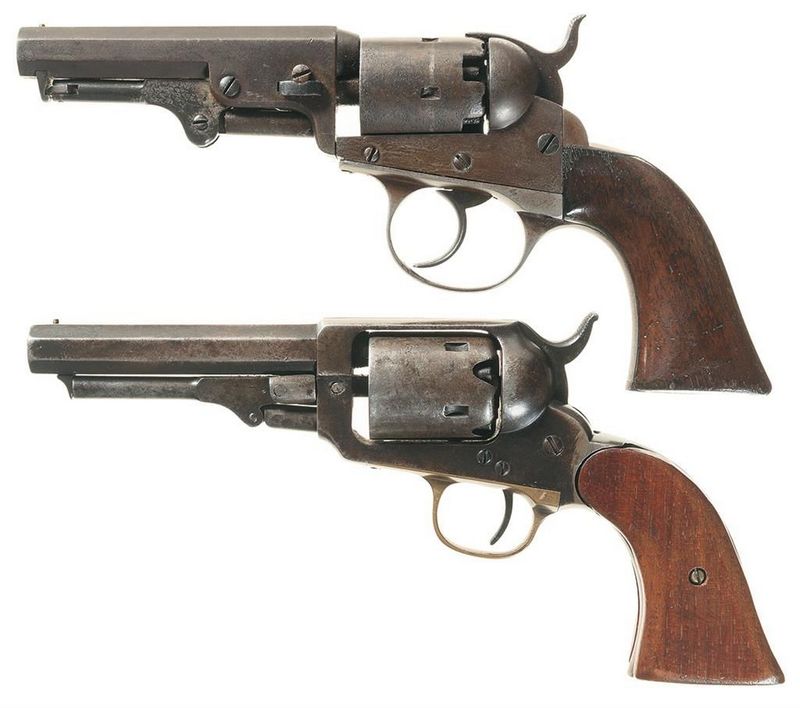
The design of the Cooper pocket revolver followed examples from other revolvers of the time. It has a five-chambered smooth cylinder designed to load gunpowder and projectiles from the front and nipples at the rear for the use of primers. The barrel is octagonal and is available in 4, 5 and 6 inches in length with an integral loading rod mounted below the barrel assembly. The operator pulls down the front end of the loading rod, which operates a push rod that pushes the contents of each cylinder chamber back.
The gun's frame was open, similar to the Colt products of the time (unlike the popular fixed-frame Remingtons), and finished in cool blue. The hammer has a distinct thorn and is held with the thumb. The brass trigger ring protects the well-curved trigger assembly under the frame.
The handle is covered with a comfortable walnut finish and is ergonomically designed for a firm grip. There is a small fixed rear sight along the top of the barrel behind the muzzle, while the hammer thorn serves as the rear sight.
Cooper pistols are made for . 31 balls and samples with the Cooper Firearms Manufacturing Co logo printed on the top of the barrel. About 15,000 examples of this type were eventually produced, making it a rare collectible in today's gun market.
Specification
Roles
- Close Combat (CQB) / Personal Protection
- Sidearms
Dimensions
140 mm (5.51 in)
127 mm (5.00 in)
rear hammer; front iron.
Performance
double action; repeat
5 rounds per minute
Changes
Cooper Pocket - name of the basic series
 Argentina
 Armenia
 Australia
 Austria
 Austria-Hungary
 Belgium
 Brazil
 United Kingdom
 Brunei
 Bulgaria
 Canada
 Chile
Chile China
China Colonial America
 Colombia
 Confederate States
 Croatia
 Czech
Czech Denmark
 Egypt
Egypt Finland
 France
 Georgia
 Germany
 German Imperial
 Greece
 Holland
 Hungary
 India
India Indonesia
 Iran
Iran Iraq
Iraq Ireland
 Israel
 Italy
Italy Japan
Japan Japan (1940)
 Jordan
 Kingdom of Italy
 Malaysia
 Mexico
 Myanmar
 Nazi Germany
 Netherlands
 New Zealand
 North Korea
 Norway
 Pakistan
 Peru
Peru Philippines
 Poland
 Portugal
 Prussia
 Romania
 Russia
 Saudi Arabia
 Serbia
 Singapore
 Slovakia
 Slovenia
 South Africa
 South Korea
 Soviet Union
 Spain
Spain Sweden
 Switzerland
 Syria
Syria Taiwan
 Thailand
 Turkey
 UAE
UAE Ukraine
 Vietnam
 Yugoslavia