


History
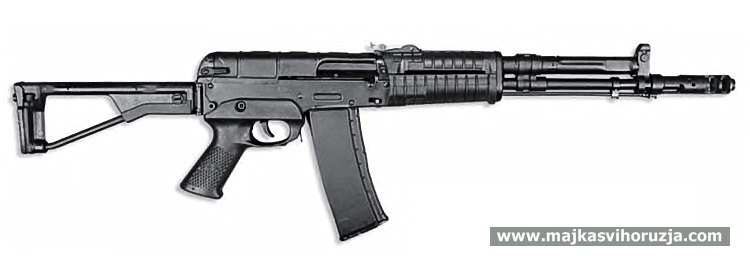
The AEK-971 Assault Rifle emerged from the Kovrov Machine Works (KMZ) in the 1980s, and design work began ten years earlier. At the heart of the weapon is a conventional automatic weapon system that fires the usual array of standard Soviet cartridges via a pneumatically rotating bolt breech. They are similar in form and function to the classic line of Kalashnikov rifles, including a gas cylinder above the barrel and a curved detachable magazine. The AEK-971 differs in that it uses the BARS action - "Balanced Automatic Recoil System" - which has been shown to improve the shooter's ability to shoot in continuous fire (i.e. burst fire, fully automatic fire) by reducing the effects of recoil accuracy.
In the BARS system, the recoil effect is shifted closer to the muzzle, and the rearward action of the bolt and bolt carrier helps to further reduce the effect of "muzzle climb".
The AEK-971 was one of several guns competing to find the next standardized Soviet Army rifle, including the competing AN-94 described elsewhere on this site. The rifle was eventually adopted, albeit in limited quantities and distributed to various branches of the Soviet Navy and the Federal Armed Forces, but this design was barely seen in terms of range - it successfully fought against Russian troops in the Second Chechen War .Although the AN-94 is heavier and more expensive to manufacture, it outperforms the AEK-971 in the long run.
Nonetheless, support remains for the AEK-971 design, which has successfully survived and provided several related variants and sub-variants. The AEK-971 became the main variant of the series, chambered in the 5.45x39mm cartridge, while the AEK-972 was chambered in the Western preferred 5.56x45mm NATO cartridge. This results in a slight deviation in the magazine curvature.
The AEK-973 is the third in the series and holds a 7.62x39mm rifle cartridge for better penetration at range. AEK-971 and AEK-973 subsequently produced their own sub-variants, which became the improved AEK-971S and AEK-973S, respectively.
The duo used an all-new trigger system, three-round burst mode, and a lighter stock.
More modern versions of the AEK-971 are the A-545 and A-762. As the name suggests, these models hold 5.45x39mm and 7.62x39mm cartridges, respectively. The A-545 actively competes with the AK-12 model, as both are in limited service for evaluation purposes.
The A-545 is considered a direct successor to the earlier AEK-971 series.
Specification
Roles
- Frontline/Attack
Dimensions
960 mm (37.80 in)
420 mm (16.54 in)
3.30 kg
Front and rear irons; optional optics
Performance
Gas powered; rotating bolt; selective fire
2,885 ft/s (879 m/s)
900 rounds per minute
1,640 ft (500 m; 547 yd)
Changes
AEK-971 - Name of the basic series; holds 5. 45x39mm cartridges.
AEK-971S - An improved variant of the AEK-971 with a new trigger mechanism, lighter shoulder rest and triple-round firing mode.
AEK-972 - Holds the 5.56x45mm NATO cartridge.
AEK-973 - Equipped with 7th 62x39mm cartridge
AEK-973S - An improved version of the AEK-973 with a new trigger mechanism, lighter shoulder rest and triple burst mode.
A-545 - Modernized offshoot of AEK-971, caliber 5.45x39 mm; improved iron sights, Picatinny rail support and ambidextrous firing mode selector.
A-762 - A modernized offshoot of the AEK-971 in 7.62x39mm; improved iron sights, Picatinny rail support and ambidextrous firing mode selector.
 Argentina
 Armenia
 Australia
 Austria
 Austria-Hungary
 Belgium
 Brazil
 United Kingdom
 United States
 Brunei
 Bulgaria
 Canada
 Chile
Chile China
China Colonial America
 Colombia
 Confederate States
 Croatia
 Czech
Czech Denmark
 Egypt
Egypt Finland
 France
 Georgia
 Germany
 German Imperial
 Greece
 Holland
 Hungary
 India
India Indonesia
 Iran
Iran Iraq
Iraq Ireland
 Israel
 Italy
Italy Japan
Japan Japan (1940)
 Jordan
 Kingdom of Italy
 Malaysia
 Mexico
 Myanmar
 Nazi Germany
 Netherlands
 New Zealand
 North Korea
 Norway
 Pakistan
 Peru
Peru Philippines
 Poland
 Portugal
 Prussia
 Romania
 Russia
 Saudi Arabia
 Serbia
 Singapore
 Slovakia
 Slovenia
 South Africa
 South Korea
 Spain
Spain Sweden
 Switzerland
 Syria
Syria Taiwan
 Thailand
 Turkey
 UAE
UAE Ukraine
 Vietnam
 Yugoslavia