



History of Knight's Armament Company PDW (Personal Defense Weapon)
The Heckler & Koch HK MP5 submachine gun is currently used by most of the world's elite special forces. Introduced in the 1970s, the weapon was designed as a compact system that could be used in confined spaces and fire the widely accepted 9x19mm Parabellum pistol cartridge. The 9mm bullet has a lower lethal knockout value with a minimum range of 70m (230ft) to 200m (656ft), but is still a proven stopover. MP5 Series models have a muzzle velocity of 1,312 feet per second (400 m/s).
By comparison, the American AR-15-based M4 carbine fires a 5.56x45mm bullet and has a lethal range of 500 meters at a muzzle velocity of 2,970 feet per second (910 m/s). However, given the narrow scope of urban warfare, the main disadvantage of the gun is its overall length.
Therefore, what is needed is a hybrid design between a submachine gun and a carbine assault weapon.
A Personal Defense Weapon (PDW) is a compact semi-automatic or fully automatic firearm comparable to a submachine gun. The predecessor to the modern PDW was the 1942 M1 Carbine, issued to the U.S. Airborne Forces for $45 each, with a low muzzle velocity of 1,950 fps when using a pistol cartridge.
The M1 Carbine served in World War II for officers and secondary units such as truck drivers, engineers, medics and military personnel who needed a compact weapon that could be detached from the vehicle for quick-response personal defense.
C. Reed Knight founded the privately-held Knight Armament Corporation (KAC) in 1982 in Titusville, Florida. In 2006, his company began work on a new firearm design, known simply as a Personal Defense Weapon (PDW). The design focuses on a new 6x35mm cartridge that increases the range's lethal ballistics and develops the weapon that fires it.
Knight's development of the 6x35mm cartridge was achieved by optimizing the performance of the case, bullet and the gun itself. The new 6x35mm cartridge is designed to perform well with shorter rifled barrels. KAC can make guns in 12" or 14" barrel lengths and simply use a 5.56x45mm cartridge as the reel, but the concept chosen was to be more compact and use an 8" or 10" barrel.
Keeping the barrel length up to 300 meters has the desired effect. The KAC PDW looks and feels similar to the competitive M4 carbine and is designed to make the transition to PDW as easy as possible.
By keeping the same trigger mechanism and pistol grip as the M4, the PDW feels the same to operate, only the weapon will be more compact and lighter in the cargo hold.
8" or 10" barrels require heavier ammo at the desired range. To make up for this, KAC opted for a 65-grain bullet. The 65-grain Open Tip Match (OTM) bullet weighs 4.2 grams and can penetrate bulletproof glass and body armor up to 300 meters. Even in fully automatic fire, this cartridge provides very low recoil, allowing for good target acquisition and accuracy in subsequent shots - a big improvement over the existing M4. The KAC PDW is estimated to have 75% less recoil than the 5.56x45mm M4A1 NATO carbine.
Those who fired KAC weapons compared their perceived effects to firing pellet rifles. Essentially, the PDW tries to combine the performance of an assault rifle with the form factor of a submachine gun, while offering minimal recoilthe best in the world.
The Honady Company produces the short film exclusively. 243 cartridges for knight equipment. Because the cartridge is unique to PDW, the shaft portion of the gun that receives the magazine must be 1/3 inch shorter than the M4's magazine.
The 6x35mm cartridge is also .32 inches shorter than the 5.56x45mm NATO cartridge.
If a .243 caliber bullet is fired from a 10" PDW, it fires a 65-grain round at an amazing energy rate of 848 ft/lb at 2,425 ft/s. Compared to the 5.56x45mm NATO round fired from the same barrel length, the PDW 6x35mm round has an additional 74 feet of penetration per pound of energy. This gives the PDW a rifle caliber cartridge in a compact and lightweight body that many shooters prefer.
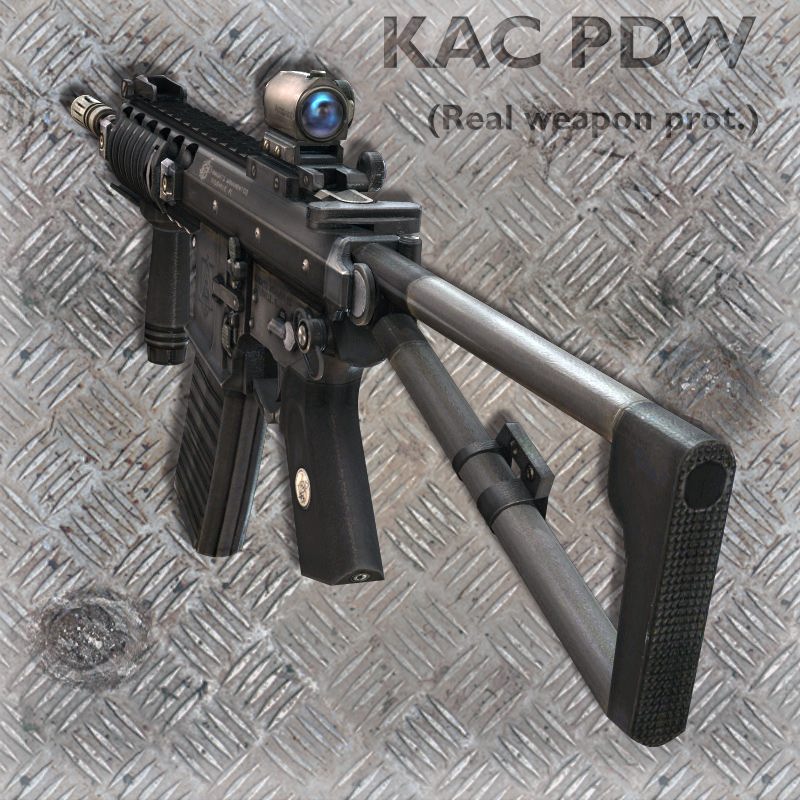
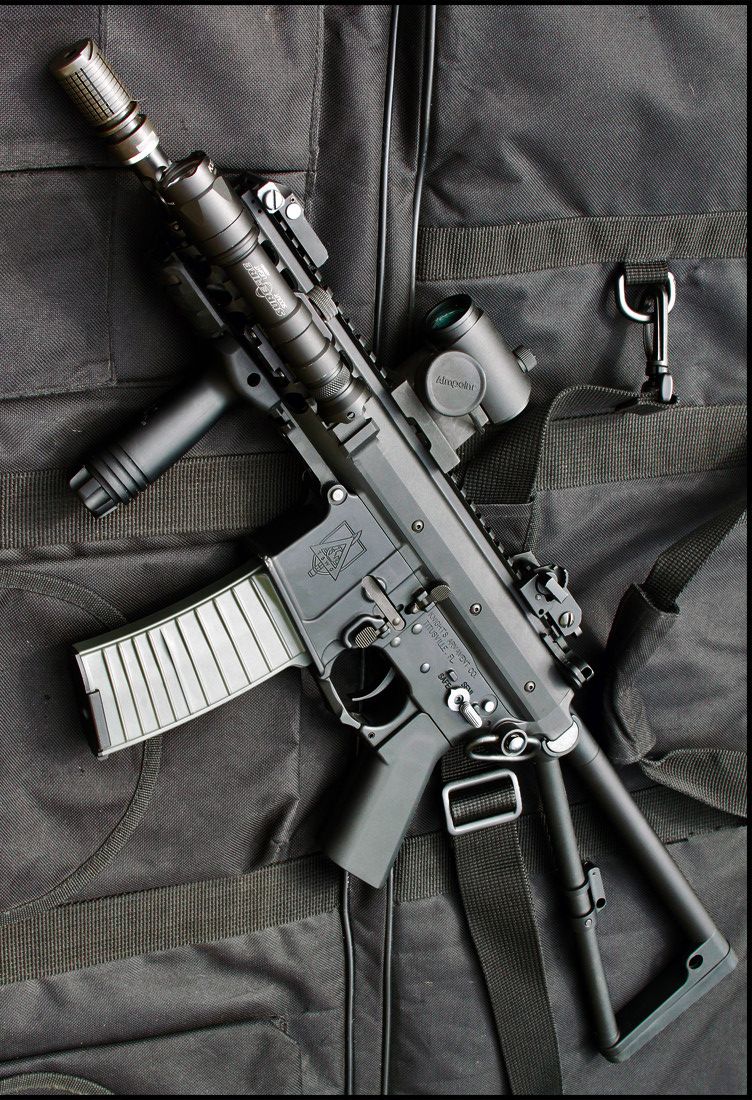
The powder in the 6x35mm cartridge is designed to burn completely within the 8" or 10" barrel, so the operator neither sees a huge fireball at the muzzle end nor hears a huge crash. The PDW is concealable and compact as its length is controlled by the foldable buttstock, which when folded is only 17.5 inches (444.5 mm) in overall length - no wider than a person's shoulders, allowing users to maneuver the PDW in tight spaces. [/p ]
Several weight reduction measures have been incorporated into the finished PDW: the folding stock is hollowed out and uses less metal without a cover. The barrel is intentionally shorter and specially machined to be lighter. In order to reduce parts and weight, the bolt set compared to the Kalashnikov submachine gun, less parts means less weight. The AK-type bolt set is almost completely enclosed within its auxiliary frame.
The recoil spring is compact in the upper receiver. The muzzle brake and flash suppressor on the 8" and 10" barrels are machined to fit a lightweight KAC silencer.
The flash hider is one of the key components of the KAC PDW design, it is based on Eugene Stoner's original work and provides very low recoil. The muzzle brake acts as a baffle to stop the rapid gas produced when the powder burns and pushes the bullet as it leaves the barrel. As the gas pushes against the baffles, it reduces recoil while directing the exhaust out of 100 small vents around the entire brake.
This reduces muzzle rise and reduces muzzle flash.
The PDW follows the M4/M16 model, but the upper receiver group has no ejector cover due to the AK-style bolt group. The bolt is driven by two short-stroke gas pistons, each with a spring, driven by two cylinders flanking the gas block. Worth mentioning is the fire control group, which has three lateral pins. After the M16 configuration, the PDW had one for the trigger, the second for the hammer, and the third for the automatic trigger.
The retaining plate on the right side of the receiver is used to hold the pin in place. When the stock is folded, it is bolted to the right side of the lower receiver group with steel bolts. The PDW has QD sling mounts on the left and right, front and rear.
The operator can select an anchor point for three different hide locations.
PDW has a range of standard rails to accommodate KAC systems as well as equipment from other manufacturers. It uses an Integral Rail Handguard with KAC's Flip-Up BUIS. The top rail can mount different optical systems according to your needs. Side rails are designed for a variety of hand guards, lights and laser targets.
PDW's M16A2 pistol grip was shortened and thinner.
Over the past 20 years, weapons have been developed to meet the need for small shoulder-mounted systems with near to medium ranges. With the production of the KAC PDW, elite troops and personal protection agencies will see the benefits of the PDW's role long played by the ubiquitous HK MP5.
Specification
Roles
- Close Combat (CQB) / Personal Protection
- Frontline/Attack
Dimensions
710 mm (27.95 in)
254 mm (10.00 in)
4.41 lbs (2.00 kg)
Front and rear iron
Performance
Gas powered; rotating bolt
740 feet per second (226 meters per second)
900 ft (274 m; 300 yd)
Changes
KAC PDW - Base Series Name
 Argentina
 Armenia
 Australia
 Austria
 Austria-Hungary
 Belgium
 Brazil
 United Kingdom
 Brunei
 Bulgaria
 Canada
 Chile
Chile China
China Colonial America
 Colombia
 Confederate States
 Croatia
 Czech
Czech Denmark
 Egypt
Egypt Finland
 France
 Georgia
 Germany
 German Imperial
 Greece
 Holland
 Hungary
 India
India Indonesia
 Iran
Iran Iraq
Iraq Ireland
 Israel
 Italy
Italy Japan
Japan Japan (1940)
 Jordan
 Kingdom of Italy
 Malaysia
 Mexico
 Myanmar
 Nazi Germany
 Netherlands
 New Zealand
 North Korea
 Norway
 Pakistan
 Peru
Peru Philippines
 Poland
 Portugal
 Prussia
 Romania
 Russia
 Saudi Arabia
 Serbia
 Singapore
 Slovakia
 Slovenia
 South Africa
 South Korea
 Soviet Union
 Spain
Spain Sweden
 Switzerland
 Syria
Syria Taiwan
 Thailand
 Turkey
 UAE
UAE Ukraine
 Vietnam
 Yugoslavia