



History of MAS 38 (Pistol Mitrailleur MAS modele 38)
World War I introduced the concept of the "submachine gun", filling the gap between the sidearm of a pistol and the deadly two-handed light machine gun. As a result, the submachine gun was actually born to provide a single infantryman with the firepower of a machine gun in a portable pistol frame.
After the war, many countries began to design firearms for this new type of weapon, and France was no exception. A major small arms program was launched in 1918 to finance the development of semi-automatic rifles, submachine guns and light machine gun systems for the French Army to modernize its ground forces.
Such designs appeared in the mid-1920s, and by 1938, when war swept Europe again, the idea was fully formed - this time under the guise of Adolf Hitler and his Nazi German war machine. The new French submachine gun became the 7.65mm caliber "MAS 1938 submachine gun" (or "Pistolet Mitrailleur MAS modele 38") and retained the origins of the experimental MAS 35 system of 1935. By the way, the name "MAS" comes from the Manufacture d'Armes de Saint-Etienne ("Saint-Etienne Arms Industries"), now known as the manufacturing flag of Nexter (formerly GIAT Industries, the French state-owned armament company). Production It began quickly, but as the German war machine began its invasion of France in 1940, providing key resources and vital assets for other defensive advancements such as the Maginot Line, the numbers were small.
Although northern and western France fell into Hitler's hands, production of the MAS 38 continued for the Wehrmacht in the Free South and some German-occupied areas (the latter used it as MP722(f)). Only 1,958 MAS 38 guns were completed before the German invasion.
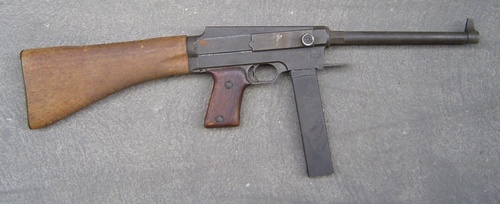
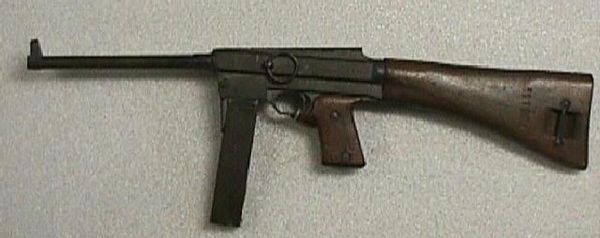
The MAS 38 does look like a submachine gun even by modern standards. It comes with a solid wood rifle stock fixed to the rear of the receiver. This in itself was an evolutionary approach to design at a time when guns still used a one-piece wooden receiver and stock.
The pistol grip is covered with wooden furniture and integrated into the elongated trigger ring. The trigger itself has been ergonomically curved for maximum effect. The 32-round magazine is straight and angled slightly forward, while also serving as a forward vertical grip. The receiver itself does not have a straight horizontal line.
The cylindrical barrel protrudes forward and is covered by a front iron sight. The chosen caliber is the 7.65mm long (7.65mm long) cartridge, which can achieve a rate of fire of 600 rounds per minute. The MAS 38 comes with a full magazine, weighs only 7.5 pounds, and has a range of 164 yards. Although its main body is made of steel, the MAS 38 is still a relatively light submachine gun.
Add the use of the lightweight 7.65mm cartridge to the design formula and you have your own controllable weapon with good inherent accuracy. The gun was loaded via a slide on the right side of the case.
The sides of the receiver are slanted significantly back from the angle of the barrel, giving the gun's profile a "curved" appearance. The MAS 38 is 25 inches long.
In use, the MAS 38 proved to be a reliable but sophisticated weapon system. She was deemed suitable for the role, but her sophistication ensured that she wasn't a pro-war design that could come in handy in the plethora of numbers she needed.
This complexity also comes at a literal cost, as the MAS 38 proves to be quite expensive to acquire in any number of notes. To their chagrin, the choice of the 7.65mm cartridge was rather poor compared to its contemporaries (especially the German 9mm Parabellum) and limited its lethality to some extent. This also limited the possibility of their French soldiers using captured enemy ammunition (only the French M1935 pistol used the same cartridge). In addition, the choice of low-power French cartridges precluded their interest in another European power at the time. Outside of France and Germany, only Italian partisans have used this weapon.
In any case, MAS 38 operated in its previous career and continued until the end of the war in 1945. Its legacy lived on in the years that followed, securing its place in today's military history. Production of all MAS 38s continued until 1949.
The MAS 38 was formally replaced in the French Army inventory by the MAT-49 submachine gun of 1949.
MAS 38 (Pistolet Mitrailleur MAS modele 38) Specification
ROLES
- Close Quarters Battle (CQB) / Personal Security
STRUCTURAL
623 mm (24. 53 in)
224 mm (8. 82 in)
6. 33 lb (2. 87 kg)
Front Iron Post.
PERFORMANCE
Blowback; Automatic
1,148 feet-per-second (350 meters-per-second)
650 rounds-per-minute
300 ft (91 m; 100 yd)
VARIANTS
MAS 38 - Base Series Designation
MP722(f) - German Army Designation
 Argentina
 Armenia
 Australia
 Austria
 Austria-Hungary
 Belgium
 Brazil
 United Kingdom
 United States
 Brunei
 Bulgaria
 Canada
 Chile
Chile China
China Colonial America
 Colombia
 Confederate States
 Croatia
 Czech
Czech Denmark
 Egypt
Egypt Finland
 Georgia
 Germany
 German Imperial
 Greece
 Holland
 Hungary
 India
India Indonesia
 Iran
Iran Iraq
Iraq Ireland
 Israel
 Italy
Italy Japan
Japan Japan (1940)
 Jordan
 Kingdom of Italy
 Malaysia
 Mexico
 Myanmar
 Nazi Germany
 Netherlands
 New Zealand
 North Korea
 Norway
 Pakistan
 Peru
Peru Philippines
 Poland
 Portugal
 Prussia
 Romania
 Russia
 Saudi Arabia
 Serbia
 Singapore
 Slovakia
 Slovenia
 South Africa
 South Korea
 Soviet Union
 Spain
Spain Sweden
 Switzerland
 Syria
Syria Taiwan
 Thailand
 Turkey
 UAE
UAE Ukraine
 Vietnam
 Yugoslavia