

History
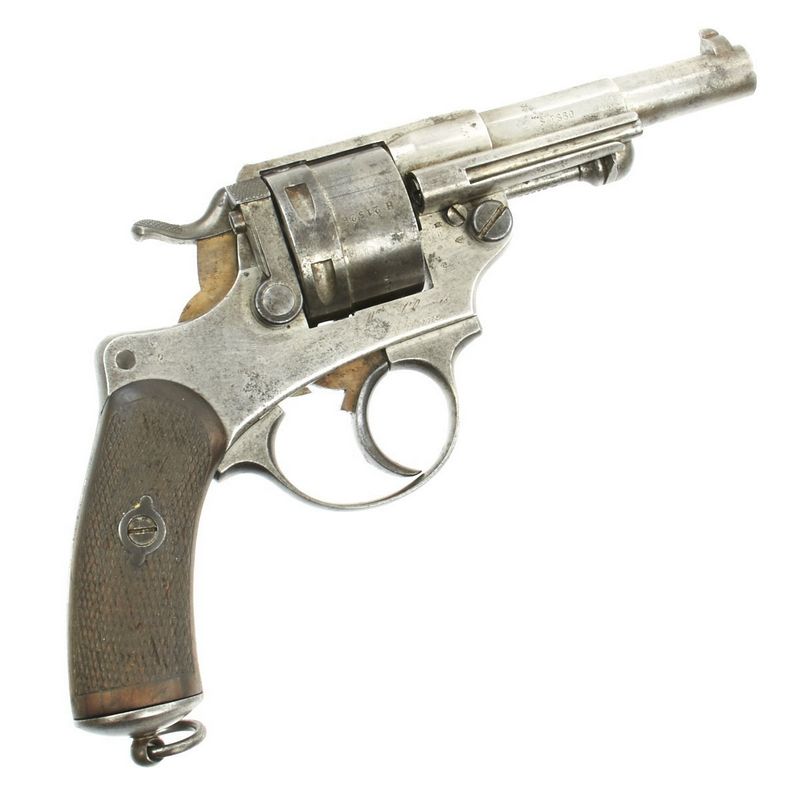
Pistols as military weapons often existed as an afterthought in the "gentlemen's wars" of the 19th century, when sabers and bayonets still reigned supreme. Following the disastrous Franco-Prussian War with Germany, France modernized its armed forces in all categories, including pistols, which led to the introduction of the MAS Modele 1873 revolver.
The gun was designed by Henri-Gustave Delviny and J. Camelot, obsolete From 1873 to 1887, the arsenal of the Arsenale de Saint-Etienne (MAS) eventually produced 337,000 prototypes in France and Belgium . Surprisingly, this weapon joins several other 19th century forms that have survived long enough to see action in World War II (1939-1945).
The Modele 1873 became the first double-action (DA) revolver of the French Army to enter service when it was introduced. This system allows the trigger pull to also affect the backward advancement of the hammer at one time. This provided a distinct advantage over the single-action (SA) revolvers of the day, which required the operator to operate the hammer alone (usually with the thumb) to move the weapon.
The Modele 1873 can still be used as a single-action revolver.
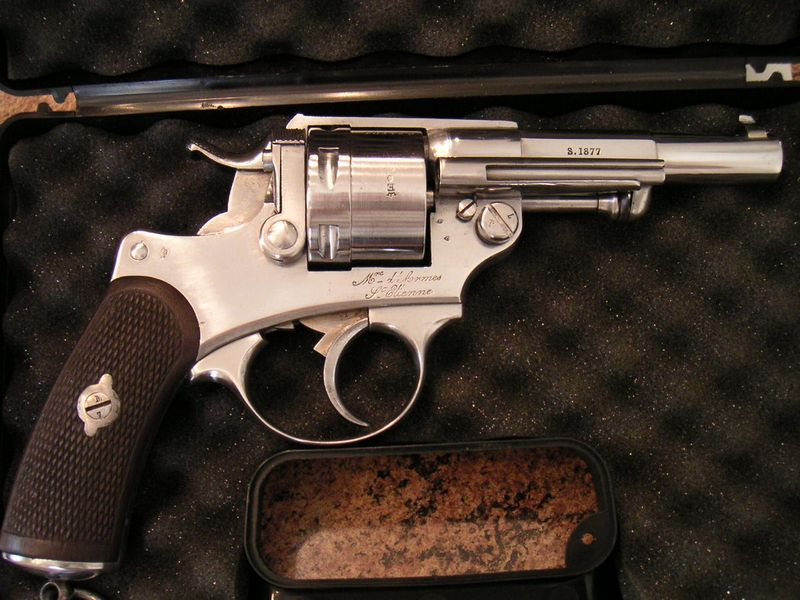
The overall configuration of the revolver is modern, using a solid metal frame with an inlaid rotating cylinder. The grip is covered with a two-part checkerboard pattern. The trigger and ring are placed and mounted on the front of the grip. The hammer is exposed on the top rear of the frame in the usual way. An iron sight (fixed front plate with rear notch) was provided above the muzzle and barrel area.
Barrels can be seen in fluted and non-grooved designs, while barrels can be round or octagonal, or a combination of the two.
The cylinder holds up to 6 ready-to-fire cartridges of 11mm Mle 1873 caliber. Effective range is up to 50 meters, with a maximum range set to 300 meters - albeit with reduced accuracy. The gun has a stated rate of fire of up to 30 rounds per minute.
The cartridge was never really successful, and was criticized for its low power, which resulted in a reduced velocity - reported to be around 550 feet per second.
The Modele 1873 series also includes improvements in the Modele 1874. These models have slightly shorter barrels and slightly heavier guns. Apart from the fact that the Modele 1874 has a Double Action Only (DAO) feature, all other features remain the same.
This series of pistols was adopted by the French Army in two designated "Army" models, followed by a dedicated "Navy" version. A new, more powerful cartridge was also introduced around this time, but it never caught on. Navy stocks are forced to continue using inferior ammunition until the end. The revolver passed through the French colonies as a standard firearm and was widely used when France entered World War I (1914-1918).
A smokeless cartridge was introduced to modernize the design. In practice, the pistol proved to be strong and resilient, even under the stress of war. After the war, the pistol remained in French inventory and was still in use during World War II, with some police forces using it.
Model 1873/1874 pistols were phased out in 1945.
Operators outside of France, including Belgium, Greece, Italy, Monaco, Netherlands and Switzerland.
Specification
Roles
- Close Combat (CQB) / Personal Protection
- Sidearms
Dimensions
240 mm (9.45 in)
115 mm (4.53 in)
2.29 lbs (1.04 kg)
Before and after ironing.
Performance
Rotary cylinder; single-acting/double-acting
550 ft/s (168 m/s)
30 rounds per minute
165 ft (50 m; 55 yd)
VARIANTS
Modele 1873 ("Army Model 73") - Base Service Revolver; smooth cylinder; Double-Action (DA)/Single-Action (SA) function.
Modele 1874 ("Army Model 74") - "Officer's Pattern" revolver; produced to a higher standard than the Modele 1873; improved finish; fluted cylinder; Double-Action Only (DAO).
Modele 1873/1874 (Navy Model) - Revised variant for French Navy use; improved cartridge.
 Argentina
 Armenia
 Australia
 Austria
 Austria-Hungary
 Belgium
 Brazil
 United Kingdom
 United States
 Brunei
 Bulgaria
 Canada
 Chile
Chile China
China Colonial America
 Colombia
 Confederate States
 Croatia
 Czech
Czech Denmark
 Egypt
Egypt Finland
 Georgia
 Germany
 German Imperial
 Greece
 Holland
 Hungary
 India
India Indonesia
 Iran
Iran Iraq
Iraq Ireland
 Israel
 Italy
Italy Japan
Japan Japan (1940)
 Jordan
 Kingdom of Italy
 Malaysia
 Mexico
 Myanmar
 Nazi Germany
 Netherlands
 New Zealand
 North Korea
 Norway
 Pakistan
 Peru
Peru Philippines
 Poland
 Portugal
 Prussia
 Romania
 Russia
 Saudi Arabia
 Serbia
 Singapore
 Slovakia
 Slovenia
 South Africa
 South Korea
 Soviet Union
 Spain
Spain Sweden
 Switzerland
 Syria
Syria Taiwan
 Thailand
 Turkey
 UAE
UAE Ukraine
 Vietnam
 Yugoslavia