


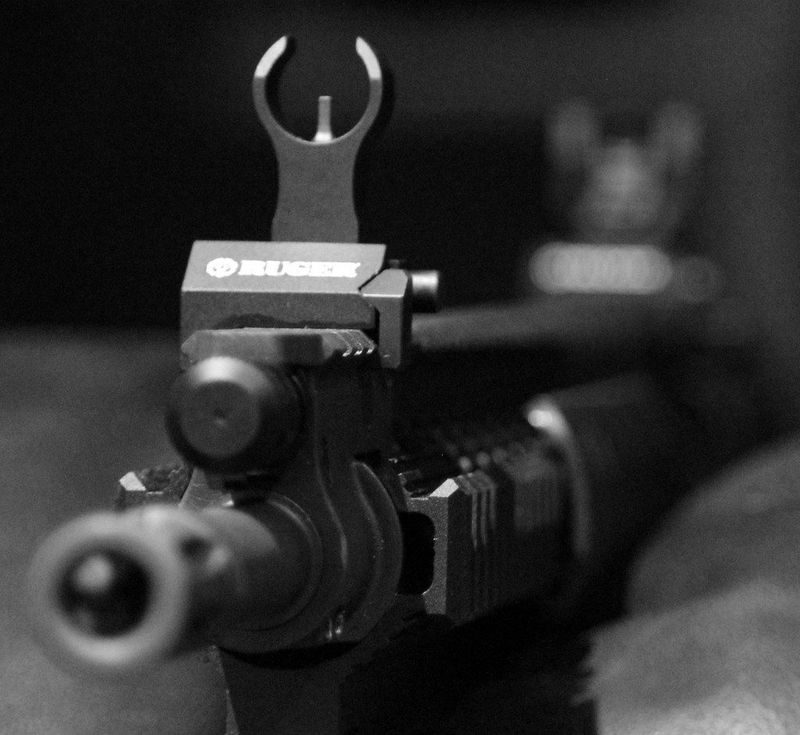
History of Ruger SR-556
The Ruger SR-556 is a relatively new commercial addition to the Armalite AR-15 series of automatic self-loading rifles that emerged in the 1950s under the direction of Eugene Stoner and produced the venerable M16 Assault for the US military Rifle (among other variants). The SR-556 was the first AR-15 style firearm manufactured by Sturm, Ruger & Company, Incorporated, and was a distinct reproduction of the original in style and layout. A key difference between the SR-556 and the original AR-15 method is the use of a two-stage chrome-plated piston-powered rotating bolt pneumatic system - this is different from the AR-15's original direct impact. rotating bolt operation method.
Marketed to law enforcement and military groups, the SR-556 has proven popular in the civilian market as well - albeit at a relatively high starting price.
Ruger's approach to the SR-556 was to minimize pollution through the use of an exhaust system that accumulated gas. The gas produced is exhausted through the bottom of the gas block, exposing the gun frame and used to keep the bolt free from contamination, while also being easy to clean.
As such, the Ruger SR-556 is in direct competition with all other AR-15 style firearms in the market as a highly reliable pneumatic shooting solution, with users praising its superior accuracy (even for AR-15 newbies) and its powerful " out of the box" performance.
The SR-225 was primarily used for the .223 Remington and 5.56x45mm NATO cartridges, with support for the 6.8 Remington cartridge later announced. The weapon weighs 7.9 pounds (3.6 kg), slightly heavier than most AR-15s on the market, and has a collapsible stock that reduces the length from 36 inches to a more manageable 32.75 inches, which can be compressed. The collapsible stock is an M4 carbine design with six preset positions.
The mil-spec 41V45 barrel assembly measures 16.2 inches, features six grooves, and features both cold forged and chrome construction. The gun is designed to hold either a 10- or 30-round STANAG magazine with a Detachable Curved Magazine (MAGPUL PMAG), depending on the variant used (see last paragraph). The Troy Industries "Folding Combat Sight" is a flip-up flat iron sight mounted on top of the receiver and handguard for improved range accuracy.
Like other rifles, the SR-225 is designed to be fired from the shoulder in a traditional fashion - the primary operator is on the pistol grip and the secondary hand is located under the handguard in front of the magazine for a three-point grip. The gas cylinder is mounted above the barrel and capped by a chromed 4-position gas regulator for pressure control.
The SR-556 is currently sold in three main production forms, subdivided into their respective sub-variants. "SR-556 Standard" includes "SR-556FB" with folding stock and 30-round magazine and "SR-556SC" with 10-round magazine but no slotted muzzle brake - both Both are available in a black plastic finish. "SR-556 Carbine" - a shortened form of the base SR-556 standard - available as "SR-556C" and "SR-556CLA", the former weighing 0.23 lbs, differing by its redesigned handguard and continuous attachment Rails. "SR-556 E-Type" is available as "SR-556E" with a foldable stock in 30-round magazine format, and as "SR-556ESC" in 10-round magazine format without a slotted muzzle brake. Both carry an accessory rail on top of the receiver, while the handguards have a clean design with slotted perforations for cooling.
Specification
Roles
- Close Combat (CQB) / Personal Protection
- Frontline/Attack
Dimensions
910 mm (35.83 in)
409 mm (16.10 in)
3.60 kg
Front and rear iron
Performance
Gas-Operated, Rotating Bolt; Semi-Automatic
VARIANTS
SR-556 - Base Series Designation; civilian-minded semi-automatic-fire-only.
SR-556E - Revised SR-556 of lightened weight.
 Argentina
 Armenia
 Australia
 Austria
 Austria-Hungary
 Belgium
 Brazil
 United Kingdom
 Brunei
 Bulgaria
 Canada
 Chile
Chile China
China Colonial America
 Colombia
 Confederate States
 Croatia
 Czech
Czech Denmark
 Egypt
Egypt Finland
 France
 Georgia
 Germany
 German Imperial
 Greece
 Holland
 Hungary
 India
India Indonesia
 Iran
Iran Iraq
Iraq Ireland
 Israel
 Italy
Italy Japan
Japan Japan (1940)
 Jordan
 Kingdom of Italy
 Malaysia
 Mexico
 Myanmar
 Nazi Germany
 Netherlands
 New Zealand
 North Korea
 Norway
 Pakistan
 Peru
Peru Philippines
 Poland
 Portugal
 Prussia
 Romania
 Russia
 Saudi Arabia
 Serbia
 Singapore
 Slovakia
 Slovenia
 South Africa
 South Korea
 Soviet Union
 Spain
Spain Sweden
 Switzerland
 Syria
Syria Taiwan
 Thailand
 Turkey
 UAE
UAE Ukraine
 Vietnam
 Yugoslavia