


History
From the mid to late 19th century to the 20th century, the revolver was the primary weapon of almost all major world armies, not unlike what happened when the U.S. military entered World War I (1914-1918). However, when the U.S. government committed to war in Europe in 1917, it lacked many of the modern tools of trade available at the time. Local industry increased to meet demand, and foreign purchases helped stock U.S. inventories.
While John Browning's excellent Colt M1911 semi-automatic pistol was selected as the standard weapon in the U.S. military before the war to replace the revolver, it was not available in the required quantities during the war, and the revolver continues to help fill the gap in the near future.
The US Army commissioned Colt and Smith & Wesson to produce a revolver officially designated the "M1917" ("Model 1917"). The weapon will be designed for the .45 ACP cartridge - the same cartridge used in the Colt M1911 - based on the existing frame for convenience. Patriotism aside, both companies recognize that war is a lucrative pursuit and manufacture weapons for every military need. These two efforts culminated in minor changes to the entire M1917 revolver line - the Colt Model 1917 was based on the existing one.
A new service model in caliber 45, Smith & Wesson opted to upgrade their SW second model. Form 455 Webley of the British Army.
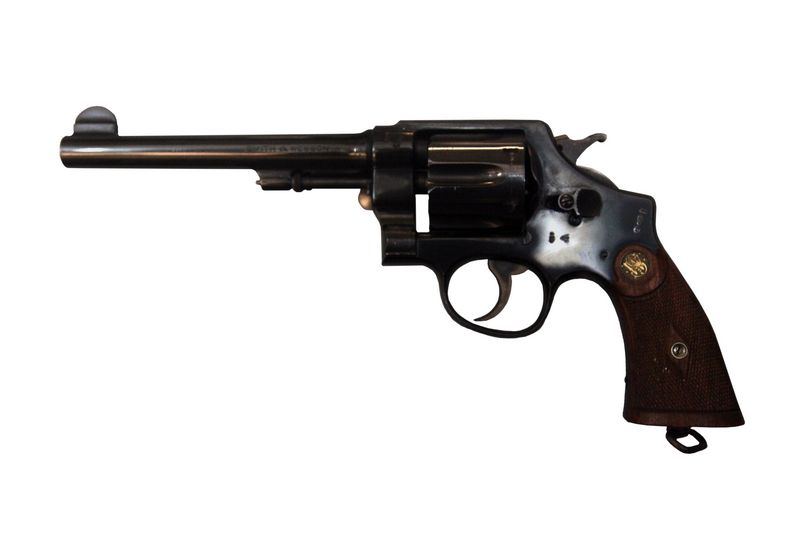
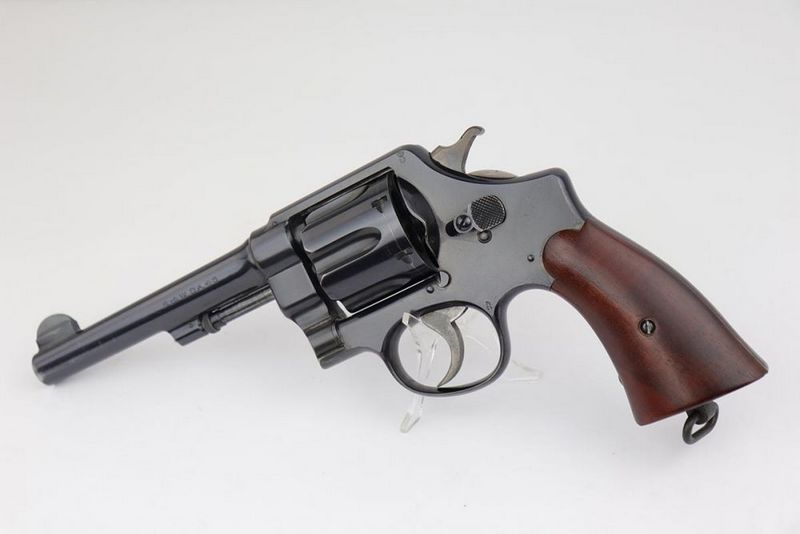
The overall design of the Smith & Wesson Model 1917 is traditional, following the original. The 44 has a narrow design (except for the required .45 ACP chamber). The firearm is designed with a sturdy frame - a bridge on a rotating cylinder - to provide a stronger frame.
The frame is solid metal, and the barrel is naturally located at the front of the rotating cylinder, with an ejection rod mounted below. The cartridge is slotted and holds six. Insert 45 rounds from the rear. The exposed malleus are clearly visible from the rear of the frame, and the pistol grip is padded with smooth wood for limited comfort.
The curved trigger assembly is located in an elongated ring under the barrel.
Because of frameless. 45 cartridge requirements, the Model 1917 was loaded via a three-round "moon clip", a cartridge insertion method patented by Smith & Wesson. In this way, the weapon can be reloaded quickly, since three cartridges are used at the same time.
The clip method also allows the ejection lever to operate normally, the clip basically acts as the "edge" of the cartridge, holding it in front of the firing pin. This helps extract spent cartridges and speeds up the reloading process, as all six chambers can now be refilled quickly. Only a formal request from the U.S. Army allowed the Colt to use the same lunar clip feature.
The barrel of the SW 1917 was also shortened due to the use of an rimless cartridge.
The SW Model 1917 revolver was used immediately during the First World War. They serve as secondary weapons for officers, infantry and support personnel on multiple fronts of the conflict. Even in the harshest conditions, the revolver has proven to be a robust, durable and reliable system and has proven itself in battle.
The Smith & Wesson Model 1917 series - like the Colt Model 1917 - survived the war and served in the ensuing conflict, a testament to their strong design and engineering. After World War I, Smith & Wesson continued to offer its Model 1917 to the police and civilian markets, citing near-term wartime performance as a huge selling point for the product. 1920 with trim. The 45 cartridge - ".45 Auto Rim" - was introduced by the Peters Cartridge Company, which made it possible to phase out the lunar clip. Smith & Wesson also made a completely new cylinder to handle the standard.
45 ACP cartridges for the M1911 and supplied to M1917 owners.
Like many successful WW1 era firearms, Smith & Wesson's line of M1917 revolvers was used alongside competing Colt Model 1917 revolvers and Colt M1911 semi-automatic pistols into WW2 (1939-1945), where she continued to excel. During the pre-war years, the Brazilian government ordered 25,000 SW M1917s, designated them "M1937s", and modified them slightly to meet Brazil's military needs.
During the Korean and Vietnam Wars, the M1917 was used in one form or another until the available numbers of this type dwindled to become the collectibles it is today. The M1917 served in official capacity until 1954, although the private form lasted much longer.
Smith & Wesson produced a total of 153,000 M1917 revolvers for Colt's 150,000 M1917s.
Specification
Roles
- Close Combat (CQB) / Personal Protection
- Sidearms
Dimensions
270 mm (10.63 in)
140 mm (5.51 in)
2.25 lbs (1.02 kg)
Front and rear iron
Performance
Double Action (DA)
760 feet per second (232 meters per second)
15 rounds per minute
Changes
Model 1917 - Basic series designation; based on Smith & Wesson SW Second Model. 44 Manual ejector.
 Argentina
 Armenia
 Australia
 Austria
 Austria-Hungary
 Belgium
 Brazil
 United Kingdom
 Brunei
 Bulgaria
 Canada
 Chile
Chile China
China Colonial America
 Colombia
 Confederate States
 Croatia
 Czech
Czech Denmark
 Egypt
Egypt Finland
 France
 Georgia
 Germany
 German Imperial
 Greece
 Holland
 Hungary
 India
India Indonesia
 Iran
Iran Iraq
Iraq Ireland
 Israel
 Italy
Italy Japan
Japan Japan (1940)
 Jordan
 Kingdom of Italy
 Malaysia
 Mexico
 Myanmar
 Nazi Germany
 Netherlands
 New Zealand
 North Korea
 Norway
 Pakistan
 Peru
Peru Philippines
 Poland
 Portugal
 Prussia
 Romania
 Russia
 Saudi Arabia
 Serbia
 Singapore
 Slovakia
 Slovenia
 South Africa
 South Korea
 Soviet Union
 Spain
Spain Sweden
 Switzerland
 Syria
Syria Taiwan
 Thailand
 Turkey
 UAE
UAE Ukraine
 Vietnam
 Yugoslavia