
History
In the early 1990s, the US Navy abandoned the bolt-action rifle. 50 BMG rifle and want to go back to their original requirement for a semi-automatic rifle. 50 BMG rifle.
Given the success of the USMC with the Barrett M82, a number of companies decided to develop their own semi-automatic. Including the 50 caliber rifle, Knight Manufacturing Company (now known as Knight Arms). Eugene Stoner, the designer of the AR-15 and SR-25, and later a KMC employee, began developing semi-automatic ones.
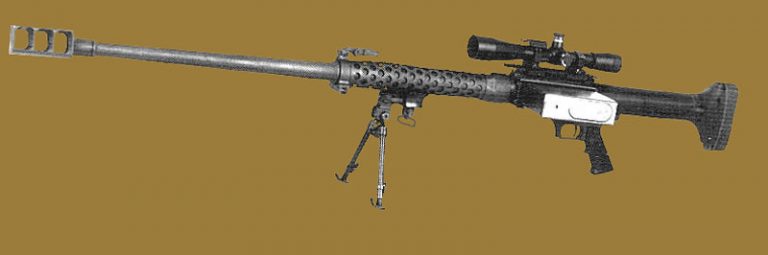
1996 50 caliber rifle designed to complement the SR-25. The rifle was designed for a short period of time, about a month; a working prototype was also produced for internal testing at KAC's old facility in Vero Beach, Florida.
The rifle was advertised on billboards, and people who wanted one paid a $1,000 deposit.
At the same time, however, KMC has doubled the manufacturing capacity of the Mk 11 series. This is a case of poor timing when the Clinton ban went into effect. As a result, KMC invested all of its funds in the expansion to meet its military contracts and perform commissioned work for Colt.
Eventually, KMC received an order to build mufflers for the MK23 and the entire Heckler & Koch product line, and the SR-50 project was put on hold for a short time.
The first prototype was called too light, although it worked well after some modifications to its magazine. Some kinks were also found in the second model, which is believed to be ready for mass production.
While KMC was producing some parts for a small test series rifle, it was later discovered that there was a problem with the bolts, causing service to be suspended.
Unfortunately, before this was all done, Stoner died of brain cancer and essentially stopped developing; the weapon was later handed over to "an incompetent designer" who was said to have worked so hard on the design changes, so much so that a complete overhaul was required to approach the reliability of the previous prototype.
Some engineers at KMC attempted to restore the project to its starting state by designing another improved version of the rifle; parts were also fabricated to test and evaluate this improved design.
Ultimately, KMC decided not to pursue the matter, as the military didn't seem to have any real interest in autoloading. 50 caliber rifles other than the Barrett M82, with a focus on SR-25 production.
KAC appears to have refunded everyone who ordered the SR-50 "without losing their place in the queue".
Only four rifles were made, three of which survive today; Rifle No. 1 is in the Modern Arms Hall of the Military Technical Academy; No. 3 and No. 4 are believed to be still in KAC, while No. 2 was removed "for incompetence" destroy.
The history of this rifle is considered by KAC employees as "the most wonderful pain point".
Specification
Base
Years of Service
1998
Origins
United States
Categories
Anti-Material Rifle (AMR)
Manufacturer
Knights Armament Company - USA
Operators
United States
ROLLING
Anti-Tank/Anti-Tank/Anti-Material
Designed to engage at long range and defeat armored/enemy tanks.
Special Forces
The qualities of this weapon have proven its worth to special forces who need a versatile, reliable solution for the rigors of special operations.
Dimensions and Weights
Curb Weight
31.48 lbs
14.28 kg
Attractions
Optics
Action
Gas Shock; Semi-Auto
Semi-automatic
One shot per trigger; self-loading or self-loading action supported by internal mechanisms; stroke management (and initial cocking) typically required by operators; subsequent shots assisted by unlocking/moving bolts.
CARTRIDGE & FEED
Caliber(s)*
. 50 BMG
Rounds / Feed
10-round detachable box magazine
PERFORMANCE
Muzzle Velocity
2,855 ft/sec
(870 m/sec)
VARIANTS
SR-50 - Base Series Designation
 Argentina
 Armenia
 Australia
 Austria
 Austria-Hungary
 Belgium
 Brazil
 United Kingdom
 Brunei
 Bulgaria
 Canada
 Chile
Chile China
China Colonial America
 Colombia
 Confederate States
 Croatia
 Czech
Czech Denmark
 Egypt
Egypt Finland
 France
 Georgia
 Germany
 German Imperial
 Greece
 Holland
 Hungary
 India
India Indonesia
 Iran
Iran Iraq
Iraq Ireland
 Israel
 Italy
Italy Japan
Japan Japan (1940)
 Jordan
 Kingdom of Italy
 Malaysia
 Mexico
 Myanmar
 Nazi Germany
 Netherlands
 New Zealand
 North Korea
 Norway
 Pakistan
 Peru
Peru Philippines
 Poland
 Portugal
 Prussia
 Romania
 Russia
 Saudi Arabia
 Serbia
 Singapore
 Slovakia
 Slovenia
 South Africa
 South Korea
 Soviet Union
 Spain
Spain Sweden
 Switzerland
 Syria
Syria Taiwan
 Thailand
 Turkey
 UAE
UAE Ukraine
 Vietnam
 Yugoslavia