
History
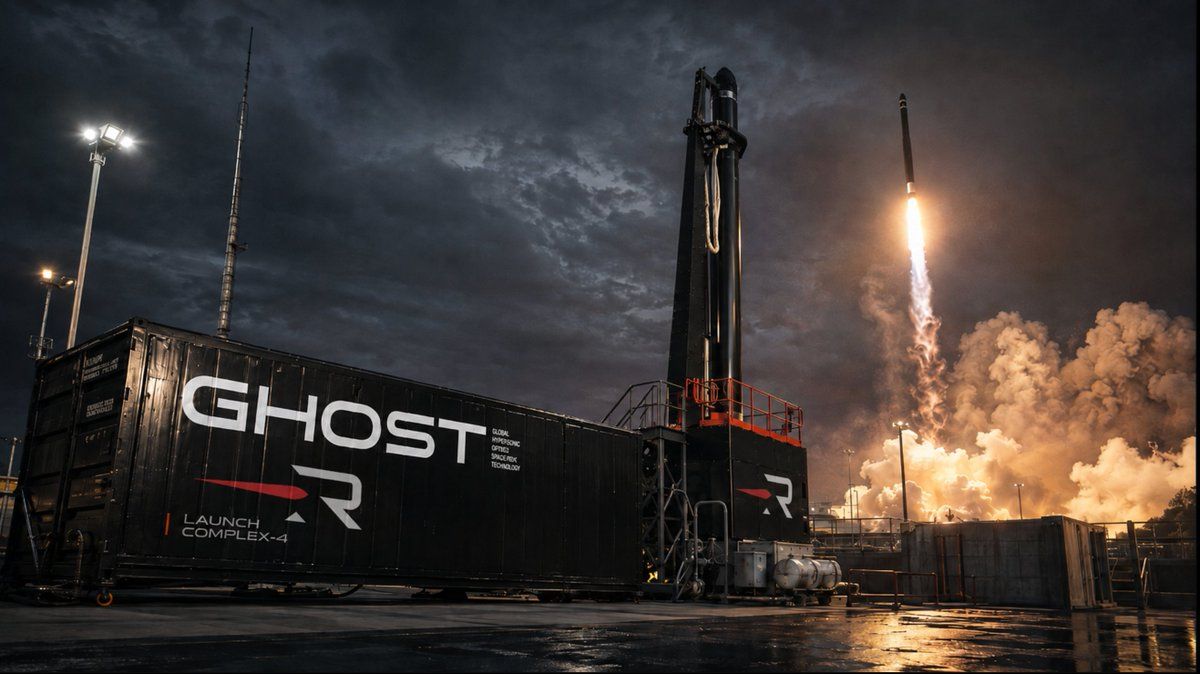
Rocket Lab GHOST, short for Global Hypersonic & Orbital Spaceport Technology, is a deployable containerized launch-support system designed for the company's Electron orbital launch vehicle and HASTE suborbital test vehicle. Rocket Lab unveiled the system in August 2026 as a way to establish orbital and suborbital launch capability at additional locations without relying exclusively on its permanent launch complexes.
GHOST packages rockets, launch infrastructure, ground-support equipment, and range-control systems within standard shipping containers. The concept is intended for multi-launch campaigns, responsive missions, missile-defense testing, and sovereign launch requirements where launch infrastructure must be moved to a new site.
The first planned GHOST installation is Rocket Lab Launch Complex 4 at the Pacific Spaceport Complex-Alaska on Kodiak Island. Two pads are planned there, and Rocket Lab expects GHOST to make its operational debut with a suborbital launch from Alaska in 2027.
Development
Rocket Lab developed GHOST after experience operating dedicated launch infrastructure for Electron and HASTE. According to reporting by Space.com, company founder and chief executive Peter Beck said the concept was influenced by a HASTE customer that wanted Rocket Lab to be more mobile. The resulting system applies infrastructure already used with the two related launch vehicles to a deployable configuration.
Rocket Lab announced GHOST on August 10, 2026. Contemporary coverage by SpaceNews described it as containerized infrastructure for orbital and suborbital launches, while additional reports consistently identified the system as supporting both Electron and HASTE.
The initial deployment is planned for Alaska. Rocket Lab Launch Complex 4 is to consist of two GHOST-supported pads at the Pacific Spaceport Complex-Alaska. The planned installation is intended to support high-frequency campaigns and expands the company's infrastructure beyond its established sites in New Zealand and Virginia.
The Alaska development also follows Rocket Lab's July 2026 award of a US Space Force contract covering 12 suborbital launches with options for six additional launches. Reporting on the project linked the Kodiak expansion to missile-defense and hypersonic-test requirements, although the available sources do not identify the customer for GHOST's first planned mission.
Design
GHOST is designed as a modular launch-site package rather than a launch vehicle. Its defining feature is the use of standard shipping containers to transport the equipment required to establish a Rocket Lab launch capability at another suitable location. Published descriptions state that the system can deploy complete rockets together with launch infrastructure, ground-support equipment, and range-control systems.
The containerized arrangement is intended to reduce dependence on a permanently constructed Rocket Lab launch site. The available sources describe GHOST as having a small modular footprint and being intended for rapid site activation. Rocket Lab has not publicly provided a complete technical inventory of the containers, the number of containers required, detailed site-preparation requirements, activation time, or the amount of fixed infrastructure that may still be necessary.
Launch infrastructure
GHOST supports the ground systems required by both Electron and HASTE. These vehicles share launch infrastructure, allowing one GHOST installation to support orbital satellite launches with Electron and suborbital test missions with HASTE. This commonality is central to the system because it permits the same deployable infrastructure concept to serve two different mission classes.
The system includes range-control equipment as part of the deployable package. Range control coordinates activities required to conduct a launch safely within an assigned launch area. The published descriptions do not provide a detailed breakdown of GHOST's range instrumentation, communications equipment, tracking systems, or command architecture.
Transport and deployment
All major GHOST elements are described as being packaged in standard shipping containers. This allows the infrastructure and associated launch hardware to use established commercial transport methods. Rocket Lab describes the concept as globally deployable, although the available reports do not specify which transport modes are required for each component or the complete logistical sequence for moving and establishing a site.
The modular design is intended to support temporary or campaign-based deployment. Published descriptions emphasize multi-launch operations, rapid activation, and the possibility of simultaneous launch activity. At the first planned site in Alaska, two pads are to be established for high-frequency launch campaigns.
Electron and HASTE compatibility
Electron is Rocket Lab's small orbital launch vehicle and has used the company's established ground infrastructure in New Zealand and Virginia. HASTE, or Hypersonic Accelerator Suborbital Test Electron, is a suborbital derivative used for hypersonic and missile-defense-related testing. Its first flight occurred in June 2023.
Because Electron and HASTE use common ground infrastructure, GHOST can provide what Rocket Lab describes as dual-launch capability at new locations. A single GHOST deployment is therefore intended to support both sovereign orbital-launch requirements and suborbital test campaigns without requiring separate infrastructure systems for the two vehicles.
Program status
As of its August 2026 announcement, GHOST had been unveiled as a planned deployable launch system, but the sources do not document a completed operational GHOST launch site or launch conducted with the system. Its first announced installation is Rocket Lab Launch Complex 4 at Kodiak, Alaska.
Two pads are planned for Launch Complex 4. Rocket Lab expects the system's operational debut to occur with a suborbital launch from Alaska in 2027. This date is a planned milestone rather than a completed event.
The Alaska pads are intended to complement Rocket Lab's existing infrastructure at Launch Complex 1 in New Zealand and its Virginia facilities. Coverage by CompositesWorld states that the additional pads would bring the company's total number of pads to six across two hemispheres once established.
Rocket Lab presents GHOST as applicable to future deployments beyond Alaska, including missions requiring sovereign launch capability, additional launch trajectories, missile-defense testing, and time-critical national-security support. No additional confirmed operational GHOST locations are identified in the supplied sources.
Specifications (GHOST deployable launch system)
General characteristics
- Manufacturer: Rocket Lab Corporation
- Official name: Global Hypersonic & Orbital Spaceport Technology
- Abbreviation: GHOST
- Type: Deployable containerized launch-support infrastructure
- Packaging: Standard shipping containers
- Supported launch vehicles: Electron and HASTE
- Supported mission classes: Orbital and suborbital launches
- Included functions: Rocket deployment, launch infrastructure, ground support, and range-control systems
- Configuration: Modular, small-footprint system intended for deployment to additional launch locations
- First planned installation: Rocket Lab Launch Complex 4, Pacific Spaceport Complex-Alaska, Kodiak, Alaska
- Launch pads at first planned installation: Two
- Planned operational debut: Suborbital launch from Alaska in 2027
Mission capabilities
- Electron role: Orbital launch support
- HASTE role: Suborbital test-launch support
- Campaign concept: Multi-launch and high-frequency launch campaigns
- Deployment objective: Rapid establishment of launch capability at new locations
- National-security applications: Responsive launch, missile-defense testing, and time-critical missions
- Sovereign launch application: Establishing orbital or suborbital launch capability for locations without an existing permanent Rocket Lab launch complex
Related equipment
- Rocket Lab Electron: Small orbital launch vehicle supported by GHOST infrastructure.
- Rocket Lab HASTE: Suborbital Electron-derived vehicle for hypersonic and related test missions that uses compatible ground infrastructure.
 Argentina
 Armenia
 Australia
 Austria
 Austria-Hungary
 Belgium
 Brazil
 United Kingdom
 Brunei
 Bulgaria
 Canada
 Chile
Chile China
China Colonial America
 Colombia
 Confederate States
 Croatia
 Czech
Czech Denmark
 Egypt
Egypt Finland
 France
 Georgia
 Germany
 German Imperial
 Greece
 Holland
 Hungary
 India
India Indonesia
 Iran
Iran Iraq
Iraq Ireland
 Israel
 Italy
Italy Japan
Japan Japan (1940)
 Jordan
 Kingdom of Italy
 Malaysia
 Mexico
 Myanmar
 Nazi Germany
 Netherlands
 New Zealand
 North Korea
 Norway
 Pakistan
 Peru
Peru Philippines
 Poland
 Portugal
 Prussia
 Romania
 Russia
 Saudi Arabia
 Serbia
 Singapore
 Slovakia
 Slovenia
 South Africa
 South Korea
 Soviet Union
 Spain
Spain Sweden
 Switzerland
 Syria
Syria Taiwan
 Thailand
 Turkey
 UAE
UAE Ukraine
 Vietnam
 Yugoslavia