
History
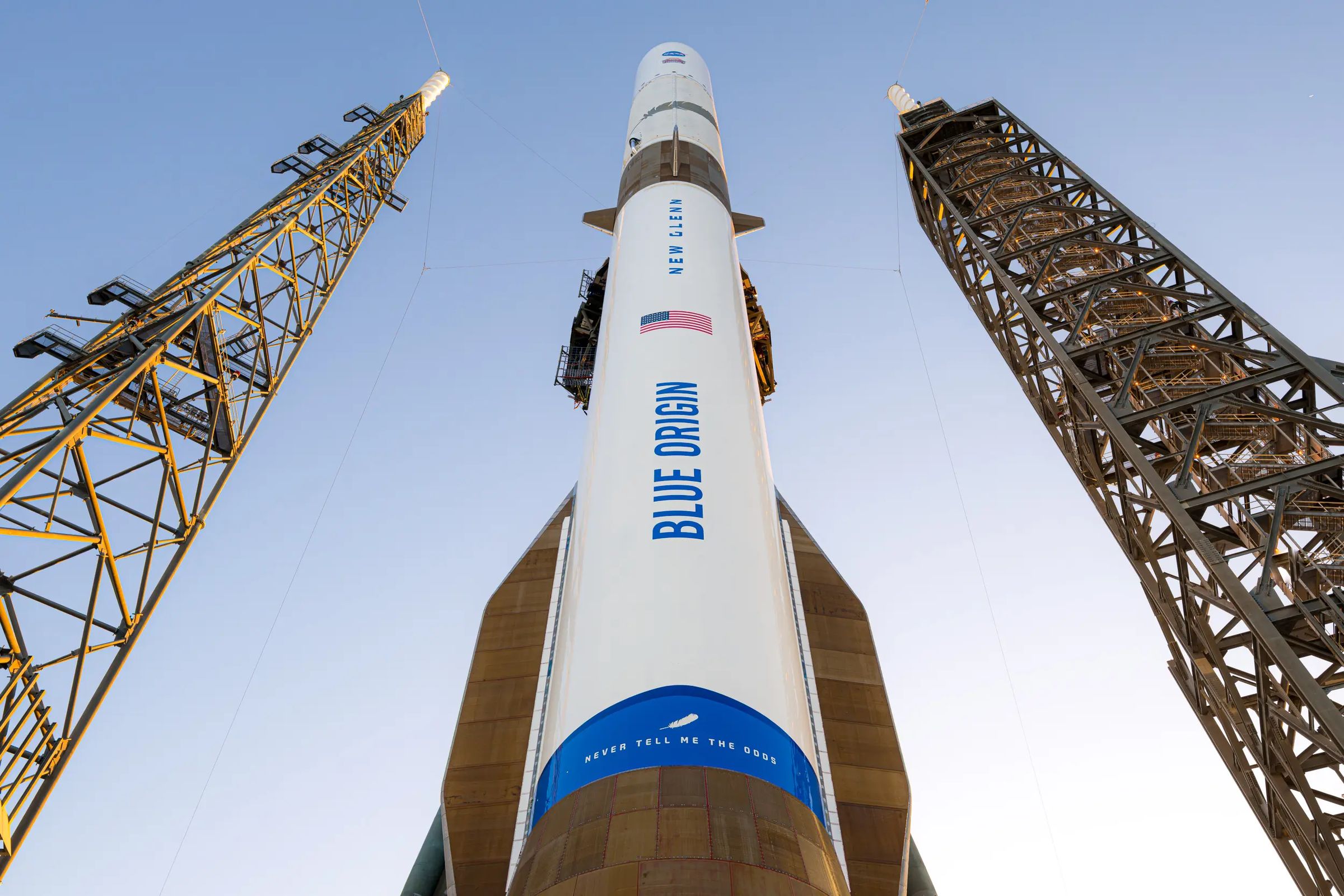
Blue Origin New Glenn 9×4 is a planned enlarged configuration of the American New Glenn orbital launch vehicle. Its designation describes an engine arrangement with nine BE-4 engines on the first stage and four BE-3U engines on the second stage.
The 9×4 configuration is intended to carry larger and heavier payloads than the original New Glenn 7×2. It remains under development and has not yet flown. Blue Origin is expanding Launch Complex 36 at Cape Canaveral Space Force Station to provide a dedicated operational pad and vertical-integration infrastructure for the vehicle.
New Glenn 9×4 retains the New Glenn concept of a reusable first stage. Public information does not yet provide a confirmed first-launch date, payload rating, overall dimensions, or final production configuration.
New Glenn background
Blue Origin leased Launch Complex 36 in 2015 and began constructing a new launch facility there in 2016. The complex had previously operated two pads for Atlas-Centaur and later Atlas launch vehicles before its early-2000s closure and demolition.
The baseline New Glenn 7×2 made its first launch from LC-36 in 2025. It uses seven BE-4 engines on the reusable first stage and two BE-3U engines on the second stage. The 7×2 established the basic flight architecture from which the more powerful 9×4 configuration is being developed.
9×4 development
Blue Origin disclosed work on the larger engine arrangement as part of an effort to increase New Glenn performance and production capability. The 9×4 adds two first-stage BE-4 engines and doubles the number of second-stage BE-3U engines. The resulting rocket is expected to be taller than the 7×2.
Program reporting in March 2026 connected the enlarged configuration with manufacturing expansion and studies of a potentially reusable upper stage. Upper-stage reusability should be treated as development work rather than a confirmed feature of the initial 9×4 vehicle. One reported planning target placed a first satellite deployment in the fourth quarter of 2027, but Blue Origin had not announced a firm debut date.
Launch Complex 36 expansion
Blue Origin plans to restore LC-36 as a two-pad complex. The existing LC-36A supports the 7×2 vehicle, while a new LC-36B is intended as the operational home of New Glenn 9×4. Associated construction includes a Vertical Integration Facility and a Payload Processing Facility.
The planned integration tower is approximately 700 ft, or 213 m, tall, and Blue Origin stated that construction would require about 2,500 tons of structural-steel columns. Vertical integration allows payloads and the launch vehicle to be assembled in an upright orientation, a capability important for some large and national-security spacecraft.
Work on LC-36B proceeded alongside repairs to LC-36A after the fourth baseline New Glenn vehicle was destroyed during a static-fire test on 8 May 2026. The accident damaged launch facilities and reduced the planned 2026 flight rate. Repairing LC-36A and developing the new 9×4 pad were assigned to separate efforts.
Design
First stage
The first stage is planned to use nine Blue Origin BE-4 engines, compared with seven on New Glenn 7×2. BE-4 burns liquid oxygen and liquefied natural gas. Increasing the engine count raises available thrust, but the final stage dimensions, propellant load, structural changes, and liftoff thrust for the complete 9×4 configuration have not been published in the supplied sources.
Like the baseline New Glenn booster, the 9×4 first stage is intended to land and fly again. Reuse requires recovery hardware, propellant reserves, and structural margins, all of which affect payload performance. No recovery flight profile specific to 9×4 has yet been demonstrated.
Second stage
The upper stage is planned with four vacuum-optimized BE-3U engines instead of the two fitted to the 7×2 configuration. This increase is intended to complement the more powerful booster and support heavier payloads. Public material does not yet establish whether the first operational 9×4 upper stage will be expendable or reusable.
Payload integration
LC-36B and its Vertical Integration Facility are being designed around the larger vehicle. The Payload Processing Facility will support spacecraft preparation before integration. The available sources do not disclose a final fairing size or certified payload capacity for 9×4, so figures for the existing 7×2 should not be presented as specifications for this variant.
Program status
As of August 2026, New Glenn 9×4 was under development and its dedicated launch infrastructure was entering construction. Blue Origin had not announced a firm first-flight schedule. A reported 2027 mission target represents planning information rather than a completed or contracted operational milestone.
The program also depends on the recovery of baseline New Glenn operations at LC-36A. Blue Origin stated that it intended to return the 7×2 to flight before the end of 2026, while construction of LC-36B continued independently.
Variants
- New Glenn 7×2 — the baseline flight configuration with seven BE-4 first-stage engines and two BE-3U second-stage engines; first launched in 2025.
- New Glenn 9×4 — the planned enlarged configuration with nine BE-4 engines and four BE-3U engines, supported by the new LC-36B pad.
- Reusable-upper-stage concept — a development study associated with future New Glenn growth; not a confirmed feature of the initial 9×4 configuration.
Specifications (planned New Glenn 9×4)
General characteristics
- Type: two-stage orbital launch vehicle
- Manufacturer: Blue Origin
- Launch site: Launch Complex 36B, Cape Canaveral Space Force Station
- First stage: nine BE-4 engines
- Second stage: four BE-3U engines
- First-stage propellants: liquid oxygen and liquefied natural gas
- First-stage recovery: planned propulsive landing and reuse
 Argentina
 Armenia
 Australia
 Austria
 Austria-Hungary
 Belgium
 Brazil
 United Kingdom
 Brunei
 Bulgaria
 Canada
 Chile
Chile China
China Colonial America
 Colombia
 Confederate States
 Croatia
 Czech
Czech Denmark
 Egypt
Egypt Finland
 France
 Georgia
 Germany
 German Imperial
 Greece
 Holland
 Hungary
 India
India Indonesia
 Iran
Iran Iraq
Iraq Ireland
 Israel
 Italy
Italy Japan
Japan Japan (1940)
 Jordan
 Kingdom of Italy
 Malaysia
 Mexico
 Myanmar
 Nazi Germany
 Netherlands
 New Zealand
 North Korea
 Norway
 Pakistan
 Peru
Peru Philippines
 Poland
 Portugal
 Prussia
 Romania
 Russia
 Saudi Arabia
 Serbia
 Singapore
 Slovakia
 Slovenia
 South Africa
 South Korea
 Soviet Union
 Spain
Spain Sweden
 Switzerland
 Syria
Syria Taiwan
 Thailand
 Turkey
 UAE
UAE Ukraine
 Vietnam
 Yugoslavia