
History
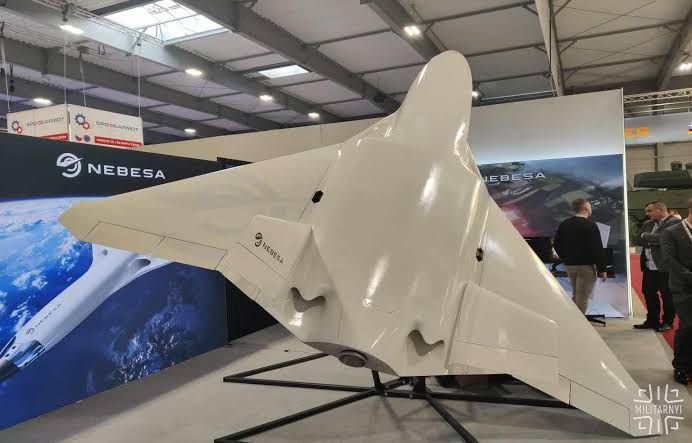
The NEBESA unmanned suborbital spaceplane is the first development by Czech company Nebesa Aerospace. It was presented at the Future Forces Forum in Prague in October 2026, with company representative Vojtěch Kubuš describing the platform. NEBESA is intended for testing, research, and defensive tasks. At the time of its public presentation, Nebesa Aerospace was seeking international partners and first customers to launch serial production and flight testing. In parallel, the company is developing a separate jet-powered unmanned aerial vehicle with a range of up to 1,000 km, a speed of 800 km/h, and a payload capacity of up to 80 kg.
Design
NEBESA uses a tailless aerodynamic configuration with an elongated delta wing. Two vertical fins are mounted on the wing panels, and a rocket engine exhaust nozzle is located at the rear. The modular payload bay allows rapid swapping of equipment, including various sensors, onboard antennas, communication systems, and flight control systems. The platform can take off and land at conventional airfields or on sections of road, so it does not require dedicated spaceport infrastructure. In the military domain, the platform can be employed for air reconnaissance, surveillance, as an air target for air defense system testing, and for testing detection and tracking systems.
Specifications
The platform is designed to reach an altitude of up to 110 km and a speed of up to Mach 3.5 (3,700–4,300 km/h). Maximum modular payload is 25 kg. Propulsion is provided by a liquid-propellant rocket engine with a maximum thrust of 9 kN, developed using metal 3D printing, computer modeling, and AI algorithms. The suborbital platform is optimized for microgravity research, materials testing, aerodynamics verification at supersonic speeds, and avionics testing.
 Argentina
 Armenia
 Australia
 Austria
 Austria-Hungary
 Belgium
 Brazil
 United Kingdom
 United States
 Brunei
 Bulgaria
 Canada
 Chile
 China
 Colonial America
 Colombia
 Confederate States
 Croatia
 Denmark
 Egypt
 Finland
 France
 Georgia
 Germany
 German Imperial
 Greece
 Holland
 Hungary
 India
 Indonesia
 Iran
 Iraq
 Ireland
 Israel
 Italy
 Japan
 Japan (1940)
 Jordan
 Kingdom of Italy
 Malaysia
 Mexico
 Myanmar
 Nazi Germany
 Netherlands
 New Zealand
 North Korea
 Norway
 Pakistan
 Peru
 Philippines
 Poland
 Portugal
 Prussia
 Romania

 Russia
 Saudi Arabia
 Serbia
 Singapore
 Slovakia
 Slovenia
 South Africa
 South Korea
 Soviet Union
 Spain
 Sweden
 Switzerland
 Syria
 Taiwan
 Thailand
 Turkey
 UAE
 Ukraine
 Vietnam
 Yugoslavia