
History
Cambridge Aerospace developed the Skyhammer and Starhammer as complementary tube-launched interceptors for air-defense missions. Skyhammer is a lightweight turbojet-powered weapon intended primarily for slower unmanned aerial vehicles, while Starhammer is a higher-speed rocket-powered missile intended for cruise missiles and other faster or higher-altitude threats.
The British company began Skyhammer development in January 2025 and moved to initial flight testing approximately six weeks later. By September 2025, Cambridge Aerospace had publicly presented both systems, with Skyhammer in production and Starhammer described as being at final-prototype status.
Cambridge Aerospace continued developing the two interceptors as different tiers of the same air-defense portfolio. In August 2026, the company announced plans to display Skyhammer and Starhammer at the Future Forces Exhibition & Forum in Prague from October 21 to 23, 2026.
Development
Cambridge Aerospace was founded on September 4, 2024. Skyhammer development started in January 2025, and the first flight test followed about six weeks later. The company subsequently adopted a weekly testing cycle and a spiral-development approach in which design changes could be incorporated as testing progressed.
At DSEI 2025, Cambridge Aerospace publicly presented Skyhammer and Starhammer. Contemporary reporting described Skyhammer as the lower tier of the portfolio and Starhammer as a higher-energy interceptor then at final-prototype status. The company developed most Skyhammer components internally and used a UK-based supply chain. Further details from the 2025 presentation were reported by EDR Magazine.
On April 10, 2026, a UK procurement covering Skyhammer interceptors, launchers, integration, support and end-user training was announced. Initial deliveries were scheduled from May 2026, while the interceptor and launcher were also tested in Jordan. The available material does not confirm that the scheduled deliveries had been completed.
By August 2026, Cambridge Aerospace stated that it intended to increase Skyhammer production to 2,500 interceptors per month by March 2027. The company also planned to present both Skyhammer and Starhammer at Future Forces Prague in October 2026.
Design
Skyhammer
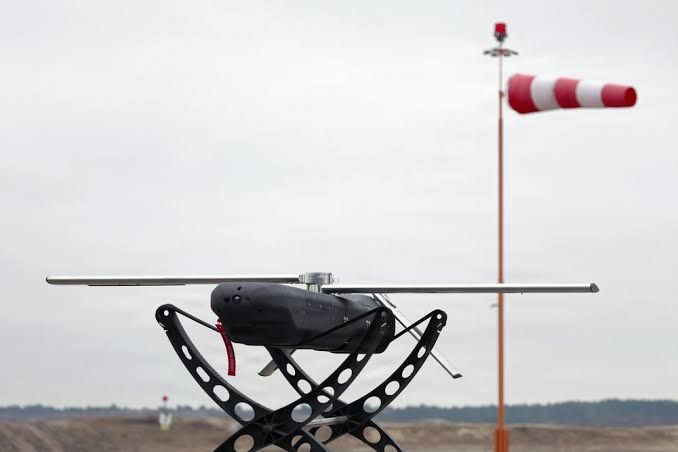
Skyhammer is a tube-launched interceptor powered by a kerosene-fuelled turbojet. Its aerodynamic surfaces fold along the body for storage in the launch tube and deploy after launch. The system is intended to provide a comparatively light interceptor for repeated engagements against unmanned aerial vehicles and other lower-speed airborne targets.
The interceptor uses active radar guidance and resilient communications. Reporting from 2026 describes a dual-band active radar system and operation when GNSS is denied, while information released around DSEI 2025 identified an X-band radar seeker. External sensors can provide a target track before launch, allowing the interceptor to receive target information from a wider air-defense network rather than relying solely on onboard detection from the beginning of the engagement.
Skyhammer carries a 2 kg warhead. The 2025 description identified it as a blast-fragmentation warhead intended for targets including unmanned aircraft and subsonic cruise missiles. Later reporting emphasized the counter-UAS role and stated that the warhead was configured to limit collateral damage around the intercept point.
Published physical figures for Skyhammer have changed during development. DSEI 2025 reporting described an approximately 18 kg interceptor less than 1 m long with a 1.3 m wingspan. August 2026 reporting instead gave a mass of 17 kg, a length of 1.8 m and a deployed span of 1.5 m. Because Cambridge Aerospace uses continuous spiral development, these figures may represent different configurations, but the available sources do not explicitly explain the discrepancy.
Starhammer
Starhammer is the higher-speed component of the Cambridge Aerospace interceptor family. It is tube-launched and powered by a solid rocket motor. Cambridge Aerospace developed its own propulsion system, named Nightstar, for the missile and established a dedicated production facility for the motor.
The missile uses inertial navigation and datalink functions together with an active radar seeker. It is designed for higher-speed targets whose velocity or engagement geometry exceeds the practical envelope of Skyhammer. Public descriptions specifically identify high-speed cruise missiles as a target class, while 2025 reporting stated that Cambridge Aerospace was also considering ballistic missiles as possible targets.
Starhammer is designed to exceed Mach 2 and to operate to an altitude of about 10 km. Its higher acceleration and speed provide a substantially different engagement envelope from the turbojet-powered Skyhammer.
Program status
Skyhammer had entered production by September 2025, when Cambridge Aerospace reported annual production capacity in the low hundreds and stated an intention to expand output. By August 2026, the company was targeting production of 2,500 Skyhammer interceptors per month by March 2027.
Starhammer was described as being at final-prototype status in September 2025 and expected to proceed toward production. The available material does not confirm operational service or serial production of Starhammer. Cambridge Aerospace planned to exhibit both systems at Future Forces Prague in October 2026.
Variants
- Skyhammer: Lightweight, turbojet-powered tube-launched interceptor intended primarily for sustained counter-UAS engagements and other comparatively low-speed airborne threats.
- Starhammer: Higher-energy, solid-rocket-powered tube-launched interceptor designed for faster targets including high-speed cruise missiles.
Specifications (Skyhammer and Starhammer)
Skyhammer
- Type: Tube-launched air-defense interceptor
- Propulsion: Kerosene-fuelled turbojet
- Mass: 17 kg in August 2026 reporting; approximately 18 kg in September 2025 reporting
- Length: 1.8 m in August 2026 reporting; less than 1 m in September 2025 reporting
- Deployed wingspan: 1.5 m in August 2026 reporting; approximately 1.3 m in September 2025 reporting
- Maximum speed: About 700 km/h
- Range: More than 30 km in August 2026 reporting; up to approximately 30 km in September 2025 reporting
- Operating altitude: Above 4 km
- Warhead: 2 kg; described as blast-fragmentation in 2025 reporting
- Guidance and sensing: Active radar seeker, communications link and networked target information; later reporting describes dual-band active radar and GNSS-denied operation
- Launch container: 2.0 m long and 350 mm in diameter according to August 2026 reporting
- Deployment time: Less than one minute
Starhammer
- Type: Tube-launched high-speed air-defense missile
- Propulsion: Solid rocket motor; Cambridge Aerospace Nightstar propulsion system
- Take-off mass: Approximately 90 kg according to September 2025 reporting
- Length: 2.8 m in August 2026 reporting; approximately 3 m was estimated in September 2025
- Wingspan: 0.41 m according to August 2026 reporting
- Maximum speed: More than Mach 2
- Range: More than 20 km
- Maximum engagement altitude: Approximately 10 km
- Guidance: Inertial navigation, datalink and active radar seeker
 Argentina
 Armenia
 Australia
 Austria
 Austria-Hungary
 Belgium
 Brazil
 United States
 Brunei
 Bulgaria
 Canada
 Chile
Chile China
China Colonial America
 Colombia
 Confederate States
 Croatia
 Czech
Czech Denmark
 Egypt
Egypt Finland
 France
 Georgia
 Germany
 German Imperial
 Greece
 Holland
 Hungary
 India
India Indonesia
 Iran
Iran Iraq
Iraq Ireland
 Israel
 Italy
Italy Japan
Japan Japan (1940)
 Jordan
 Kingdom of Italy
 Malaysia
 Mexico
 Myanmar
 Nazi Germany
 Netherlands
 New Zealand
 North Korea
 Norway
 Pakistan
 Peru
Peru Philippines
 Poland
 Portugal
 Prussia
 Romania
 Russia
 Saudi Arabia
 Serbia
 Singapore
 Slovakia
 Slovenia
 South Africa
 South Korea
 Soviet Union
 Spain
Spain Sweden
 Switzerland
 Syria
Syria Taiwan
 Thailand
 Turkey
 UAE
UAE Ukraine
 Vietnam
 Yugoslavia