
History
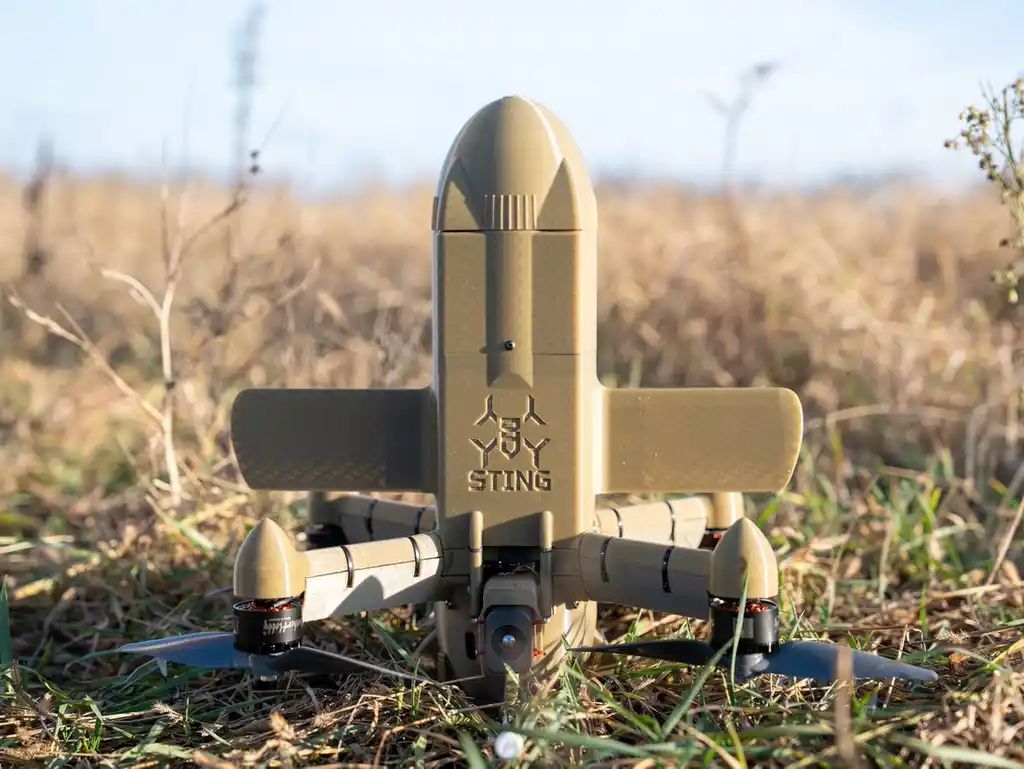
The Wild Hornets Sting is a Ukrainian interceptor unmanned aerial vehicle developed during the Russia-Ukraine war to destroy hostile drones. The project was created by the Wild Hornets group as a lower-cost counter-UAS system intended particularly for threats such as Shahed-type one-way attack drones.
After months of testing and modification, Sting achieved its first widely reported combat success in April 2025, when footage showed an interceptor destroying a Shahed-type drone. The system subsequently entered broader Ukrainian use and was employed against both one-way attack drones and reconnaissance UAVs.
In August 2026, a Sting operated by the Klever crew of the Hrim unmanned systems detachment of Ukraine's 27th National Guard Regiment intercepted a Russian UAV at an altitude of 7,472 m. This exceeded other high-altitude interceptions reported earlier in the same period.
Development
Wild Hornets developed Sting in response to the large number of Shahed-type drones used against Ukrainian targets. Such drones can place sustained pressure on conventional air-defense systems, particularly when they are employed in large numbers. The Sting project therefore focused on providing a comparatively inexpensive reusable launch-and-control architecture combined with expendable interceptor aircraft.
The development program underwent several months of testing and modification. Public reporting states that financial difficulties brought the project close to suspension in early 2025. Volunteer contributions and charitable funding supported further development, including assistance associated with Ukrainian activist Serhii Sternenko.
The first publicized successful interception occurred in April 2025. In May, Wild Hornets released thermal-imaging footage showing a Sting intercepting a Shahed-type drone. By 1 August 2025, the supplier of the interceptor's thermal-imaging equipment stated that Sting aircraft had already intercepted dozens of Iranian-Russian drones.
In October 2025, a Ukrainian military delegation demonstrated Sting in Denmark against a QinetiQ Banshee target drone. Public reporting from the same month stated that Sting interceptors had destroyed more than 1,000 hostile UAVs.
In December 2025, Sting was reported as the first interceptor drone to destroy the Russian Geran-3, a jet-powered derivative of the Shahed family. By February 2026, public reporting attributed more than 3,900 destroyed Shahed and Geran drones to Sting interceptors.
Production expanded rapidly. By March 2026, the reported production rate had exceeded 10,000 Sting interceptors per month. In April 2026, the manufacturer claimed that Sting had been Ukraine's leading anti-Shahed interceptor by number of kills for seven consecutive months. Reporting from the same period attributed about 70 percent of intercepted jet-powered Shahed-type drones to Sting.
Also in April 2026, Ukraine's Unmanned Systems Forces used a Sting launched from an unmanned surface vessel to intercept a Russian Shahed-type drone. The event demonstrated that the interceptor could be deployed from a maritime unmanned platform rather than only from conventional ground positions.
Reported cumulative results continued to rise during 2026. Public accounts placed the number of intercepted Shahed and Gerbera drones at approximately 7,000 in May and 9,000 in June.
Design
Sting uses a compact aerodynamic body with four rotors. Its structure has been described as a 3D-printed, bullet-shaped airframe. The configuration is optimized for high-speed interception rather than long-endurance reconnaissance.
The interceptor uses thermal-imaging equipment supplied by the Ukrainian company Odd Systems. Kurbas thermal cameras provide the operator with imagery for detecting, tracking, and approaching targets, including operations in darkness.
Reported maximum speed is 343 km/h. The commonly cited cruising altitude is approximately 3,000 m, while combat use has demonstrated that the aircraft can operate substantially higher under interception conditions. In August 2026, a Sting completed an interception at 7,472 m.
The reported engagement range is up to 25 km. Sting can also be integrated with the Hornet Vision Control system, which has been reported to permit remote control from locations as far as 2,000 km from the aircraft. This figure describes remote operator connectivity through the control system and should not be interpreted as the interceptor's normal flight radius.
Public estimates have placed the cost of an individual Sting at about US$2,100. This was presented as substantially lower than the cost of the Shahed-type one-way attack drones it was designed to intercept, allowing interceptor drones to supplement more expensive conventional air-defense weapons.
Operational history
Sting entered combat use in Ukraine during 2025. Early operations concentrated on Shahed-type one-way attack UAVs, but the interceptor was subsequently used against additional classes of Russian unmanned aircraft.
In October 2025, Sting was demonstrated outside Ukraine against a QinetiQ Banshee target drone in Denmark. The event showed the system operating against a representative aerial target under demonstration conditions rather than combat conditions.
During 2026, Ukrainian units increasingly used interceptor drones against reconnaissance UAVs operating at high altitude. Russian reconnaissance aircraft such as the ZALA Z-20 were reported to be flying higher in an attempt to reduce their vulnerability to Ukrainian air defenses.
At the end of July 2026, an interceptor-drone operator from the National Guard's Lazar's Group destroyed a Russian reconnaissance UAV at an altitude of about 6.4 km, although the available source does not identify that interceptor specifically as a Sting. In early August, a pilot from the Security Service of Ukraine's Special Operations Center A struck an aerial target at 6,955 m.
On 18 August 2026, the Klever crew of the Hrim unmanned systems detachment, part of the 27th National Guard Regiment named after Prince Sviatoslav Yaroslavovych, used a Sting to intercept a Russian UAV at 7,472 m. The engagement represented the highest Sting interception altitude explicitly documented in the supplied material.
Operators
- Ukraine: The 27th Regiment of the National Guard of Ukraine is confirmed in the supplied source as a Sting operator. Its Klever crew used the interceptor to destroy a Russian UAV at 7,472 m in August 2026.
Specifications (Sting)
General characteristics
- Type: Interceptor UAV and drone-intercepting loitering munition
- Configuration: Four-rotor unmanned aircraft
- Airframe: Aerodynamic bullet-shaped structure described as 3D printed
- Electro-optical equipment: Kurbas thermal-imaging camera from Odd Systems
- Control system: Compatible with Hornet Vision Control
Performance
- Maximum reported speed: 343 km/h
- Reported cruising altitude: 3,000 m
- Engagement range: Up to 25 km
- Reported remote-control distance: Up to 2,000 km when using Hornet Vision Control
- Demonstrated interception altitude: 7,472 m in August 2026
 Argentina
 Armenia
 Australia
 Austria
 Austria-Hungary
 Belgium
 Brazil
 United Kingdom
 United States
 Brunei
 Bulgaria
 Canada
 Chile
Chile China
China Colonial America
 Colombia
 Confederate States
 Croatia
 Czech
Czech Denmark
 Egypt
Egypt Finland
 France
 Georgia
 Germany
 German Imperial
 Greece
 Holland
 Hungary
 India
India Indonesia
 Iran
Iran Iraq
Iraq Ireland
 Israel
 Italy
Italy Japan
Japan Japan (1940)
 Jordan
 Kingdom of Italy
 Malaysia
 Mexico
 Myanmar
 Nazi Germany
 Netherlands
 New Zealand
 North Korea
 Norway
 Pakistan
 Peru
Peru Philippines
 Poland
 Portugal
 Prussia
 Romania
 Russia
 Saudi Arabia
 Serbia
 Singapore
 Slovakia
 Slovenia
 South Africa
 South Korea
 Soviet Union
 Spain
Spain Sweden
 Switzerland
 Syria
Syria Taiwan
 Thailand
 Turkey
 UAE
UAE Vietnam
 Yugoslavia